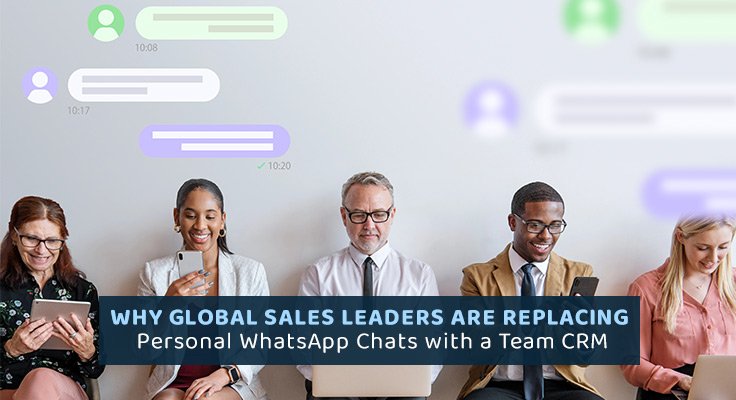
WhatsApp has become an important sales channel for exporters, manufacturers, cross-border e-commerce companies, and other businesses serving international customers. It allows representatives to answer questions quickly, exchange product information, discuss quotations, and maintain relationships with buyers in different countries.
The channel often develops organically. A salesperson begins using WhatsApp with a few customers, more buyers start contacting the company, and additional representatives create their own accounts. Before long, a large part of the company’s sales activity takes place inside separate chat histories that managers cannot easily see.
This model may work during the early stages of a business, but it becomes increasingly risky as the company grows. Customer information remains tied to individuals, responsibilities become unclear, and management has little visibility into follow-up quality or pipeline progress.
Global sales leaders are therefore moving from employee-controlled WhatsApp conversations to structured team CRM systems. The objective is not to restrict communication. It is to make customer relationships visible, transferable, and manageable at the company level.
Personal WhatsApp Creates Hidden Business Risk
Sales representatives often view their WhatsApp contacts as part of their personal working network. From the company’s perspective, however, these conversations may contain valuable commercial information:
- Buyer contact details
- Product requirements
- Price discussions
- Quotations
- Purchase timelines
- Objections and concerns
- Files and specifications
- Follow-up commitments
- Long-term relationship history
When this information remains on personal devices or separate accounts, the company does not have a reliable customer record.
The risk becomes clear when an employee is absent, changes roles, or leaves the organization. Managers may know that the employee handled a particular market, but they may not know which buyers are active, what has already been promised, or when the next follow-up is due.
The result is not only data loss. Customers may receive slower responses, repeat their requirements, or lose confidence when a new representative cannot continue the previous conversation.
Growth Makes Informal Communication Harder to Control
A small founder-led team can coordinate customer conversations through direct communication. As the sales organization expands, informal coordination becomes less dependable.
Consider a business with ten representatives working across several countries and product categories. Each employee may have multiple WhatsApp accounts and hundreds of contacts. Without a central system, management may struggle to answer basic questions:
- Who is responsible for each buyer?
- Has this customer already received a quotation?
- Are two employees contacting the same company?
- Which leads have not received a response?
- How many opportunities are currently active?
- Which accounts require technical support?
- What happens when a representative is unavailable?
- Which conversations are moving toward revenue?
Individual salespeople may understand their own accounts, but the company lacks a complete operational view.
This makes forecasting difficult and increases dependence on manual reports. Representatives may spend time reconstructing their weekly activity, while managers receive information that is already outdated.
Customer Ownership Should Belong to the Business
Strong sales relationships are usually built by individuals. Buyers often trust a particular representative because that person understands their history, communication style, and commercial priorities.
A team CRM should preserve this personal relationship rather than weaken it.
The representative can remain the primary owner of the customer while the company maintains access to essential context. Other authorized employees do not need to interfere with daily communication, but they should be able to continue the relationship when necessary.
A practical ownership model includes:
- One primary representative for every qualified lead or customer.
- A shared customer record containing essential business information.
- Clear rules for viewing, editing, exporting, and reassigning records.
- A documented process for temporary and permanent handovers.
- Manager visibility into activity without unnecessary intervention.
This approach protects both the salesperson’s working relationship and the company’s long-term customer asset.
A WhatsApp CRM Gives Leaders Operational Visibility
A WhatsApp CRM for sales teams connects conversations with customer profiles, ownership, sales stages, notes, and follow-up tasks.
Instead of asking representatives to report every activity separately, managers can view the information required to understand the health of the sales operation.
Useful management indicators may include:
- Number of new leads
- First-response time
- Leads without an assigned owner
- Overdue follow-ups
- Active quotations
- Opportunities by market or representative
- Leads that have remained inactive
- Conversation volume by account
- Customer handover status
- Conversion progress
The purpose is not to measure employees by the number of messages they send. Message volume alone says little about sales quality. A representative can send hundreds of messages without qualifying the right buyers or moving opportunities forward.
Leaders should use CRM visibility to identify bottlenecks, improve processes, and provide support. It should not become a tool for excessive monitoring.
Clear Lead Assignment Prevents Internal Competition
When customer ownership is not defined, sales representatives may compete for the same account without realizing it.
One employee may find a buyer through Google Maps or a business directory, while another receives an inquiry from the same company through the website. Both may begin WhatsApp conversations independently.
This can lead to:
- Duplicate introductions
- Conflicting prices
- Different product recommendations
- Confusion over commissions
- Poor customer experience
- Internal disagreements
A team CRM can record the lead source, assign a primary owner, and make the existing relationship visible to authorized team members.
Businesses should define assignment rules based on their actual structure. Leads may be distributed by country, language, product category, customer size, source, or current workload. The chosen rule matters less than applying it consistently.
When reassignment is necessary, the reason and new owner should be recorded so responsibility remains clear.
Multi-Account Management Requires Company-Level Coordination
International sales teams often use several WhatsApp accounts. Different accounts may serve separate markets, brands, stores, products, or employees.
Switching between accounts manually creates several problems:
- Representatives may overlook messages
- Customers may contact the wrong number
- Managers cannot easily check account status
- The same buyer may appear across several accounts
- Conversation history remains fragmented
- Workload is difficult to balance
A centralized workspace can help teams organize several accounts, maintain customer ownership, and reduce unnecessary account switching.
Leaders should first map why each account exists. Some accounts may be necessary for regional or operational reasons, while others may have been created without a clear long-term plan.
CRM implementation provides an opportunity to simplify this structure and establish rules for account naming, access, ownership, customer assignment, and backup.
International Sales Needs Multilingual Continuity
Global teams regularly communicate with buyers who use different languages. Without built-in support, employees may copy messages into separate translation tools or wait for colleagues to help.
This slows down responses and makes account handovers harder. A new representative may not understand the previous conversation well enough to continue it accurately.
Real-time translation inside a WhatsApp CRM can help employees read and prepare messages without leaving the sales workspace. It can also allow a broader group of team members to support international accounts.
Human review remains necessary for:
- Product specifications
- Prices and payment terms
- Contractual language
- Delivery commitments
- Compliance information
- Safety instructions
AI translation can improve everyday speed, but responsibility for important commercial information should remain with qualified employees.
AI Should Support Sales Judgment, Not Replace It
AI is increasingly useful in customer communication, but leadership teams should be clear about which decisions can be automated.
AI can help with:
- Drafting routine replies
- Summarizing long conversations
- Answering common questions
- Translating messages
- Suggesting follow-up content
- Organizing or tagging leads
- Identifying inactive opportunities
- Providing after-hours responses
These functions reduce repetitive work and help representatives respond consistently.
However, AI should not independently make commitments about custom pricing, legal terms, technical suitability, delivery guarantees, or sensitive customer disputes. These situations require context and commercial judgment.
A well-designed process separates low-risk, repetitive tasks from high-value decisions. AI handles part of the workload, while employees remain accountable for the relationship.
Customer Data Protection Is Also a Leadership Issue
Customer data protection is often discussed as an IT or compliance responsibility. For sales leaders, it is also an operational continuity issue.
Important customer information can be lost even without a cyberattack. It may disappear because:
- An employee leaves unexpectedly
- A phone is lost or damaged
- An account becomes inaccessible
- Records are deleted
- Conversations remain on an old device
- No formal handover takes place
A company needs policies for how customer information is stored, accessed, transferred, exported, and removed.
A WhatsApp CRM customer data protection strategy should include:
- Company-controlled customer records
- Role-based access where appropriate
- Preserved conversation context
- Clear account ownership
- Documented reassignment procedures
- Employee offboarding controls
- Data retention and deletion rules
- Privacy and consent considerations
The objective is not to give every employee unrestricted access. It is to make sure authorized people can maintain business continuity without exposing more information than necessary.
Offboarding Should Include Customer Handover
Many companies treat offboarding as an administrative checklist involving equipment, payroll, and account access. For sales employees, customer handover should be equally important.
Before a representative leaves, the manager should review:
- Active leads
- Existing customers
- Open quotations
- Pending follow-ups
- Unresolved service issues
- Important files
- Verbal commitments
- Relevant decision-makers
- Expected order dates
Each active account should receive a new owner, and the incoming representative should have enough context to continue the relationship.
For important customers, the transition should be communicated directly. A short introduction from the previous representative can reduce uncertainty and preserve trust.
When an employee leaves suddenly, centralized CRM records become even more valuable because the company can reconstruct the customer’s status without relying on the departing person.
Leaders Need Adoption, Not Just Software
Purchasing CRM software does not guarantee that salespeople will use it.
Representatives may resist a new system if it requires excessive manual entry, slows down conversations, or appears to exist only for management surveillance. If the CRM creates more work than it removes, employees will continue relying on personal chats and update the system only before review meetings.
Leaders should design the workflow around actual sales activity.
A practical implementation process includes:
- Identify where customer information is currently lost.
- Define the minimum information every lead record requires.
- Establish ownership and handover rules.
- Connect WhatsApp activity with the customer record.
- Automate repetitive updates where possible.
- Train managers and representatives on the same workflow.
- Review adoption and remove unnecessary steps.
- Use CRM information to support employees, not only evaluate them.
The system should make the salesperson’s job easier. When representatives can find customer history, avoid duplicate work, receive follow-up reminders, and communicate across languages more efficiently, adoption becomes more natural.
How WADesk Supports Global Sales Management
WADesk is an AI-powered WhatsApp CRM designed for businesses that use WhatsApp for international customer development and sales.
It brings several parts of the workflow into one environment:
- B2B buyer discovery through channels such as Google Maps
- Contact validation and lead import
- Multiple WhatsApp account management
- Centralized customer records
- Lead assignments and team visibility
- AI-assisted replies and follow-ups
- Knowledge-based chatbot support
- Real-time translation
- Customer history retention
- Employee and account handovers
This combination is relevant to exporters, manufacturers, cross-border e-commerce businesses, and other companies that need to coordinate several representatives across markets.
WADesk helps move WhatsApp customer relationships from individual devices into a more structured company workflow. Representatives can continue communicating naturally, while managers gain the visibility and continuity required to support business growth.
Questions Leaders Should Ask Before Choosing a WhatsApp CRM
Before selecting a platform, decision-makers should evaluate more than a feature list.
Does it support the company’s account model?
Some businesses use one WhatsApp Business Platform number with many agents. Others operate several existing accounts across representatives and markets. The system should support the current structure or provide a realistic migration path.
Can managers see ownership and follow-up status?
The CRM should make responsibility clear without forcing managers to read every conversation.
What happens when an employee leaves?
Customer records, conversation history, pending tasks, and account ownership should be transferable.
How are permissions controlled?
Different roles may require different levels of access. The platform should support the company’s management and privacy requirements.
Does AI remain under human control?
Representatives should be able to review important replies and take over automated conversations when necessary.
Will the sales team actually use it?
The workflow should reduce account switching, manual reporting, repeated data entry, and lost follow-ups.
Final Thoughts
Personal WhatsApp conversations can help a young business move quickly, but they are not a reliable foundation for a growing international sales organization.
As customer volume, account numbers, and team size increase, leaders need clearer ownership, shared context, consistent follow-up, and better protection of customer information. A team CRM provides that structure without removing the human relationships that make WhatsApp effective.
The transition should not be framed as taking customer control away from salespeople. It should be presented as giving representatives better tools while protecting the company and its customers from avoidable disruption.
When customer relationships remain visible, transferable, and properly managed, WhatsApp can develop from an informal communication channel into a scalable part of the global sales operation.
Frequently Asked Questions
Why should a company avoid keeping customer records only in personal WhatsApp accounts?
Personal accounts make customer information difficult to access, transfer, and manage at the company level. This creates continuity risks when employees are absent, change roles, or leave the business.
Can a WhatsApp CRM manage several sales representatives?
Yes. Many platforms provide lead assignments, shared customer context, permissions, internal notes, and manager visibility. The exact setup depends on whether the business uses one WhatsApp API number or several existing accounts.
Will a team CRM damage the salesperson’s relationship with the customer?
Not if it is implemented correctly. The representative can remain the main customer contact while essential context is preserved for authorized team members. The goal is continuity and coordination, not unnecessary interference.