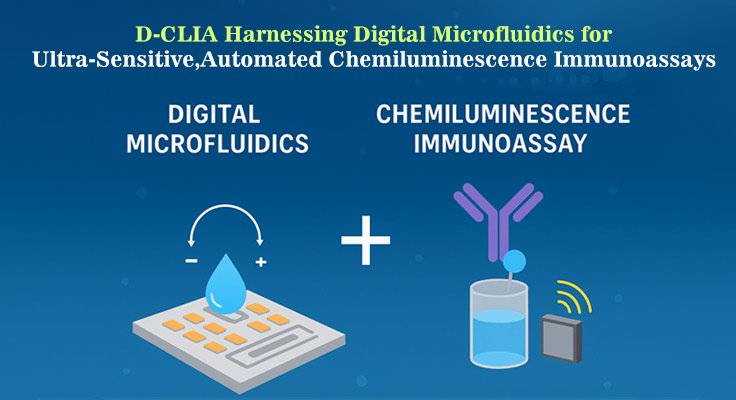
Modern clinical diagnostics and research require fast and accurate quantification of biomarkers, enabling everything from early disease detection to therapeutic monitoring. While traditional immunoassays have set high standards for sensitivity, they often have significant limitations in speed, sample consumption, and portability.
While a validated Chemiluminescent Immunoassay Kit maintains established sensitivity benchmarks, it relies on large, fixed instrumentation and high reagent consumption. These limitations prohibit effective deployment of immunoassays in decentralized settings.
The following two powerful technologies can help address these limitations:
- Digital Microfluidics (DMF) for automated sample handling
- Chemiluminescence Immunoassay (CLIA) for ultra-sensitive detection
Known as D-CLIA, this integration helps transform complex laboratory protocols into miniaturized, automated, and autonomous diagnostic tools.
Digital Microfluidics (DMF) Principles
Digital Microfluidics (DMF) replaces rigid microchannels with programmable electronic actuation, revolutionizing fluid handling. DMF uses the principle of electrowetting-on-dielectric (EWOD) to manipulate discrete droplets of samples and reagents on an open surface.
A plate at the bottom of an EWOD chip features an array of individual addressable electrodes. Each electrode is covered by a dielectric and a hydrophobic layer. The chip also consists of a grounded top plate.
The Lippmann-Young (L-Y) equation governs the physical force driving droplet motion. This equation describes the change in solid-liquid angle under an applied voltage
When a voltage is applied to an electrode directly next to the droplet, the electrical charge locally decreases the droplet’s contact angle, making the surface under that electrode highly wettable. This creates a surface tension gradient that draws the droplet away from the less-charged surface and toward the newly activated electrode.
This allows precise control over the performance of transportation, splitting, merging, mixing, and other fundamental assay operations, all performed autonomously.
Contact Angle Saturation
It is a phenomenon in which increasing voltage stops the decrease in contact angle, limiting the maximum actuation force and requiring careful chip design.
The Integration Challenge
With a high signal-to-noise ratio, CLIA offers greater sensitivity and a wider dynamic range than fluorescence or colorimetric methods. Managing the solid-phase substrate is the primary challenge in integrating CLIA with DMF. The solid-phase substrate is the step where an antibody captures the analyte.
This challenge is addressed using Magnetic Digital Microfluidics (MDMF). Superparamagnetic beads provide the solid support, functionalized with capture antibodies.
The EWOD mechanism effectively mixes superparamagnetic beads with the reagent droplets. An external magnetic field is applied to separate and clean these beads. This process enables efficient washing and control of the sequencing reaction.
Efficient Washing
Low background signal dramatically improves sensitivity in immunoassays, making the removal of unbound reagents a critical step. Faster and thorough washing with MDMF results in a lower limit of detection.
Sequential Reaction Control
The core advantage of DMF is the ability to precisely handle nanoliter volumes, which is critical for adapting complex, sequential reactions. Commercial chemiluminescent immunoassay kit protocols define these reactions. Key steps in the protocol include:
- Antibody incubation
- Washing
- Substrate addition
DMF helps move all these steps onto a single, compact chip.
In the final step, the chemiluminescent substrate (e.g., acridinium ester or luminol systems) is added. The reaction generates a transient light signal that is captured by an integrated or external photodetector directly coupled to the chip.
Performance Metrics and Translational Impact
D-CLIA systems directly address the following key concerns of clinical researchers, providing significant performance advantages over benchtop counterparts.
Ultra-High Sensitivity
MDMF helps achieve efficient washing and a low background. D-CLIA platforms demonstrate a limit of detection in the picogram per milliliter (pg/mL) or even femtomolar (fM) range. This makes them suitable for detecting low-abundance biomarkers.
Reduced Assay Time and Multiplexing
This automation reduces the turnaround time from hours to minutes (∼10–20 minutes). Precise droplet control also enables multiplexing.
| Multiplexing is the ability to run multiple different tests for multiple different targets at the same time on a single sample. |
Cost and Resource Economy
This approach reduces reagent volumes from microliters to nanoliters, thereby significantly reducing costs, especially when dealing with expensive or scarce research antibodies.
Conclusion
The integration of Digital Microfluidics and Chemiluminescence represents a powerful convergence of microengineering and analytical chemistry. D-CLIA provides researchers with a versatile platform that achieves high sensitivity, rapid throughput, and true portability, overcoming the limitations of conventional laboratory methods.
Also Read: From Fitness to Medical Wellness: How American Gyms Are Evolving