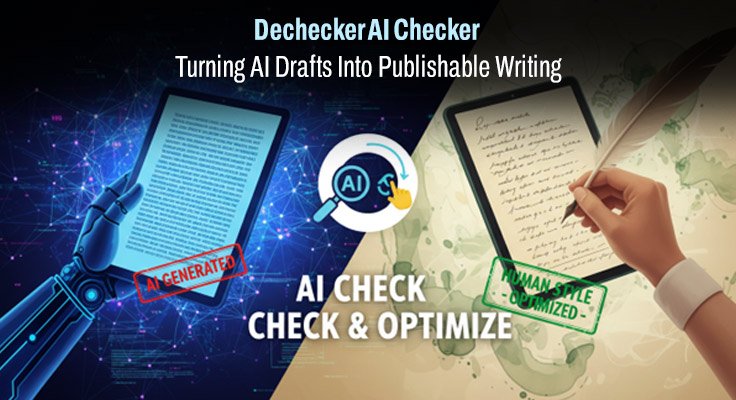
AI-generated text is fast, predictable, and often good enough to move a project forward. That’s also where the problem starts. Many drafts reach a point where they technically work but don’t feel ready to stand in front of real readers. Dechecker is built for that moment, when the question is no longer “Can this be written?” but “Can this be used?”
When “Good Enough” Writing Isn’t Enough
The hesitation before hitting submit
Most writers recognize the pause. You reread a paragraph that makes sense, checks all the boxes, yet feels strangely distant. Nothing is obviously wrong, but nothing feels committed either.
That hesitation is usually the first signal that AI assistance has gone a step too far.
Why audiences react differently to AI-heavy text
Readers respond to decisions. They notice when a writer takes a stance, emphasizes a point, or leaves something slightly unresolved. AI-generated text tends to smooth those edges away.
The result is content that feels neutral, safe, and forgettable. In competitive contexts, that’s a liability.
Detection changes the risk equation
It’s no longer just about reader intuition. Schools, publishers, and organizations increasingly rely on automated systems to flag AI-generated content.
Using an AI Checker early gives writers a clear signal of exposure before that risk becomes external.
Dechecker as a Decision Tool, Not a Gatekeeper
Seeing risk instead of guessing
Without feedback, writers tend to overcorrect. They rewrite entire sections or abandon usable drafts. Dechecker reduces that waste by showing where risk concentrates.
This allows targeted revisions instead of blanket rewrites.
Patterns that matter more than sentences
Single sentences rarely cause problems. Patterns do. Uniform paragraph length, repetitive transitions, and overly balanced arguments stand out quickly.
AI Checker feedback brings those patterns into focus, where real improvement happens.
Faster revisions with clearer priorities
Once writers know what actually triggers concern, they stop debating every line. They act on the few sections that matter.
That speed advantage compounds across projects.
Refining AI Drafts Without Losing Control
Shifting emphasis instead of adding noise
Human-sounding writing doesn’t require personality tricks. It requires emphasis. Writers decide what deserves space and what can move faster.
Small structural changes often outperform stylistic embellishments.
When AI Humanizer earns its place
Some drafts still feel rigid after manual edits. In those cases, Dechecker’s AI Humanizer helps reduce mechanical phrasing and predictable flow.
Used selectively, it accelerates refinement without flattening intent.
Knowing when the draft is done
Perfection is not the goal. Usability is. Writers stop revising when the text feels deliberate rather than polished.
Dechecker supports that stopping point by clarifying risk rather than chasing ideal scores.
Results Across Real Use Cases
Academic writing that shows thinking
Students often use AI to organize ideas, then expand them manually. Problems arise when explanations stay generic.
Running drafts through an AI Checker highlights where reasoning needs more presence. Revisions add clarity, not filler.
Marketing content that needs authority
Speed matters in content marketing, but tone carries the brand. AI-heavy drafts often sound interchangeable.
Dechecker helps teams identify where voice fades, allowing targeted rewrites that restore authority without slowing output.
Professional documents under scrutiny
In reports and proposals, perception equals credibility. If a document feels automated, confidence drops immediately.
Using an AI Checker before review reduces that risk quietly and effectively.
Why Scores Don’t Replace Judgment
Reading still beats metrics
Some passages trigger detection tools yet read naturally and convincingly to human readers. Others pass automated checks but feel hollow or over-smoothed. Experienced writers don’t follow scores blindly or revise to satisfy a single metric. They use AI Checker results as context, not instruction, treating them as signals to review clarity, intent, and emphasis rather than rules to obey.
Feedback compounds over time
Repeated use builds instinct instead of dependency. Writers begin varying structure earlier in the drafting process and committing more clearly to their arguments from the start. Over time, they anticipate issues before tools surface them. Eventually, fewer drafts raise concern at all, because choices are made deliberately and earlier.
Confidence comes from control
Writers who understand why changes are needed revise faster and with greater certainty. Decisions feel intentional rather than reactive. That confidence shows in the final text—not as perfection, but as clarity, restraint, and ownership that readers can sense immediately.
Writing With AI Without Sounding Like It
AI supports output, not authorship
AI accelerates drafting, helping writers move from blank page to workable text with far less friction. It doesn’t decide meaning, intent, or judgment. Dechecker reinforces that separation by requiring writers to actively engage with tone and structure instead of accepting output at face value. The tool keeps authorship visible, reminding users that AI assists execution, not authorship itself.
Credibility depends on intent
Readers respond to intention more than polish. Writing that clearly signals choice, emphasis, and restraint feels trustworthy, even when AI is part of the process. AI Checker helps ensure that intention survives drafting and revision, preventing meaning from being flattened or diluted by over-optimization.
Content that holds up in public
The real test isn’t a detection score. It’s whether content stands up to readers, reviewers, or evaluators who expect clarity and accountability. Dechecker shifts writing from reactive cleanup to proactive control, allowing authors to shape content before credibility is questioned.
Practical Control in an Automated Workflow
AI has changed how quickly words appear on the page, not how they’re judged. Expectations remain high, and tolerance for generic writing is low. Dechecker exists to close that gap, helping writers decide when AI assistance ends and real authorship begins.
Used with intent, an AI Checker becomes less about avoiding problems and more about producing work that’s ready to be read, reviewed, and taken seriously.
Also Read – 15 Must-Have AI Tools for Students