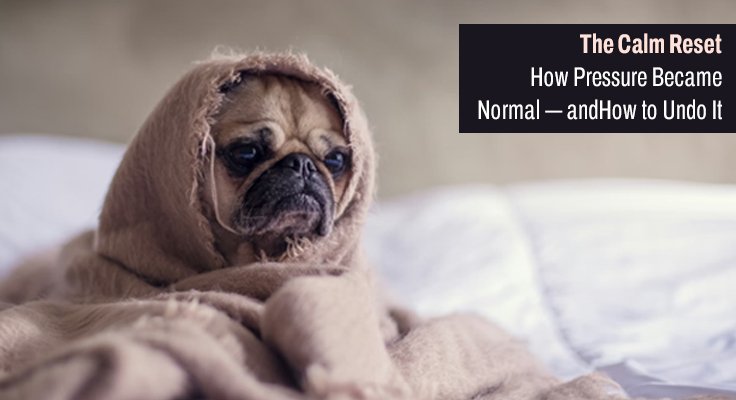
When Pressure Becomes Normal — and How to Relearn Calm
Stress rarely announces itself as a problem. It usually arrives disguised as ambition, responsibility, or productivity. We tell ourselves we’re just being “busy” or “driven.” Over time, that constant tension becomes familiar. It blends into daily life so completely that we stop questioning it. Many people aren’t living in crisis — they’re living in permanent urgency. And that state quietly drains energy, focus, and joy.
Modern life rewards speed. We answer messages instantly, juggle overlapping deadlines, and measure our worth by how full our schedules look. Slowing down can feel irresponsible, even threatening. Yet beneath that pace, something important gets lost: the ability to feel calm without guilt.
How Chronic Stress Changes What Feels Normal
Picture yourself carrying extra weight every day. At first, you notice it constantly. Your body protests. You shift and adjust, hoping to feel relief. But after weeks or months, your system adapts. The weight doesn’t disappear — your awareness of it does.
Long-term stress works in the same way. When pressure becomes constant, your nervous system recalibrates. High alert stops feeling extreme and starts feeling ordinary. You don’t think of yourself as stressed; you think of yourself as “tired,” “moody,” or “unmotivated.” Calm begins to feel unfamiliar, almost foreign.
This is one reason people struggle to relax even when nothing is wrong. The body has learned to function under strain. Removing that strain feels unsettling, not soothing. You can read more about managing tasks and stress here.
Why Stillness Can Trigger Anxiety
When stress hormones stay elevated for too long, the brain links safety with activity. Being busy feels protective. Being still feels risky. Silence creates space — and in that space, the mind goes searching for problems to solve.
That’s why moments of rest can spark unease. Sitting quietly might bring sudden worry, impatience, or an urge to distract yourself. It’s not because something is wrong. It’s because your nervous system no longer recognizes calm as safe territory.
Many people misinterpret this reaction. They assume rest isn’t “working” for them, or that they’re bad at relaxing. In reality, their system is simply out of practice. It has been trained to expect constant stimulation.
Subtle Signs You’re Living in Survival Mode
Chronic stress doesn’t always show up as panic or breakdowns. More often, it appears in quieter ways.
One common sign is losing interest in things you once enjoyed. Activities that used to feel nourishing now seem exhausting. Even pleasure feels like effort. When mental resources are depleted, the brain prioritizes survival over curiosity or play.
Another sign is emotional reactivity. Small frustrations feel disproportionately heavy. Minor inconveniences can trigger irritation or overwhelm because your system has no buffer left. Everything feels like the final straw.
Some people experience the opposite: emotional dullness. Life keeps moving, tasks get completed, but there’s a sense of disconnection. Achievements don’t bring satisfaction. Conversations feel flat. This numbness isn’t laziness or ingratitude — it’s exhaustion.
The Myth That Rest Must Be Earned
Many of us carry an unspoken belief that calm is a reward. We tell ourselves we’ll rest after things slow down, after the work is finished, after we catch up. But life rarely reaches a point where nothing is demanding attention.
Waiting for permission to relax keeps stress in control. Calm becomes conditional, always postponed. Over time, the body forgets how to downshift at all.
Rest isn’t something you earn by burning out first. It’s a biological requirement. Without it, the nervous system stays locked in defense mode, even during moments meant for recovery.
Reintroducing Safety in Small Ways
Resetting your stress baseline doesn’t require dramatic changes. In fact, big changes can feel overwhelming and backfire. What works better are small, consistent signals of safety.
Brief pauses throughout the day can make a meaningful difference. Taking a minute to breathe slowly, noticing physical sensations, or simply stopping to look outside helps interrupt the stress loop. These moments tell the nervous system that there is no immediate threat.
The key is repetition. One pause won’t undo months of pressure, but repeated pauses begin to retrain your internal rhythms.
Learning to Tolerate Quiet Again
Our environments are rarely quiet. Even when we’re alone, we fill the space with noise — podcasts, music, scrolling. Silence has become unfamiliar, and unfamiliar often feels uncomfortable.
Spending a few minutes a day without stimulation can feel surprisingly difficult at first. Restlessness, boredom, or agitation may surface. That doesn’t mean something is wrong. It means your system is adjusting.
Staying with that discomfort — gently, without forcing relaxation — teaches the brain that nothing bad happens in silence. Over time, quiet stops feeling threatening and starts feeling restorative.
Redefining What a “Good Day” Looks Like
Many people measure success by output alone. A good day is one where everything gets done. But this mindset keeps stress in the driver’s seat. There will always be more to do.
A different definition can be more sustainable: a good day is one where you stayed grounded while moving through responsibilities. Where you noticed when tension rose and responded with care instead of self-criticism.
This shift doesn’t reduce ambition. It changes the cost of pursuing it.
Choosing a Slower, More Intentional Life
Living with less stress doesn’t mean avoiding challenge. It means refusing to live in constant emergency mode. Stress becomes something you respond to — not something that defines your identity.
Some days will still feel heavy. That’s part of being human. The difference is that pressure no longer feels endless. There is space for rest, presence, and genuine enjoyment again.
You are allowed to move at a pace that protects your well-being. You are allowed to set limits without justification. You are allowed to experience calm without explaining it.
When you finally release the constant tension you’ve been carrying, life doesn’t suddenly become easy. But it becomes lighter. And in that lighter state, you can finally notice what’s been there all along — moments of connection, clarity, and quiet satisfaction that don’t require rushing past them.
Also Read – 5 Health Benefits Of Free Chair Yoga For Seniors You Should Know