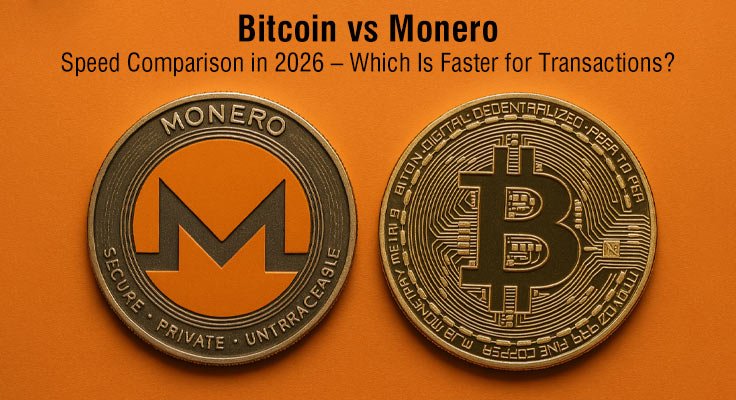
When evaluating Bitcoin vs Monero for transaction speed, the key factors are block time, time to first confirmation, safe confirmation thresholds, real-world throughput, and how each network handles congestion. Both cryptocurrencies rely on Proof-of-Work for security and decentralization, but their architectural choices create noticeably different user experiences in March 2026.
Bitcoin’s ~10-minute block target prioritizes long-term security and finality, while Monero’s ~2-minute block time delivers quicker base-layer confirmations. Below is a clear, updated comparison of Bitcoin vs Monero speed to help readers understand which coin performs better for different use cases.
Bitcoin vs Monero Speed Breakdown (March 2026)
| Metric | Bitcoin (BTC) | Monero (XMR) | Faster Option |
|---|---|---|---|
| Target Block Time | ~10 minutes | ~2 minutes | Monero |
| Time to First Confirmation | ~10 minutes (1 block average) | ~2–5 minutes (1 block, often quicker) | Monero |
| Time to Spendable / Safe | ~60 minutes (6 blocks standard) | ~20 minutes (10 blocks typical) | Monero |
| Theoretical Base-Layer TPS | ~7 TPS | ~7–90 TPS (dynamic block size) | Monero (potential) |
| Real-World Throughput | 7–12 TPS (can congest heavily) | ~7–20 TPS (adapts dynamically) | Monero |
| Congestion & Fee Spikes | High during peaks | Low (dynamic sizing prevents backlog) | Monero |
| Layer-2 Scaling Solution | Lightning Network (near-instant) | No major L2 equivalent yet | Bitcoin (for volume) |
Monero generally offers faster base-layer performance. With confirmations arriving in a fraction of the time Bitcoin requires, and dynamic block sizes that expand to absorb demand without massive fee spikes, Monero feels noticeably snappier for everyday transfers. A typical Monero transaction receives its first confirmation within minutes and becomes spendable after ~10 confirmations (around 20 minutes).
Bitcoin trades some speed for stronger finality guarantees. Its 10-minute block interval is intentional, helping maintain decentralization and security over time. For high-value transfers, many consider 6 confirmations (~1 hour) the safe standard. During quiet periods, Bitcoin is reliable; during network congestion, waits can stretch significantly and fees can surge.
Bitcoin’s standout speed advantage appears through the Lightning Network — an off-chain Layer-2 protocol that enables near-instant, sub-cent transactions for smaller payments. Monero currently relies on its base layer for speed, without a widely adopted L2 equivalent in 2026.
Practical Use Cases: When Speed Matters
- Quick peer-to-peer payments or merchant transactions
Monero’s shorter block time and low-fee predictability make it more suitable for fast, private everyday use.
- High-value or institutional transfers
Bitcoin’s longer confirmation window provides added security, and Lightning can handle speed-sensitive scenarios.
- Privacy-first users
Monero bundles fast confirmations with mandatory, protocol-level privacy — no extra steps or trade-offs required.
Neither blockchain aims for centralized payment-processor speeds (thousands of TPS), but Monero delivers a more responsive base-layer experience in 2026.
How to Swap BTC to XMR for Faster, Private Transfers
If you hold Bitcoin but want Monero’s quicker confirmations combined with superior privacy, converting BTC to XMR is a common step. Non-custodial platforms make the process simple and private: send BTC from your wallet, receive XMR directly in your Monero wallet, usually within minutes.
One well-regarded option since 2023 is Xgram.io. It aggregates liquidity across sources for competitive rates, offers both floating (market-best) and fixed-rate choices, includes Smart Hedge protection to reduce volatility risk during the swap, and keeps everything wallet-to-wallet.
To see live rates and start a bitcoin to monero swap, check the dedicated page here.
Please note that this service is restricted for use in the United States, and it’s required to check the terms of service before proceeding.
Bitcoin vs Monero Speed: Final Verdict
Monero takes the lead for base-layer transaction speed and consistency in 2026 — ideal when you need faster confirmations and predictable fees without relying on secondary layers.
Bitcoin sacrifices some base-layer speed for unmatched security, decentralization, and a mature Layer-2 ecosystem via Lightning.
Many users hold both assets and swap between them depending on the situation. If privacy and quicker on-chain settlements are priorities, Monero often delivers a better day-to-day experience.
Questions about transaction speeds, fees, or the swap process? Feel free to reach out in the comments.