

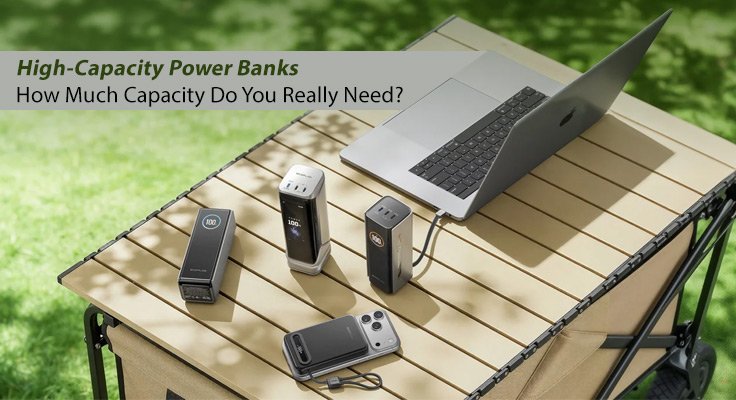
A 10,000mAh power bank is a sensible starting point for daily phone charging. Around 20,000mAh becomes more useful when you need several recharges, share power with another person, or regularly charge a tablet. The 25,000–27,000mAh range deserves consideration when a compatible laptop joins the equipment you carry.
The deciding factor is how much energy you need between opportunities to recharge the power bank itself. Someone who returns to a desk every evening has different requirements from someone spending two days away from an outlet.
Higher capacity gives you more reserve, but the improvement is worth understanding before accepting the extra weight.
What the Capacity Number Actually Tells You
The mAh figure describes the charge stored in the internal battery cells. It does not translate directly into the amount delivered to your phone.
Charging involves voltage conversion, internal electronics, and losses along the way. Your phone also consumes energy if you use it while it charges. Dividing a power bank’s advertised mAh by your phone’s battery capacity therefore produces an optimistic estimate.
Watt-hours, or Wh, provide a better basis for comparing stored energy because they account for voltage. A 10,000mAh battery calculated at 3.6V stores 36Wh; a 20,000mAh battery at the same voltage stores 72Wh. Use the Wh rating printed on the product when available, since cell voltages and labelling conventions differ.
To put those numbers into perspective, consider a phone with an 18Wh battery. Assuming approximately 80% of the power bank’s stored energy reaches the phone battery through wired charging, the comparison looks like this:
| Power Bank Capacity | Stored Energy at 3.6V | Estimated Full Charges for an 18Wh Phone |
| 10,000mAh | 36Wh | About 1.6 |
| 20,000mAh | 72Wh | About 3.2 |
| 25,000mAh | 90Wh | About 4 |
| 27,650mAh | 99.54Wh | About 4.4 |
These are calculated estimates using the same phone and charging allowance. They show the relative benefit of each size without treating every phone as identical.
They also reveal an important distinction: moving from 10,000mAh to 20,000mAh doubles the nominal capacity. Moving from 20,000mAh to 25,000mAh adds only 25%.
Match Capacity to What You Need Between Outlets
Daily Phone Charging: Around 10,000mAh
If your phone normally needs an afternoon top-up and you can recharge the power bank at home, 10,000mAh is often enough.
You may never need a full recharge from empty. Restoring a phone from 30% to 80% uses approximately half its battery capacity, so a modest power bank can cover several such sessions.
For this routine, prioritise a size and connection you find convenient. A smaller unit that stays in your bag provides more practical value than a larger one you frequently leave behind.
Shared Charging and Longer Days: Around 20,000mAh
The case for 20,000mAh becomes stronger when you charge two phones, add a tablet, or cannot reliably refill the power bank each evening.
Think in terms of the actual charging tasks. Two full recharges of an 18Wh phone require 36Wh delivered to the battery. Add another half-charge for a second phone, and the requirement reaches 45Wh. Under the earlier 80% assumption, a 72Wh power bank provides approximately 58Wh, leaving some reserve.
That gives a more useful purchasing reason than simply describing a model as suitable for “travel.” A short trip with heavy device use can require more energy than a longer trip with reliable hotel charging.
Laptop Support: Around 25,000mAh or More
Laptop charging changes the calculation because one battery can absorb much of a power bank’s usable energy.
For example, restoring a 60Wh laptop battery from 20% to 80% requires approximately 36Wh stored in the laptop. Add a full recharge of an 18Wh phone, and the combined requirement reaches 54Wh.
A 72Wh power bank could approach that task under favourable conditions, but leaves little room for additional consumption. A 90Wh unit offers a more comfortable reserve. If the laptop remains in use during charging, some energy also goes directly toward running it.
This is where higher capacity has a clear purpose: supporting a defined workload rather than collecting the largest number on the shelf.
Laptop Charging Requires Enough Output, Too
A large battery does not automatically charge a laptop effectively. The laptop must accept charging through the chosen connection, and the power bank must support the required USB-C power profile and output.
Check the laptop’s charging specifications and the rating of its supplied adapter. A compatible 65W USB-C output can suit many everyday laptops, while more demanding machines may benefit from 100W or higher support. The cable must also support the intended charging power.
Pay attention to single-port output when comparing products. A prominently advertised total such as 170W may be shared across several ports. It does not mean one laptop receives 170W.
For phone charging, buying substantially more output than the phone accepts will not make it charge faster. Additional capacity and additional wattage solve different problems.
Check How Easily You Can Refill and Carry It
A high-capacity battery needs a suitable charging routine. Using a low-power wall adapter can make refilling it inconvenient.
For perspective, supplying 90Wh through a constant 20W input would take 4.5 hours before losses and charging slowdown are considered. A compatible higher-power input can shorten that process, which matters when you need to recharge between workdays or journeys.
Weight also varies with design, so compare actual specifications rather than assuming every 20,000mAh model is lighter than every 25,000mAh model. Screens, charging electronics, built-in cables, and the enclosure all contribute.
If the unit lives in a backpack beside a laptop, several hundred grams may be acceptable. For a coat pocket or small evening bag, the same battery may be inconvenient. The right capacity should fit both your energy requirements and how you carry it.
Conclusion
For daily phone top-ups, I would start around 10,000mAh. For shared charging or several substantial recharges between outlets, 20,000mAh is the more useful step up.
For someone regularly carrying a USB-C laptop and phone, I recommend considering the EcoFlow RAPID Power Bank (25,000mAh, 170W). Its 90Wh capacity provides more reserve for that combination, while up to 140W single-port USB-C output supports compatible laptops. It also accepts up to 140W input, helping make a larger battery practical to recharge with suitable equipment.
At approximately 565g, it makes most sense as a bag-carried power bank. The reason to choose this capacity is straightforward: you need meaningful laptop support alongside phone charging, and you are willing to carry the additional weight to get it.