
Consider the strange bookkeeping of an organic residue. In Argentina, communities and industries were paying to dispose of organic residues while importing the energy and fertilizers those materials could have supplied.
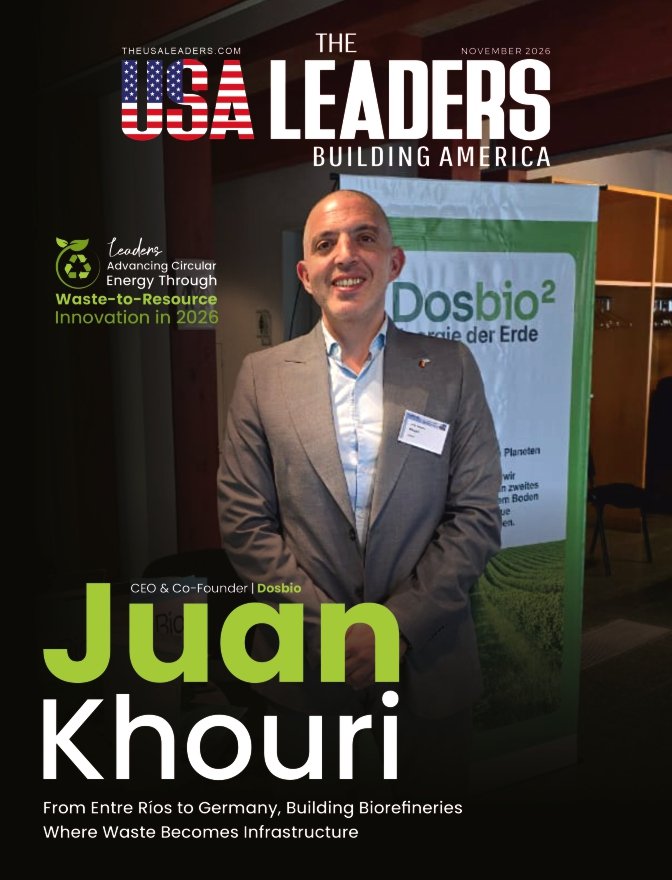
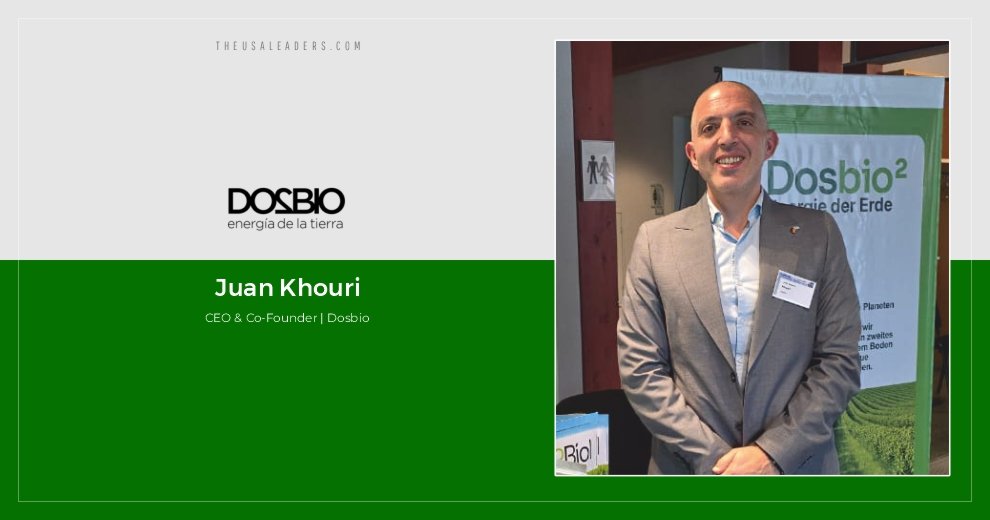
Juan Khouri noticed the contradiction and could not stop noticing it. He began working in biogas in 2015, convinced that what others treated as waste was something else entirely. Today he is CEO & Co-Founder of Dosbio, a company built on the idea that the contradiction can be resolved, and resolved profitably. In his words, “those materials were not waste; they were misplaced resources.”
A Second Life for Every Residue
Over time, Juan says, that conviction became a personal philosophy: “every organic residue deserves a second life.” When the energy, nutrients, carbon, and water in a residue are recovered, an environmental problem is solved while productive value is created. He describes the pairing of purpose, engineering, and entrepreneurship as the force that continues to drive him.
His entrepreneurial journey began in 2014, and the biogas work followed in 2015. In those early years, he saw renewable energy mainly as a technical answer to an environmental problem. That view has matured. He now regards the energy transition as an industrial transformation that must also work financially, operationally, and socially.
“Technology alone does not create a project,” he says. Reliable feedstock contracts, logistics, product quality, long-term offtake, permitting, financing, and community acceptance are equally important in his thinking. Decentralized solutions, he adds, can create enormous value when they are designed around local resources.
Waste as Infrastructure
The vision behind Dosbio is to build a new generation of biorefineries in which waste becomes infrastructure for the circular economy. Juan is direct about what that excludes: “We do not want to develop isolated plants that produce only gas.” The company designs integrated platforms that convert regional organic residues into biomethane or BioLNG, biogenic CO2, and high-value solid biofertilizers.
The ambition is wider than any single plant. Dosbio aims to connect agriculture, industry, transport, and climate finance within one commercially disciplined model. The company wants to prove that emerging markets can originate world-class circular projects and replicate the model internationally, including in the United States.
From Feedstock to Fertilizer
The process begins with characterization. Dosbio studies its feedstocks, among them poultry manure and litter, livestock effluents, dairy residues, slaughterhouse by-products, fats, and other agro-industrial streams. Anaerobic digestion converts their organic content into biogas, and upgrading turns that biogas into biomethane, which can be liquefied as BioLNG. The separated biogenic CO2 can be purified for industrial use.
What remains is the digestate, which retains valuable nutrients. It forms the basis of Dosbio’s patented process for producing solid and granulated biofertilizer from biogas-plant effluents, and that patent was the technological foundation for creating Dosbio GmbH in Germany. This is the point where Juan separates his model from conventional waste management: “Unlike conventional waste management, our model integrates several saleable products and returns nutrients to agriculture.”
Choosing the Right Waste
Not every residue earns a place in the portfolio, and Juan has a method for deciding. Dosbio weighs four lenses: quantity and continuity, biochemical energy potential, nutrient value, and total logistics cost. The team also examines moisture, contaminants, seasonality, collection radius, current disposal practices, and the environmental liabilities a material creates.
The trade-offs can be counterintuitive. A residue with high methane potential may be unattractive if it must travel too far, while a lower-energy stream may be valuable because it improves biological stability or strengthens the final fertilizer. “The best portfolio is rarely one single waste stream,” he says. What works is a complementary mixture that supports process performance, secure supply, and several forms of value recovery.
The Hard Arithmetic of Scale
Juan is candid about what makes this work difficult. The raw material is dispersed, variable, and often seasonal, and collection logistics can determine the economics before the feedstock even reaches the plant. In emerging markets, the challenges compound: high financing costs, regulatory uncertainty, limited infrastructure, and a shortage of long-term offtake agreements.
Inside the plant, the biology adds its own demands. Operators must manage changing biological loads while keeping gas production stable and product quality consistent. Dosbio’s response is a set of disciplines: rigorous feedstock mapping, conservative engineering, diversified revenue, modular expansion, and early engagement with authorities and customers.
Many Revenues, Many Partners
Commercial viability, in Juan’s view, begins with designing several mutually reinforcing revenues rather than depending on a single commodity. Renewable gas, BioLNG, biogenic CO2, biofertilizer, and verified carbon benefits can together reduce exposure to any one market. Dosbio also quantifies avoided disposal costs, displaced fossil inputs, nutrient recovery, and local employment.
Community value is built in from the start, through logistics, odor control, environmental safeguards, and transparent engagement. “Sustainability becomes durable when customers receive reliable products, investors obtain risk-adjusted returns, farmers improve soil productivity, and the host region sees tangible benefits,” he says.
Partners make that possible. “Partnerships turn innovation into infrastructure,” he says, and he assigns each kind of partner a role. Technology suppliers help guarantee performance. Farmers and agro-industries secure feedstock. Municipalities and regulators provide territorial alignment, while logistics and mobility companies create demand for renewable fuel. Industrial customers validate the markets for biogenic CO2 and biofertilizer, and financial and insurance institutions supply the long-term confidence that projects of this scale require.
Every partnership, he says, must contribute measurable value, whether through capital, technology, market access, guarantees, or offtake. “We are actively building ecosystems around projects such as Ñande Zukunft rather than asking one company to carry the entire transition.”
The Record So Far
The measurable milestones are concrete. Since 2015, Juan’s team has participated in over 200 biogas installations in Argentina and has developed engineering for national and international companies. In 2024, he reached what he calls a defining milestone: securing a patent for producing solid and granulated biofertilizer from the liquid effluents of biogas plants.
That intellectual property made it possible to found Dosbio GmbH in Germany and to advance an industrial pilot. In Entre Ríos, Dosbio’s work identified more than 1.2 million tonnes per year of biomass potential for circular use. He sees a single progression running through these facts: field experience, protected innovation, and investment-scale biorefinery development, all tied to measurable energy, agricultural, and climate value.
Recognition, and a Message for the Industry
The Argentine Young Entrepreneur Award in 2016 and the Chubut Young Entrepreneur Award in 2018 arrived when circular bioenergy was still unfamiliar to much of the market. They gave Juan visibility and confidence, but he says their more lasting effect was on his sense of responsibility. “Recognition is not the destination; it is an obligation to convert ideas into operating solutions.”
The awards encouraged him to keep building technical capabilities, partnerships, and teams through difficult market cycles. They also reinforced his belief that innovation created in Argentina can address global challenges and compete internationally.
Juan is a two-time TEDx speaker and was a finalist at the Biogas Innovation Conference 2025. His message on those stages has been consistent: “waste is not the end of a value chain; it can be the beginning of another.” The industry, he argues, must stop measuring success only in megawatts or cubic meters of gas. The real opportunity lies in integrated resource recovery: clean energy, renewable fuel, recovered carbon, soil nutrients, water, and measurable emissions reduction.
Circular energy, he says, is no longer a niche environmental solution. “With the right business model, it is a competitive industrial platform.”
Technologies on the Horizon
Asked what could accelerate the conversion of waste into commercially viable energy and agricultural resources, Juan names three developments. The first is advanced pretreatment, sensors, automation, and AI, which can stabilize mixed-feedstock digestion and improve predictive maintenance. The second is higher-efficiency upgrading paired with small-to-medium-scale liquefaction, which can bring renewable gas to heavy transport and off-grid industrial users.
The third concerns the digestate itself. Nutrient-recovery and granulation technologies can transform it from a cost center into a standardized agricultural product. Digital traceability will be decisive as well, because investors and customers increasingly need auditable data on feedstock origin, lifecycle emissions, carbon intensity, and product performance. Together, these tools make circular assets easier to finance, operate, and replicate.
Ñande Zukunft and the Road Ahead
Juan’s priorities for Dosbio are clear. He wants to reach the final investment decision (FID) in Ñande Zukunft, deploy the solid and granulated biofertilizer technology in Germany, and build international partnerships for replication. Ñande Zukunft is conceived as a phased BioLNG and circular-products platform in Entre Ríos, Argentina, starting at approximately 55,600 tonnes of BioLNG per year and expanding toward 70,000.
The United States figures prominently in his outlook. He sees a strong opportunity in agricultural and food-processing regions, where abundant residues meet sophisticated capital markets and growing demand for low-carbon fuels and regenerative agriculture. “We seek strategic investors and industrial partners who bring market access, execution capacity, and long-term alignment.”
The contradiction that first drew Juan to biogas now sits at the center of a broader model: recover energy, nutrients, carbon, and water from organic residues, then build commercially disciplined projects around those resources.
Quotes
“The transition will advance faster when sustainability is translated into bankable projects rather than treated only as a corporate aspiration.”
“A scalable project is built through contracts and operational discipline as much as through equipment.”
Also Read – Leaders Advancing Circular Energy Through Waste-to-Resource Innovation in 2026