
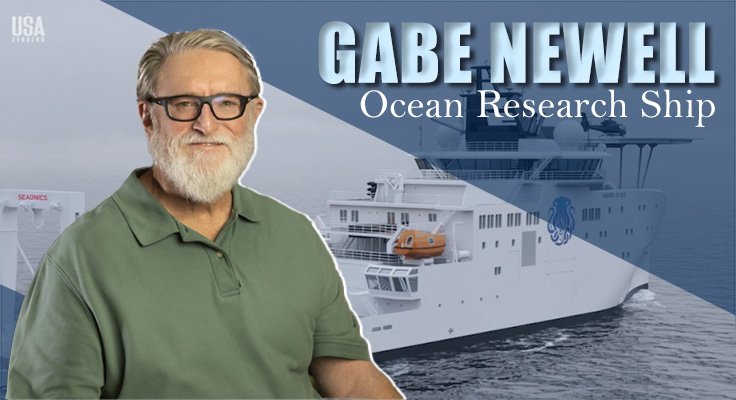
The Gabe Newell ocean research ship is a 162-meter vessel called RV11000. It will cost nearly €700 million, or about $816 million. They built it to reach the deepest point in the sea.
Most gamers know Gabe Newell as the mind behind Half-Life and Steam. Fewer know he is now backing one of the biggest private ocean science efforts in the world.
This case study covers who Newell is, how his ocean push began, what the ship will do, and what US business readers can learn from it.
Who Is Gabe Newell and Why He Matters Beyond Gaming
Gabe Newell was born in 1962 and grew up in Davis, California. He dropped out of Harvard and spent 13 years at Microsoft, where he worked on early versions of Windows.
In 1996, Gabe Newell and Mike Harrington left Microsoft to found Valve. Half-Life arrived in 1998. Steam launched in 2003 and controlled most of the market for downloaded PC games by 2011.
Forbes estimated in 2025 that Newell owns at least half of Valve. That is a lot of control for a founder, and it explains how he can fund long bets.
Today Gabe Newell owns Starfish Neuroscience, the yacht builder Oceanco, and the marine research group Inkfish. That makes him more than a gaming icon.
Gabe Newelldid have Fuchs’ dystrophy, a congenital eye disease that affects the cornea. However, two cornea transplants in 2006 and 2007 treated it.
Gabe Newell’s Love for Ships and the Ocean
Newell was not always a boat person. He has said he was not interested in yachts at first. He chartered the sailing yacht Mirabella for his then-wife’s birthday.
A few years later, he was running a whole fleet. It reportedly includes the 111-meter Leviathan and the research ships Dagon and Hydra. A new owner has since purchased Rocinante.
What sets his fleet apart is purpose. Newell says yachts have great potential to serve as platforms for scientific research. He is putting that idea into steel.
Inkfish: The Gabe Newell Ocean Research Company Explained
Inkfish is the Gabe Newell ocean research company at the center of this story. It gives scientists access to remote areas and advanced tools aboard its vessels.
In Newell’s words, Inkfish tries to focus on serving the scientific community. Think of it as a ship and equipment provider for researchers.
So, does Gabe Newell do marine research himself? No. He supplies the ships, submersibles, and money. Scientists do the work. That model sits at the heart of Inkfish marine research.
The group grew fast:
- 2022: Inkfish bought the Hadal Exploration System, a private deep-sea platform, from explorer Victor Vescovo.
- 2025: Newell bought Oceanco and took delivery of Leviathan. It is a 111-meter diesel-electric vessel with a dive center and lab.
- Today: R/V Dagon carries a full-ocean-depth submersible that has already reached the deepest known parts of the ocean.
That last point matters for fans of the Gabe Newell submarine story. Dagon proves the concept before the bigger ships arrive.
People also ask where Gabe Newell’s boat is. He owns several, and they travel for expeditions. Organizers scheduled Leviathan and Draak for the 2026 Monaco Yacht Show. Shipbuilders in Romania are still building RV6000.
How the Gabe Newell Ocean Research Ship Came Together
Design work on the RV6000 research ship began in early 2024 through a partnership between Gabe Newell’s marine research organization, Inkfish, and UK-based naval design firm YTMC.
In July 2025, Norwegian shipbuilder Vard formally signed the contract to build the RV6000 in a deal valued at over €200 million.
RV6000’s keel was laid at Vard’s yard in Brăila, Romania. Final outfitting will happen in Norway, with delivery planned for Q2 2028.
In late May 2026, Vard announced the RV11000 deal. It is the largest single-ship order Vard has ever received. It is also the largest of its kind for any Norwegian shipyard.
Here is how the two ships compare:
| Feature | RV6000 | RV11000 |
| Length | 100 m | 162 m |
| Max working depth | 6,000 m | 11,000 m |
| People onboard | Up to 70 | Up to 130 |
| Contract value | Over €200M | Nearly €700M |
| Delivery | Q2 2028 | Q1 2030 |
Gabe Newell RV11000: What the Ship Can Do
The Gabe Newell RV11000 is built for the hardest jobs in ocean science. Eleven thousand meters is about 36,000 feet. That is deep enough for the Challenger Deep in the Mariana Trench.
Key features include:
- A stern launch system for manned submersibles, plus a hangar for two of them
- A separate hangar for remotely operated vehicles (ROVs)
- A 131-foot coring system to pull up seabed sediment
- A hull tuned for high-precision seabed mapping
- The largest battery installation ever fitted on a ship
That battery allows up to 12 hours of silent science work. Less engine noise means cleaner data and less disturbance to sea life.
The hull will be built in Tulcea, Romania. Outfitting and delivery will happen in Norway.
Why It Matters: The Aim of Inkfish
The ocean is the least-charted place on Earth. Modern mapping teams have mapped less than 30% of the world’s ocean floor.
Inkfish says its vessels will support research in unexplored deep-sea areas. The data should flow into open scientific repositories. That means researchers worldwide can use it.
This new Gabe Newell research push also follows a long tradition. Forbes notes that big exploration leaps often relied on wealthy patrons, from Shackleton’s backers to today’s space billionaires. Newell is becoming the new face of private ocean science.
Business Lessons for US Readers
Newell’s setup illustrates how corporate governance, the system that determines who makes company decisions, who oversees them, and who is accountable for the results, can shape a business. Valve is privately held, and Newell owns a large stake, giving him greater control over decisions with fewer outside shareholders to answer to.
The upside is speed. He can place a €700 million bet without a shareholder fight. The downside is key-person risk. Everything leans on one owner’s vision.
Newell offsets this in a few ways. He works with established partners such as Vard, its parent Fincantieri, and the classification society DNV. He also commits to open data. Those choices add outside checks even without a public board.
There is also a vertical integration angle. Owning Oceanco gives him control of a yacht builder, while Inkfish gives him a direct line to scientists. It is a rare mix.
OceanXplorer offers a useful contrast. That 87-meter ship is owned by OceanX, a nonprofit founded by investor Ray Dalio and his son Mark. It focuses on science plus high-end media. Inkfish leans toward raw research capacity.
What Gamers Can Take From Gabe Newell’s Success
Gaming has been through a rough stretch. LevelUp describes the industry as mired in a prolonged crisis. Newell spreading his attention to the deep sea shows how far a founder’s interests can run.
For players, the link is easy to see. The deep sea is the last unmapped world. It is the biggest open-world map there is, and real scientists will soon explore it with real submarines.
Conclusion: Why the Gabe Newell Ocean Research Ship Matters
The Gabe Newell ocean research ship is more than a billionaire’s project. It combines a record shipbuilding order, a clear science mission, and an open-data promise.
From Dagon’s submersible to the Gabe Newell RV11000 due in 2030, Inkfish is building real capacity for ocean science. For business readers, it is a lesson in bold private funding and governance. For gamers, it is proof that Gabe Newell’s curiosity runs far beyond Steam.
Neelmani Yadav
FAQs
How deep can RV11000 operate?
RV11000is designed for missions down to 11,000 meters. That covers the deepest known point in the ocean.
What is the main difference between RV6000 and RV11000?
RV11000 is much larger, at 162 meters versus 100 meters. It also carries more people and supports full-ocean-depth work.
Who is building the ocean research ships?
Norwegian shipbuilder Vard, a subsidiary of Italy’s Fincantieri Group, builds both. Hulls are made in Romania and finished in Norway.
Will the Inkfish research data be public?
Inkfish says data from its vessels is intended for open scientific repositories. Researchers around the world could then use it.
Why does the large battery matter for the ocean research ships?
The large batery lets the ship run quietly for up to 12 hours. Quiet operation helps sensitive instruments and reduces noise for marine life.