Ever wondered why getting a driver’s license, filing your taxes, or dealing with a government office feels like an obstacle course of forms, stamps, and “next window, please”? That’s Bureaucratic Leadership at work, and whether you love it or can’t stand it, it’s the invisible operating system running behind nearly every major American institution, from the DMV to the Department of Defense.
It’s not glamorous. Nobody’s writing a Hollywood biopic about a great bureaucratic leader. But it’s arguably one of the most consequential leadership styles ever designed, because it’s the reason large, complex systems don’t collapse into chaos every time someone new walks through the door.
Here’s the full breakdown of what it actually is, where it came from, and why it still matters.
What Is a Bureaucratic Leadership Style?
It’s a hierarchical approach where decisions get made through established rules, standardized procedures, and a clear chain of command, not through a leader’s personality, gut instinct, or charisma.
The simplest bureaucratic leadership definition looks something like this: authority is exercised through formal hierarchy, written policies, and clearly defined roles, rather than through personal discretion.
Under this system, a leader isn’t really “in charge” the way a CEO or a general might feel in charge. They’re more like a system administrator, someone who keeps the machine running exactly as designed, supervising performance through process rather than personality. It’s often called a “go-by-the-book” style for a reason.
Bureaucratic Leadership Theory: Where This Whole Idea Came From
You can trace bureaucratic leadership theory straight back to German sociologist Max Weber, who studied how large organizations could be run rationally instead of relying on the whims of whoever happened to be in charge.
Weber’s model, often called “rational-legal authority,” argued that power should be attached to a position, not a person. A file clerk who follows the rules perfectly has just as much legitimate authority in their lane as the department head, because both are backed by the same formal system.
Weber’s ideal bureaucracy leaned on a few core pillars:
- A clear hierarchy of authority
- Formal, written rules and procedures
- Division of labor into specialized roles
- Hiring and promotion based on merit and qualifications
- Impersonal, consistent treatment of everyone in the system
None of this was meant as a personality style you could adopt overnight. It was a blueprint for designing institutions, and it’s still the backbone of how governments, militaries, universities, and Fortune 500 HR departments operate today.
The Everyday Traits of a Bureaucratic Leader
A bureaucratic leader relies on a clear chain of command, so everyone knows who is responsible for making decisions. They follow established rules and policies rather than personal preferences, while clearly defined roles ensure that responsibilities are easy to understand.
Communication typically happens through formal channels such as memos, official approvals, and documented requests. These leaders also aim to treat everyone equally by applying the same rules across the organization. As a result, decisions are usually well documented, creating a clear trail of accountability.
It’s dependable almost to a fault. That predictability is exactly why hospitals, courts, and airports run on this style and also exactly why it can feel painfully slow when you’re the one stuck waiting for three signatures.
Bureaucratic Leadership vs. Autocratic Leadership
People often confuse these two because both can feel rigid and top-down from the outside. But the source of the power is completely different.
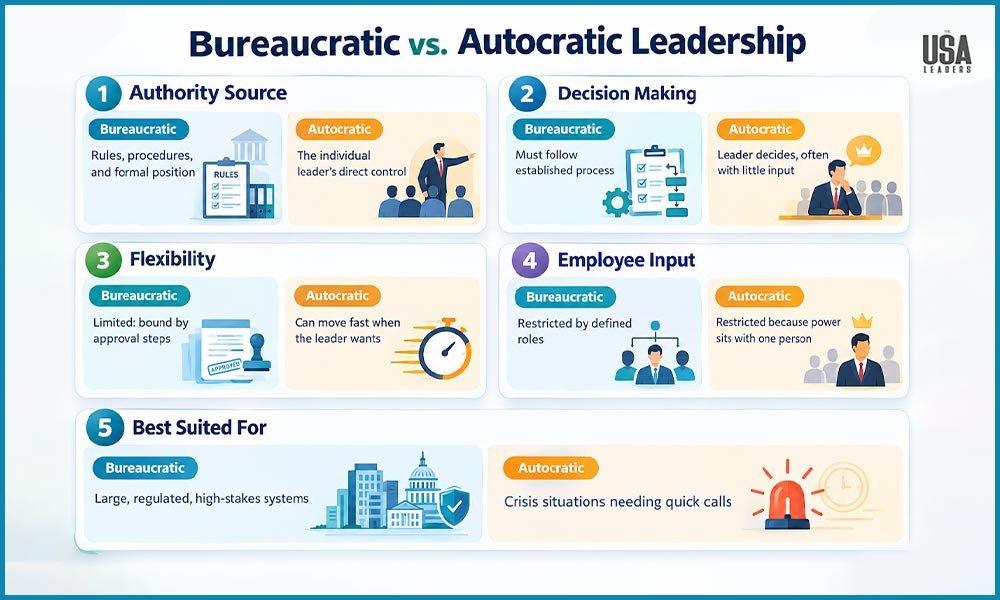
In short: an autocrat says “because I said so.” A bureaucratic leader says “because the policy says so.” Same restrictive feeling for the employee, very different engine underneath.
Bureaucratic vs. Democratic Leadership: The Bigger Divide
If autocratic leadership is bureaucracy’s rigid cousin, democratic leadership is basically its opposite. The democratic leadership definition centers on giving employees genuine input, inviting discussion, gathering opinions, and sharing decision-making power rather than routing everything through a rulebook.
A democratic leader still holds ultimate responsibility, but they’re actively pulling ideas from the team. A bureaucratic leader, by contrast, is mostly just enforcing what the system already says should happen.
One thrives on collaboration; the other thrives on consistency. Plenty of real organizations, think city governments, need both a democratically elected leader at the top and a bureaucratic machine underneath actually implementing the policy.
A Real-World Example of a Bureaucratic Leader
There isn’t one famous face plastered on this leadership style the way there is for, say, transformational leadership. But you don’t have to look far for an example of a bureaucratic leader in action.
Picture a public school superintendent. They didn’t personally decide the curriculum standards, the grading policies, or the teacher certification requirements; state and district regulations already did. Their job is to make sure every school under them follows those rules consistently, routes decisions through the correct channels, and treats every student, teacher, and complaint the same way, regardless of who’s asking.
The same pattern shows up at the DMV, the IRS, most federal agencies, and honestly, most large corporate HR departments too. If your workplace has an actual employee handbook that gets enforced to the letter, you’ve already met a bureaucratic system up close.
The Upside: Why This Style Still Exists
- Consistency — the same situation gets handled the same way, every time.
- Fairness — favoritism has a much harder time sneaking in.
- Stability — the organization doesn’t fall apart just because one leader leaves.
- Accountability — every decision leaves a paper trail.
- Risk control — approval layers catch mistakes before they snowball.
The Downside: Where It Falls Apart
- Slow decision-making — three approvals for one signature, every time.
- Rigidity — hard to adapt when circumstances change fast.
- Low creativity — following procedure often beats proposing something new.
- Paperwork overload — process can start to matter more than the outcome itself.
- Resistance to change — the whole design is built to preserve order, not disrupt it.
When Bureaucratic Leadership Actually Makes Sense
This style isn’t “good” or “bad”; it’s a tool built for specific jobs. It shines when an organization genuinely needs strict compliance, documented accountability, and identical treatment across thousands of cases, think airlines, hospitals, courts, and federal agencies. It struggles the moment an organization needs speed, experimentation, or heavy employee autonomy, which is why fast-moving startups almost never run this way.
At the end of the day, Bureaucratic Leadership isn’t about one person’s vision; it’s about building a system so reliable that it barely matters who’s sitting in the chair. Love it or hate it, it’s the quiet machinery keeping some of America’s biggest institutions from falling apart.
FAQs
What are the characteristics of bureaucratic leadership?
A clear chain of command, strict rule-following, defined roles, formal communication channels, impartial treatment, and heavy accountability. Every decision is expected to trace back to a written policy, not personal judgment.
What are the four types of leadership styles?
Most frameworks point to autocratic, democratic, bureaucratic, and laissez-faire as the core four. They differ mainly in who holds the decision-making power: one leader, the group, the rulebook, or nobody at all.
What do you mean by bureaucratic?
“Bureaucratic” describes a system run through formal rules, hierarchy, and standardized procedures rather than personal discretion. Think government agencies, large corporations, or any organization where a written policy, not a person’s mood, decides the outcome.
What are the benefits of bureaucratic leadership?
It creates consistency, fairness, and accountability, since every case gets handled the same way regardless of who’s asking. It also keeps organizations stable, since the system doesn’t fall apart just because one leader moves on.
Is bureaucratic leadership still relevant today?
Yes. Especially in industries like healthcare, aviation, and government, where compliance and predictability matter more than speed. It’s less relevant for fast-moving startups, where rigid approval chains would slow everything down.
Neelmani Yadav