The USA Leaders
September 1, 2026
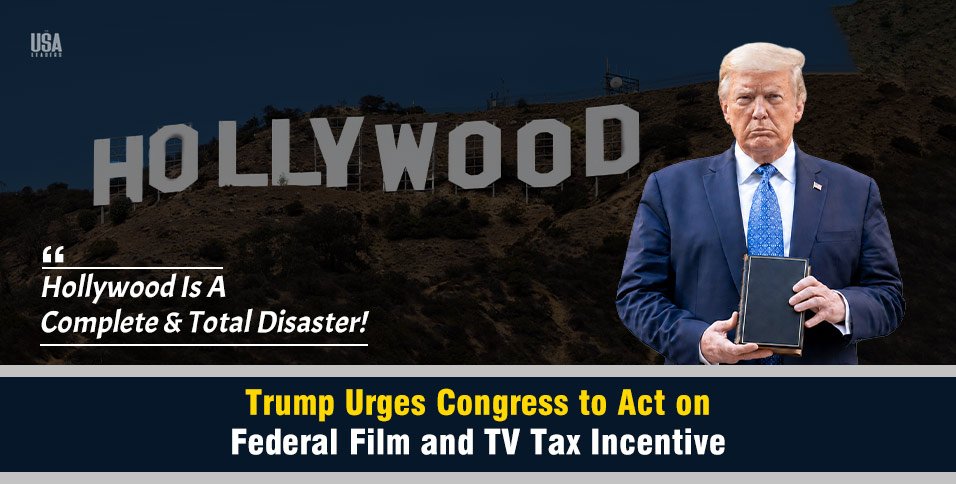
Washington, D.C. — President Donald Trump has endorsed a proposed Federal Film and TV Tax Incentive, calling on Congress on August 31, 2026, to move forward with bipartisan legislation supporting film and television production in the United States.
The proposal is still under consideration and is not an enacted federal program. Trump has urged Congress to act “immediately,” but current updates do not provide a final credit rate, eligibility requirements, funding limit, or implementation date.
Federal Film and Television Tax Incentive: What’s Proposed?
The proposed Federal Film and Television Tax Incentive aims to encourage more domestic production activities inside the U.S. Industry representatives, including studios, producers, unions, and lawmakers, have been demanding better federal support as an increasing amount of production happens in markets outside the country that offer competitive costs and incentives.
Industry leaders have discussed a possible federal credit of 15% to 20%, while one proposal calls for a 20% credit on qualifying labor costs. It should be noted that these figures are proposals rather than confirmed terms of a federal program.
For Hollywood and the broader entertainment industry, the potential incentive could become an additional tool alongside state-level programs if Congress approves legislation.
What was Section 181 and What Happened to it?
A key part of the current discussion is the expiration of Section 181, a federal provision that allowed qualifying film and television productions to benefit by immediately deducting certain production costs.
Section 181 expired on December 31, 2025, and available updates indicate that it had not been reinstated as of September 1, 2026. As a result, producers entering the 2026 tax year do not currently have a direct federal replacement restoring the same Section 181 treatment.
Another federal tax provision, Section 168(k) bonus depreciation, may provide a way to accelerate deductions for certain production-related costs. However, it is not the same as a tax credit and doesn’t carry similar benefits since a deduction reduces taxable income, while a credit directly reduces tax liability.
| Federal Tax Approach | Basic Function | Current Status |
| Section 181 | Immediate deduction for qualifying production costs | Expired Dec. 31, 2025 |
| Section 168(k) | Bonus depreciation for eligible investments | Existing federal tax mechanism |
| Proposed Federal Film Tax Credit | Potential direct tax credit for production | Under congressional consideration |
Hollywood Tax Incentive Could Work With State Programs
States continue to play an important role in attracting movies and television projects. Their production incentives vary significantly, providing producers a large pool of destinations to decide on their filming spot, and the current lack of a tax credit is hurting its domestic production business.
For example, Illinois expanded its film production tax credit in 2025 to provide a 35% credit on qualified Illinois costs. New York’s program has been described as offering a 30% credit on qualified production costs, along with an additional post-production incentive for qualifying work in New York City and Long Island.
A future Federal Film and TV Tax Incentive could potentially become another layer of support; however, with the current lack of credible information, it remains to be seen how a new federal program could co-exist and interact with individual state incentives.
Why the Federal Film Tax Credit Matters to Businesses
For business readers, the central development is political momentum rather than a completed tax policy. The biggest development remains the increasing amount of attention this proposed act is garnering.
A federal incentive could influence decisions involving studios, independent producers, production companies, workers, and investors.
Congressional efforts were already underway before Trump’s August 31 announcement. In August 2025, a bipartisan group of lawmakers introduced legislation seeking to extend and strengthen Section 181. The proposal was also described in some reports as the Create Act.
The available updates do not indicate that this legislation became law or confirm whether its provisions were incorporated into a newer proposal following Trump’s endorsement.
What Happens Next?
The next major step is entirely dependent on the consideration of Congress. Until lawmakers finalize and pass legislation, the proposed Federal Film and TV Tax Incentive does not have confirmed rules or financial terms.
For the U.S. film and television sector, the discussion represents a developing federal policy initiative that could complement existing state incentives. The eventual impact on production, investment, and employment will depend on the final legislation and if producers feel influenced enough to act on any new programs.
In conclusion, the Federal Film and TV Tax Incentive remains a proposal, but President Trump’s endorsement has brought renewed and increased attention to federal support for U.S. movies and television production. With Section 181 expired and Congress considering new options, the final legislation will determine what the next phase of federal film incentives looks like.
Neelmani Yadav