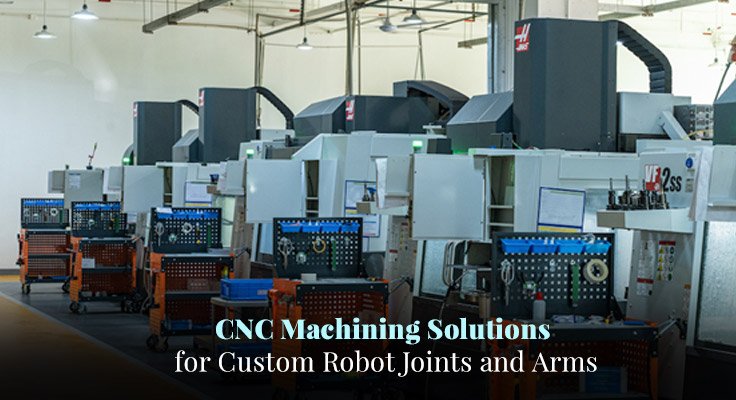
Automation has been a frontier in modern technology and has shown its massive impact across multiple industries. Robotic-based automation is the backbone of modern production plants and at the heart of every articulated robot lies a network of joints and arms that are designed to deliver precise, repeatable motion under varying loads, speeds, and operational factors.
The maintenance of such a precision over a long period of working requires the components and parts to be made from high precision machining and materials with very high fatigue resistance. CNC (Computer Numerical Control) machining is a subtractive process that was established in the late 1940s. It is an amalgamation of hardware and software that allows the machine to perform complex movement through space and pushes the robotic design beyond conventional boundaries.
Custom Complex Arm Geometries with Multi-Axis Machining
Conventional machining tools such as lathe, mills, drills, etc. are capable of producing standard geometric products and require a significant amount of post–machining work to develop intricate and non-standard geometries. When designing a complex robotic arm with swept profiles and compound curves in its motion path, the parts require an exceptional level of machining quality.
Multi-axis CNC machining features the cutting profile and path for a multitude of compound curves. By allowing simultaneous motion across the axes, these machines can approach the workpiece from virtually any angle in a single setup. This drastically reduces the need for fixtures for setting up the stage and the accumulation of tolerance errors during production. For example, a robotic elbow joint that might feature a curved bore, offset mounting flanges, and a tapered outer profile, a 5-axis machine can execute all critical features in one continuous operation while maintaining the necessary tight tolerances and keeping the joint alignment accurate.
Conventionally the design form is required to consider the constraints associated with a manufacturing process but CNC services allows the machining process to follow the design form. This enriches the designing process and allows incorporation of intricate systems.
Strategies for Reducing Weight in Arm Components Without Sacrificing Function
Since the robotic arm is designed to move in space with great precision and reliability, weight consideration is one of the critical factors during its design. Excess of material increases the motor load, reduces sensitivity of the system, slows the dynamic response, and accelerates general wear and tear on the components. Material removal for weight reduction is a critical step for ensuring that the design robotic arm is capable of performing the motions as intended.
CNC machining enables several effective lightweighting strategies. Topology-optimized pocket milling is among the most widely used: material is selectively removed from low-stress regions of a component, leaving behind a skeletal web of material concentrated along principal load paths. When combined with FEA (Finite Element Analysis), the redundant regions in the robotic arm can be programmed into CNC for removal without any compromise on its function.
Deformation Control in Lightweight Thin-Walled Structures
Advancement in material technology and design principles have allowed the incorporation of various thin-walled structures to produce more slender robotic arm profiles. Long elongated sections with minimal wall thickness are very tricky to work with as improper support during machining can easily deform the shape and even chatter. Since CNC machining relies on computers to guide its path and approaches the workpiece in a methodological manner, key machining factors such as tool pressure, tool angle (angle of approach), speed, rotation, and others can be made consistent throughout the process. This reduces the occurrence of deformation in the workpiece.
Lightweight thin-walled structures necessitate the use of fixtures, internal mandrel, or sacrificial backing which provide rigid support during the cutting passes. The supports are designed in such a way that the clamping force is evenly distributed on the workpiece and helps to maintain necessary strength during the machining process. This multi-pronged approach is easily achievable with the use of CNC process.
Another key strategic advantage of using CNC is its ability to utilize complex tool paths to get to the final product. Since CNC works on both the hardware and software levels, the use of adaptive toolpath algorithms, which has been standardized in advanced CAM software, helps to modulate the cutting parameters based on real-time engagement conditions. This has been proven to be reliable in protecting fragile geometries during the machining process. In particularly demanding geometries, in-process measurement probing allows CNC to verify critical dimensions between the operations and compensate for tolerances in a dynamic fashion.
Surface Finishing for Low-Friction Joint Performance
Joints, by their very design nature are tribological interfaces and thus the relative motion between the surfaces and their quality directly impact the longevity of the joints themselves. The quality of the surface directly governs the frictional forces, wear rate, retention of the lubrication, and stress points across the joints. CNC machining allows for progressive refinement where the surface quality of the final piece is improved by using finer and finer tools. This allows the CNC process to have precise control over the surface texture and meet the necessary competing demands.
The surface quality is the effect of material removal rate which is in turn controlled by the cutting tools, speeds, feeds, and material of the workpiece. The surface roughness (Ra) is measured as an average of the highs and lows in a surface along a defined line.
Ra = 1lr0lrz(x)dx
The machining process itself establishes the foundation of the surface quality. CNC allows to incorporate different tool features and geometries during the machining process which helps to maintain consistent surface quality throughout the piece. Beyond basic machining, CNC workflow can incorporate finishing processes such as hard turning, honing, and super-finishing in the same platform.
Conclusion
CNC machining stands as an indispensable technology in the development and manufacture of custom robotic joints and arms. Its ability to realize complex geometries through multi-axis operations, reduce component mass through precision material removal, manage the delicate challenges of thin-walled structure machining, and deliver controlled surface finishes for the necessary surface performance makes it uniquely suited to the exacting demands of modern robotics. Since robots are being designed to perform highly articulated and complex motions, ensuring longevity in their connections and making sure that the hardware follows the software without much lagging, CNC machining helps to achieve the necessary level of precision and reliability in the final product.