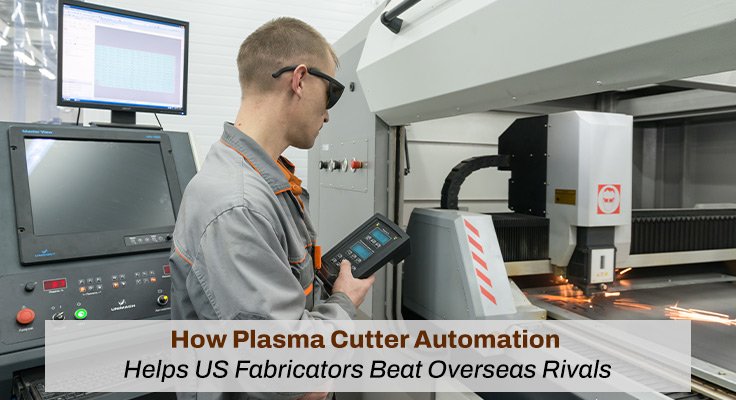
American fabrication shops have been navigating the overseas competition challenge for decades. Lower labour costs, favourable exchange rates, and large-scale production capabilities in Asia and Eastern Europe have created persistent pricing pressure that no amount of skill or craftsmanship alone can fully offset.
The fabricators that are winning, growing their businesses, holding their margins, and taking work back from overseas suppliers, aren’t doing it by competing on labour cost. They’re doing it by automating in ways that change the cost and quality equation entirely.
Plasma cutting automation is one of the most accessible and impactful places that shift is happening.
The Core Competitive Problem
Here’s the honest framing. A US fabrication shop paying competitive domestic wages cannot match the hourly labour rate of a facility in a lower-cost manufacturing region. Trying to compete by cutting labour costs is a race to the bottom that domestic fabricators cannot win.
What domestic fabricators can compete on:
- Speed and responsiveness — shorter lead times, faster design iteration, ability to respond quickly to customer changes
- Quality and precision — tighter tolerances, more consistent output, better surface quality
- Flexibility — smaller batch sizes, custom work, complex geometries that are uneconomical in high-volume offshore production
- Supply chain reliability — no ocean freight delays, no customs complications, no communication lag across time zones
Automation doesn’t eliminate the labour cost differential, but it changes the calculation by reducing the labour content of each part, increasing throughput without proportional headcount increase, and delivering the consistency that quality-sensitive customers pay a premium for.
The growing role of automation in fabrication and industrial production also aligns with priorities highlighted by the U.S. Department of Energy, which identifies smart manufacturing technologies and process optimisation as important drivers of competitiveness, productivity, and operational efficiency in modern manufacturing environments.
What Plasma Cutter Automation Actually Delivers
Modern CNC plasma cutting systems are substantially different from the manual and semi-automated plasma cutting equipment that many smaller fabricators still operate.
Cut quality and consistency. Automated systems with precise torch height control, optimised cut parameters, and current control maintain cut quality consistently across a production run in ways that manual operation cannot replicate. Part-to-part consistency is one of the specific quality advantages that domestic fabricators can offer customers who’ve experienced variability from overseas suppliers.
Throughput. An automated plasma cutting system can produce parts at rates that manual operation cannot approach. For shops taking on higher volume work, this throughput advantage changes the economics of domestic production significantly.
Nesting optimization. Software-driven nesting, the process of arranging parts on a sheet to minimise material waste, produces material utilisation rates that manual layout cannot match. In an environment where steel and aluminium costs are significant and volatile, this optimisation has a direct and meaningful impact on job margins.
Reduced operator dependency. One of the vulnerabilities of manual plasma cutting is the skill dependency it creates. Good manual plasma operators are valuable, experienced, and hard to replace. Automated systems reduce the skill requirement for production operation while concentrating skill demand at the programming and setup level, a different and more manageable dependency.
Integration with design and production workflows. Modern CNC plasma systems integrate directly with CAD/CAM software, allowing the path from customer drawing to cut parts to be compressed in time and reduced in handling. For fabricators competing on responsiveness, this integration is a genuine competitive advantage.
Choosing the Right System for Your Shop
The plasma cutting automation decision is not one-size-fits-all. The right system for a shop depends on the material range, thickness capacity, cut quality requirements, table size needs, and production volume.
The variables most worth evaluating:
- Amperage and thickness capacity — ensure the system handles the full range of materials your customers require, with headroom for the thickest sections you cut regularly
- Table size — matched to your typical sheet sizes and part dimensions, with consideration for growth in workload
- Cut quality at your typical thicknesses — the best plasma cutter for your shop is the one that delivers the quality your customers need at the thicknesses you actually cut most often
- Control system capability — the quality of the CNC controller, nesting software, and cut parameter optimisation varies significantly between systems
- Support and consumables availability — a system is only as good as the support available to keep it running
For shops doing this evaluation seriously, the guidance from Hypertherm on choosing the best plasma cutter for your specific needs is worth reading in full. The company also manufactures industrial plasma cutting systems designed for fabrication environments where cut quality, reliability, and operational efficiency matter.
The Shops That Are Getting This Right
The fabricators successfully using plasma automation to compete against overseas alternatives share certain characteristics beyond the equipment itself.
They’ve invested in the programming capability to optimise cut parameters and nesting. They maintain their equipment to the manufacturer’s specifications rather than running it until it degrades. They’ve integrated the cutting system into a coherent production workflow rather than treating it as a standalone machine. And they’ve been strategic about which customers and which work they’re targeting, focusing on the jobs where domestic advantages in quality, speed, and flexibility are valued rather than competing purely on price.
The equipment is the enabler. The strategy is what makes the automation work commercially.
Conclusion
The competitive challenge from overseas fabrication isn’t going away. But the fabricators who have invested seriously in automation, including plasma cutting automation, have found that the playing field is more level than the raw labour cost comparison suggests.
Throughput, quality consistency, material efficiency, and design-to-production speed are all advantages that automation creates and domestic fabricators can offer. The shops that are growing in this environment are the ones that have committed to building those advantages systematically.
The investment is substantial. The competitive return, for shops that execute it well, is more so.