Table of contents
- How Papa John’s Started: John Schnatter’s Story
- Papa John’s Growth in the 1990s: How It Became a Household Name
- Papa John’s Rapid Expansion: How the Franchise Model Fueled Growth (1986–2010)
- How Papa John’s Grew Around the World
- John Schnatter: The Man, the Founder, and His Net Worth
- Papa John’s Founder: Personal Life at a Glance
- What Happened to John Schnatter: The Controversy and His Departure
- Papa John’s Headquarters, Corporate Locations, and How to Reach Them
- Papa John’s and Technology: Ordering Pizza in the Digital Age
- Frequently Asked Questions
Papa John’s Pizza didn’t start in a big office; it started in a broom closet. Yes, really. It’s a classic American success story: a young man with a big dream, money from selling his car, and strong determination. From a small room in Indiana to serving customers in 50+ countries, the brand has faced many ups and downs along the way.
Here’s the story, explained simply and clearly.
How Papa John’s Started: John Schnatter’s Story
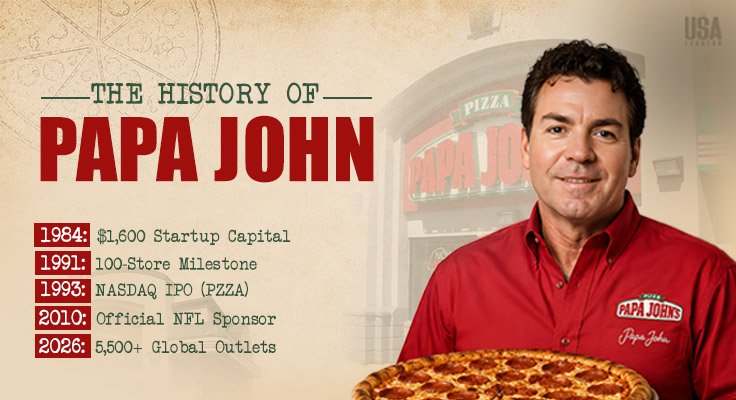
In 1984, 22-year-old John Schnatter made a bold move. He sold his 1971 Camaro Z28 for about $2,800 and used around $1,600 to buy used pizza equipment. He set everything up in a small broom-closet space behind his father’s bar, Mick’s Lounge, in Jeffersonville, Indiana.
His plan was simple: make pizza with better ingredients and keep it affordable. No fancy gimmicks were required. Just good pizza, done right. This kind of bootstrap grit is a common thread among major fast-food empires; for instance, you can see similar humble beginnings in the complete history of McDonald’s, which completely revolutionized the global restaurant framework.
By 1985, he opened his first full restaurant in the same town. A year later, he began offering franchises. The idea succeeded because it was honest, and customers could truly taste it.
According to the Papa John’s official website, the brand now has over 5,500 locations in more than 50 countries. All from a broom closet.
Is the First Papa John’s Still Open? The Jeffersonville Question
One of the most common questions about the brand is whether the first Papa John’s is still open.
The answer is clear. The original broom closet inside Mick’s Lounge is no longer a working restaurant. However, the first standalone Papa John’s store in Jeffersonville, Indiana, remains an important part of the brand’s history.
Papa John’s continues to highlight this origin story, using Jeffersonville as a key part of its identity. While you can’t buy pizza from the original location, the brand still carries the spirit of how it all began.
Papa John’s Growth in the 1990s: How It Became a Household Name
The chain celebrated the opening of its 100th store. To fund further aggressive national expansion, the brand went public on NASDAQ in 1993 exchange in 1993 under the ticker symbol PZZA. The capital raised from going public helped build regional Quality Control Centers (QCCs). These specialized logistics hubs made fresh dough and sent uniform ingredients to stores twice a week. Scaling a brand so rapidly while maintaining strict quality control echoes the blueprint pioneered by other legendary Southern chains, such as the global expansion seen in the history of KFC.
The slogan “Better Ingredients. Better Pizza.” became widely known and clearly explained what made the brand different. By the late 1990s, Papa John’s had more than 2,000 locations across the U.S. It became the third-largest pizza chain in the country, behind Pizza Hut and Domino’s, an impressive rise for a company less than ten years old.
Papa John’s Rapid Expansion: How the Franchise Model Fueled Growth (1986–2010)
After early success in Indiana, Papa John’s adopted a franchise model in 1986. This allowed rapid growth without major financial risk. Independent owners could open stores while following strict quality standards.
By 1991, the brand reached 100 locations. After going public, Papa John’s invested in Quality Control Centers (QCCs) that produced fresh dough and delivered consistent ingredients to stores twice a week, ensuring the same pizza quality nationwide.
The Core Strategy: “Better Ingredients. Better Pizza.”
The brand’s rise in the late 1990s and 2000s came down to one thing: a laser focus on quality. Papa John’s carved out a premium space between cheap delivery chains and expensive sit-down restaurants. Meanwhile, this premium value-tier positioning mirrors the exact brand strategy analyzed in the history of Starbucks, where the company focused on experience and premium product quality to dominate a crowded market. They backed it up with visible quality markers; for example, the iconic pepperoncini pepper and garlic dipping sauce in every box became signature symbols of that commitment.
What set their quality message apart was this visible commitment.
- Never Frozen Dough: Made fresh at regional hubs and delivered to stores, never frozen
- Vine-Ripened Sauce: Packed from field to can in under six hours
- 100% Real Mozzarella: No cheap fillers or blended substitutes
- Simple Menu Focus: Fewer items means better quality control on every single order
In 2010, Papa John’s signed a major deal to become the Official Pizza Sponsor of the NFL. This partnership placed the brand in front of tens of millions of sports fans every weekend, and sales responded accordingly.
How Papa John’s Grew Around the World
Papa John’s began expanding outside the U.S. in the mid-1990s, starting with Canada and Mexico. After that, the brand quickly entered key markets in Europe, the Middle East, and Asia.
Its global growth depends on master franchise partners who adjust menus and prices to local preferences while keeping Papa John’s quality standards. This approach has helped the company succeed internationally and avoid cultural mistakes made by other U.S. brands.
Key Moments in Papa John’s Global Expansion
- 1995–1999: Entered Canada, Mexico, and opened the first UK store in Grays, Essex
- Early 2000s: Expanded into Saudi Arabia, UAE, and other Middle Eastern markets through local franchise agreements
- 2010s: Accelerated growth across mainland China and the broader Asia-Pacific region
- 2020s: Focused on digital-first, smaller-footprint stores to manage rising real estate costs globally
John Schnatter: The Man, the Founder, and His Net Worth
When people thought of Papa John’s, they thought of John Schnatter. He wasn’t just the founder; he was the brand. He appeared in ads, spoke at events, and represented the company for over 30 years. His name was even printed on the pizza boxes.
Over the years, Schnatter built significant wealth through his ownership in Papa John’s and other investments. Estimates of his net worth in 2026 place it in the hundreds of millions, though the exact amount varies.
Schnatter married Annette Knight in 1987, and they have three children. While John remained in the public eye, his wife and kids mostly stayed out of the spotlight.
For many years, having “Papa John” as the face of the company helped the brand grow. Over time, however, it also became one of the company’s biggest challenges.
Papa John’s Founder: Personal Life at a Glance
| Detail | Information |
| Full Name | John Henry Schnatter |
| Born | November 22, 1961 |
| Hometown | Jeffersonville, Indiana |
| Wife | Annette Schnatter (née Knight) |
| Married | 1987 |
| Children | Three |
| Founded Papa John’s | 1984 |
| Estimated Net Worth (2026) | Several hundred million dollars (varies by source) |
| Current Status | Pursuing personal ventures and legal matters post-2018 |
What Happened to John Schnatter: The Controversy and His Departure
Problems became public in 2017 when Schnatter blamed NFL national anthem protests for hurting Papa John’s sales. The criticism was intense, and he stepped down as CEO, though he remained chairman.
In 2018, things worsened after reports said he used a racial slur on a company call. He then resigned as chairman, and the company removed his image from all marketing. Papa John’s had to quickly move away from a brand built around him.
As documented on the Papa John’s Wikipedia page, the controversy led to a full leadership shake-up and a major rebrand effort. It also became a case study in why brands should be careful about tying their entire identity to one individual.
Schnatter has publicly challenged many of these claims. He remains involved in legal disputes with the company and continues to share his perspective through interviews.
Papa John’s Headquarters, Corporate Locations, and How to Reach Them
After the 2018 upheaval, the company acted fast to recover and rebuild. In 2019, Papa John’s appointed Rob Lynch as CEO to repair franchisee relations, boost sales, and modernize the brand, and he delivered. By 2024, Todd Penegor stepped in as CEO and carried that progress forward.
Same-store sales rose, new menu items launched, digital orders increased, and the brand regained its strength.
Here are the key corporate details people often search for:
| Detail | Information |
| Papa John’s Headquarters Address | 2002 Papa John’s Blvd, Louisville, Kentucky |
| Corporate Phone Number | (877) 547-7272 (Customer Care); see papajohns.com for corporate/franchise contact |
| Founded | 1984 |
| Current CEO | Todd Penegor (as of 2024) |
| Total Global Locations | 5,500+ in 50+ countries |
| Stock Exchange | NASDAQ: PZZA |
Papa John’s corporate locations today include offices and support centers that serve both domestic and international franchise partners.
Papa John’s and Technology: Ordering Pizza in the Digital Age
Papa John’s was an early leader in online ordering, launching internet orders in the late 1990s, well before most rivals. By the time smartphones became popular, the brand was already focused on digital convenience.
Today, its mobile app, Papa Rewards program, and delivery tracking are key parts of the customer experience. During COVID-19, the company quickly added contactless delivery. While competitors raised the tech bar, Papa John’s stayed focused on quality, smart technology, and easy ordering.
Frequently Asked Questions
Who started Papa John’s Pizza?
John Schnatter founded Papa John’s in 1984 in Jeffersonville, Indiana. He sold his car to raise money and ran the first pizza operation from a broom closet in his father’s bar.
Where is Papa John’s headquarters?
The corporate headquarters is at 2002 Papa John’s Blvd, Louisville, Kentucky.
What is John Schnatter doing now?
Since leaving Papa John’s in 2018, Schnatter has been involved in legal disputes with the company and has given media interviews defending his legacy and version of events.
Is the original Papa John’s location still open?
The original broom closet inside Mick’s Lounge no longer operates as a restaurant. The first standalone store in Jeffersonville, Indiana, however, remains part of the brand’s founding heritage.
Quick Recap: What You Need to Know About Papa John’s History
- Papa John’s started in 1984 when John Schnatter sold his car and used about $1,600 to buy pizza equipment, setting up shop in a broom closet in Indiana.
- The brand became America’s third-largest pizza chain during the 1990s through smart franchising and a quality-first message.
- Schnatter was the public face of the company for over 30 years, building both a powerful brand and significant personal wealth.
- A 2018 controversy led to his resignation and a full rebrand, with new leadership first Rob Lynch, then Todd Penegor, steering a strong recovery.
- Papa John’s now operates in 50+ countries, with a growing focus on digital ordering and international franchise growth.
- The founding broom closet is gone, but the origin story remains one of the most compelling in American fast-food history.
Papa John’s Pizza has a powerful story from a small beginning to rapid success, followed by controversy and a steady comeback. It shows how big brands are built by real people making tough decisions, even when things go wrong.
Which part of the journey stands out to you most: the rise, the fall, or the comeback? Share your thoughts in the comments.