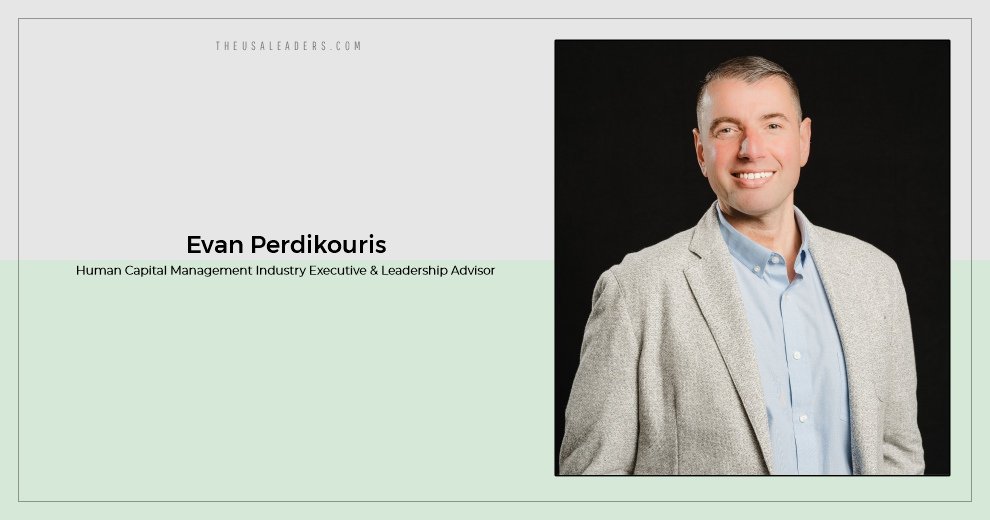
Leadership often gets reduced to numbers on a dashboard or slogans on a wall. Some leaders chase results and forget the people who produce them. Others talk about culture but struggle to create measurable progress. The tension between performance and connection is real. The strongest organizations learn how to hold both. For more than two decades, Evan Perdikouris, a seasoned Human Capital Management industry executive, has operated in that space.
His career has unfolded through leadership roles where expectations were clear, and outcomes mattered. Along the way, he formed a steady belief about what drives real performance. It begins with clarity. Teams need to understand the target and the path to reach it. It grows through strong systems that remove friction and create rhythm. It strengthens with accountability that feels firm but fair. And it lasts when trust runs deep across the organization.
Early experiences shaped this view. Evan witnessed how easily businesses can fall into the trap of short-term victories. A strong quarter can create excitement. A single big win can create noise. Yet without consistent standards and a culture that reinforces them, that energy fades. He began to see that leadership is less about chasing spikes and more about building foundations.
Over time, this approach became central to his identity as a leader. He focuses on structure without losing sight of the human element. He sets high standards but ensures people understand why those standards exist. He believes teams do their best work when they feel both challenged and supported. That balance has defined his professional journey so far. It continues to shape how he builds teams that do not simply perform for a season but grow stronger over time.
Building Nexroll on Trust and Discipline
His conviction about payroll has remained constant throughout his career. Payroll should never function as a background commodity. It holds weight. It touches every employee. It shapes how companies earn trust internally. When payroll breaks down, credibility follows.
Evan observed a consistent gap in traditional models after years of working closely with businesses across the HCM industry. Many providers processed transactions efficiently but left clients reactive. Communication felt transactional. Support arrived only when something went wrong. The structure lacked partnership.
He carried that conviction forward when he co-founded his own company, built to challenge that pattern. The organization operates as a payroll-first organization rooted in disciplined execution and steady communication. It treats payroll as an operational responsibility that demands precision and accountability.
Evan explains, “Payroll is a trust-driven, partnership-focused function. When you handle it with clarity and discipline, you create long-term recurring value instead of short-term fixes.” That belief now guides how he and his team serve partners. The focus stays on stability, consistency, and relationships that extend well beyond a single pay cycle.
Standards over Motivation
Before launching his own venture, Evan earned national recognition as a top-performing Vice President of Sales. The title reflected results, but he credits something deeper than talent or timing. He built performance through structure.
He believes standards outperform motivation. Motivation rises and falls. Standards stay steady. When expectations remain clear and consistent, teams understand what winning looks like. That clarity removes guesswork and reduces emotional swings tied to short-term results.
Coaching also plays a central role in his approach. He treats it as a daily responsibility rather than a quarterly exercise. Small corrections, regular feedback, and direct conversations create steady improvement. Over time, those habits compound.
Evan holds a firm view on culture as well. “Culture reflects what leaders tolerate,” he says. When leaders ignore small lapses, they lower the bar. When they protect standards, performance strengthens.
He also emphasizes proactive communication. Alignment does not happen by chance. It requires repetition and transparency. For Evan, high performance grows from repeatable habits supported by consistent leadership.
A Structured Approach to Human Capital Management
The HCM model Evan has championed does more than process wages and manage compliance. It builds a structured operating model designed to remove uncertainty from an area that often feels reactive.
At its core, this approach delivers payroll through proactive client communication and clearly defined service expectations. Partners know what to expect, when to expect it, and who is responsible. That structure reduces friction and builds confidence over time.
The model also creates formal partnership paths, including alignment with the ISO payments processing community. These structured channels allow partners to grow alongside the organization instead of operating as isolated vendors.
“Payroll is an outcomes business,” Evan explains. “When clients experience consistency and clarity, confidence follows.” That focus on discipline and transparency separates this approach from legacy providers. Rather than layering advice onto confusion, the goal is to build an operational rhythm that supports long-term stability and measurable performance.
Payroll as a Test of Operational Maturity
Many leaders still see payroll as a back-office task. It sits behind the scenes, runs on a schedule, and rarely enters strategic conversations. Evan challenges that view. He sees payroll as a systems test. When payroll runs cleanly, it usually signals strong upstream workflows. Time tracking works. Approvals move on schedule. Data flows without confusion. Departments communicate clearly. When payroll breaks, it often exposes deeper operational gaps.
“Payroll is a reflection of leadership alignment,” Evan says. “If your systems are disciplined, payroll becomes predictable. If they are not, the cracks show quickly.” He also urges leaders to remember the end user. The employee expects to be paid accurately and on time, every time. That trust matters. Supporting solutions such as early wage access gives employees more flexibility when needed. For Evan, payroll is not administrative overhead. It reveals how mature and aligned a business truly is.
Innovation That Reduces Friction
Innovation often gets confused with speed. New features launch. Platforms update. Companies rush to showcase what is new. Evan takes a quieter stance. For him, innovation must reduce friction, not create it. He avoids adding tools simply because they look impressive. If a new solution does not improve a partner’s daily operations, it does not belong in the system. Growth, in his view, comes from refinement rather than noise. “Innovation should accelerate maturity,” Evan says. “If it adds complexity without value, it slows trust instead of building it.”
This philosophy shapes his go-to-market strategy. The team improves onboarding so clients start with clarity. It strengthens partner enablement through thoughtful integrations. It invests in workflow automation that removes manual gaps. Clear communication loops ensure issues surface early. Each adjustment aims to preserve reliability while expanding scale. The objective is steady progress that strengthens confidence rather than introducing instability.
Creativity within Clear Standards
Building high-performing teams requires more than pressure to deliver. Evan believes structure and creativity must coexist. In the teams he has led, innovation is encouraged, but it operates within defined standards. Sales and Operations teams work with clear scorecards. Expectations remain visible. Progress is measurable. This structure creates stability, which allows creativity to surface without chaos. Team members understand the boundaries, so they feel safe testing ideas within them.
“Creativity thrives when standards are clear,” Evan says. “When people know the target and own their role, they bring better solutions forward.” Coaching remains consistent, not occasional. Regular connection points allow leaders to guide performance and refine thinking. Evan also promotes a genuine ownership culture. Teammates do not simply execute tasks. They take responsibility for outcomes.
Open communication reinforces that ownership. Every employee has a voice. Feedback flows in both directions. The goal is steady improvement that benefits employees, clients, and partners alike while preserving reliability for accounts.
Leading through Disruption
Leadership rarely gets tested when results are strong. It gets tested when uncertainty arrives without warning. Evan believes those moments reveal whether discipline holds. For him, the response to the crisis follows a simple pattern. Communicate early. Clarify the facts. Escalate when necessary. Keep stakeholders informed. Trust depends on speed and transparency, especially when pressure builds.
One of his most defining tests came when he stepped into a new Vice President of Sales role at a Fortune 500 company just days before the pandemic reshaped the market. Revenue pipelines shifted overnight. Clients faced instability. The environment demanded quick recalibration. “We had to pivot from growth conversations to survival solutions,” Evan recalls.
The team redirected its focus toward programs such as PPP support, online payment solutions, and ERC claims. Instead of retreating, they adapted. The region finished as the top-performing nationwide. Evan later received Entrepreneur of the Year recognition, a result he credits to disciplined leadership under pressure.
Measuring Impact beyond Titles
Awards and rankings often capture attention, but Evan measures success differently. He views numbers as indicators, not the full story. The deeper impact appears in the teams he has built and the leaders who have grown under his guidance. Over the years, he has focused on operational discipline as a foundation. Clear systems create predictability. Predictability builds confidence. When that structure aligns with relationship-driven growth, momentum follows naturally. Results become sustainable rather than temporary spikes.
“The real milestone is watching people step into leadership roles with confidence,” Evan says. “If the systems are strong and relationships are healthy, performance takes care of itself.” He believes sustainable growth comes from consistency. Teams that understand their standards and feel supported tend to outperform those driven only by short-term incentives. For Evan, the strongest evidence of impact is not a single achievement. It is the lasting capability built inside the organization.
Energy, Presence, and Perspective
Evan does not claim to have mastered perfect balance. He treats it as an ongoing practice rather than a finished achievement. For him, balance is less about equal hours and more about sustainable energy.
He prioritizes health as his top value. Physical strength and mental clarity allow him to lead with focus. Without that foundation, performance fades quickly. He also makes a deliberate effort to stay present with his family. Work demands attention, but presence requires intention. “I am still working on the perfect balance,” Evan says. “For me, it is about sustainable energy and being fully present where I am.”
Travel plays a key role in gaining perspective. Time away offers space for reflection and reset. Closer to home, he enjoys riding his bike along the west side of Manhattan. When traveling, he gravitates toward water sports, with jet skiing ranking as a favorite. These moments restore clarity and fuel disciplined leadership.
A Payroll-First Platform with Broader Reach
Evan sees the next chapter as an expansion of the same core belief that has guided his career. Payroll should anchor business growth, not sit quietly in the background. The long-term objective is to build a payroll-first platform that supports companies while creating reliable, recurring revenue opportunities for partners.
His vision moves beyond traditional service layers and embeds human capital management directly into software ecosystems. By integrating payroll and HCM capabilities into systems such as POS platforms, the goal is to create a seamless experience for both clients and partners.
“We are building toward full integration,” Evan says. “When payroll lives inside the systems businesses already use, friction disappears and value compounds.” This direction challenges conventional HCM models. Instead of forcing businesses to manage disconnected tools, the platform will unify operations within familiar workflows. The goal is simple but ambitious: strengthen growth while preserving clarity, discipline, and trust at scale.
Leadership as Daily Behavior
As the conversation closes, Evan Perdikouris returns to a principle that has shaped every stage of his career. He does not define leadership by title, authority, or visibility. He defines it by behavior. Titles can open doors, but behavior determines whether people follow. Strong systems create structure. Accountability keeps standards intact. Treating people with respect builds trust that no metric alone can secure. When these elements work together, performance becomes steady rather than fragile.
“Leadership is behavior, not title,” Evan says. “When you combine strong systems with accountability and treat people well, performance lasts.” He encourages readers to look inward before looking outward. Evaluate the standards you protect. Examine the culture you tolerate. Strengthen communication before chasing scale. In his view, sustainable growth begins with disciplined habits practiced daily. Over time, those habits shape teams, organizations, and results that endure beyond any single season.
Quotes
“Leadership is behavior, not title.”
“Strong systems, accountability, and treating people well create lasting performance.”
Also Read: The 10 Transformative Payroll & Leadership Advisors to Watch in 2026