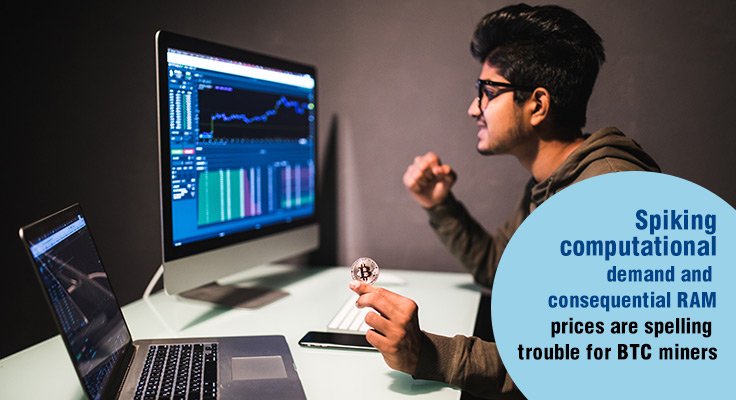
The world is facing a problem that’s only going to escalate over time – a RAM shortage, about which you’re probably aware if you’ve spent some time online. So, yes, if you didn’t get the time to sell your old laptop, that’s actually your win. It’s probably going to cost increasingly more as the scarcity intensifies and the RAM prices continue spiking.
The same can’t be said about Bitcoin miners, though. They’re not only pressured by the weak Bitcoin prices and the general rising operational costs, but also by the fact that finding affordable memory and GPUs is slowly becoming a thing of the past. Experts label this period as the worst of all times in terms of revenue-making for miners. But this battle is being fought quietly behind the screens of crypto enthusiasts, who are generally more focused on speculating and learning where prices may head, glued to price indicators and sentiment trackers like the fear and greed index. All these factors can impact Bitcoin’s price, but indirectly and not straightaway. Rising RAM and GPU prices, plus competition from AI companies, increase miners’ operating costs, making this activity unprofitable for many, who may choose to shut down rigs to prevent losses from adding up, and that can reduce the network’s hash rate growth. Lower profitability in mining can make Bitcoin slightly less attractive to investors, sometimes putting downward pressure on its price. However, many miners are holding their positions, finding innovative solutions to keep their rigs running and continue profiting from Bitcoin’s prevalence.
They’re optimizing energy use, improving cooling systems, upgrading software to get the most out of limited hardware, and even pivoting to AI infrastructure, adding new revenue streams – leveraging the current power and the expertise built in time, which didn’t come cheap at all. A leaner, more efficient mining ecosystem could support the security of the Bitcoin network while reducing excess selling pressure. The market is currently absorbing the shocks triggered by past market events, like the selloffs prompted in bulk over the past months. But Bitcoin’s fundamentals and growing adoption remain favorable in its long-term evaluation.
AI is taking computing demand to historic peaks
Jensen Huang is the current CEO of Nvidia, one of the most influential tech and AI computing companies that’s famous for inventing the GPU (Graphics Processing Unit) in 1999. And he made a huge public statement during CES 2026, stressing that AI computing requests are flourishing, and that’s impacting available memory. AI eats up a lot of RAM power, with the scale of AI models growing ten times larger each year, and computing demand ballooning. The tech titan approximates the amount of money that’ll be invested in AI infrastructure over the following five years to range between $3TN and $4TN – a stark difference compared to the billions of dollars it has been investing to date.
According to the news, the company plans to direct up to $100BN only to OpenAI as part of a collaboration looking to create 10 gigawatts of AI data centers. And last year, the company made public a $5BN investment, this time in Intel; a move intended at developing custom AI chips and infrastructure.
All this boom in AI usage and memory depletion traces back to when AI models outgrew their original functionality and began solving increasingly complex problems. AI is being leveraged in increasingly more industries, from legal to medical systems. And right now, Nvidia is working on a cutting-edge new platform – Rubin GPU – as part of the company’s freshest developments. These systems can reportedly use as much as 1,400 watts per GPU. This is extremely high compared to consumer GPUs, which can consume between 57 watts and 600+ watts, speaking volumes about the enormous computing demand for AI capabilities today.
The growth of AI computing has prompted two trends: increasing processing power demand and quickly evolving AI capacities – a dual development that’s changing priorities in semiconductor manufacturing and generating ripple effects across more tech segments, crypto included.
AI companies would pay anything for memory
RAM valuations are hitting historic peaks. Cameron Crandall, Kingston Datacenter SSD Business’s manager, said prices for NAND wafers rose by 246% compared to the first quarter of last year, with 70% of the increase registered over only two months. Other DDR5 RAM modules jumped to more than twice their previous cost. AI jobs could account for 20% of the entire DRAM supply worldwide this year.
SK Hynix and Samsung remain the main significant providers of DRAM for consumers, after Micron Technology stopped supplying memory to consumers in an attempt to serve the industry’s largest buyers, like AI companies. Companies are expanding chip factories, but analysts don’t see them producing meaningful output until 2027 in the best-case scenario.
AI companies are closing long-term contracts with chip suppliers. Reportedly, they’d buy memory regardless of the selling price, which gives them an extraordinary advantage over smaller, non-niche consumers.
The RAM emergency hits Bitcoin miners hard
The rising RAM prices see Bitcoin miners particularly struggling to finance their operations. Bitcoin’s computational throughput has reached 1.032 ZH/s, whereas the mining difficulty, representing the number of attempts needed to find a valid block, has surged to $148.26TN, disclosing how fiercely competitive the mining landscape is today. Profitability, on the other hand, has dropped significantly, even with all this competition. Daily block reward revenue dropped by 32% YOY. The dominant position of Nvidia for GPU provision for both crypto mining and AI jobs directly affects activity. The needs that the company has satisfied so far in other applications will no longer be met for the present being as the company now prioritizes its agreements with AI data centers.
The battle unfolds between miners who can adapt and those who trail.
Even so, many mining companies are now looking to transform adversity into opportunity, shifting their operations to profit from the AI craze and closing contracts with companies providing AI computing power. According to JPMorgan, Bitcoin miners have around nine months left to establish contracts with AI firms and hyperscalers in the U.S. This urgency is also reflective of how expensive branching into AI services is.
The upcoming one and a half years will separate the miners who can adapt to this shift and those who’ll fall behind in the face of AI’s expanding grip.