There is a distance inside most hospital systems that nobody puts on a map. It exists between the moment a clinician recognizes a problem and the moment that problem actually gets solved. A physician sees an inefficiency in how data flows between departments. A nurse notices a gap in how patients are monitored at home. A therapist encounters a barrier so persistent it begins to feel immovable. The seeing happens constantly, instinctively, almost reflexively. What almost never happens naturally is solving. Tim Argo has spent his career standing in that gap.
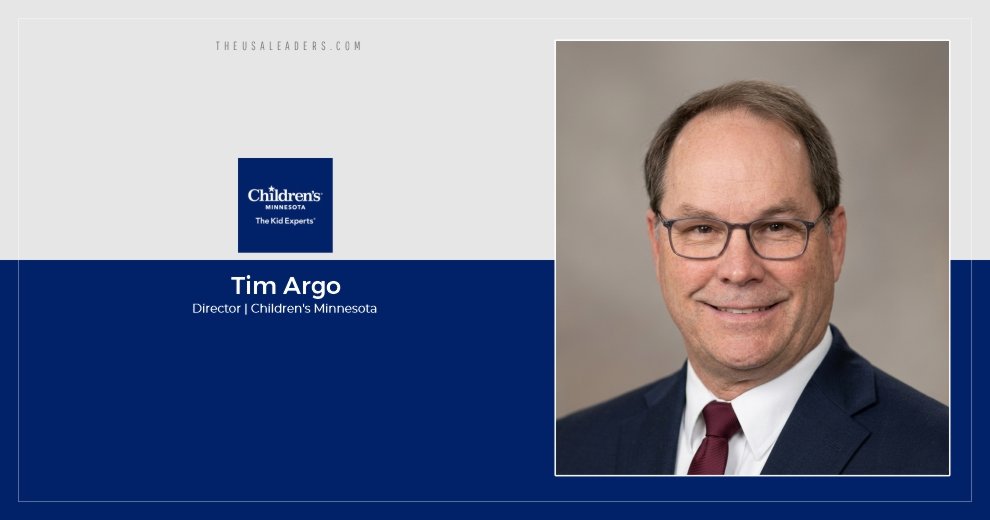
He is a healthcare innovation leader at Children’s Minnesota, one of the country’s most respected pediatric health systems, and his work is built on a rare combination of capabilities: the legal fluency to negotiate licensing agreements, the strategic vision to build lasting partnerships, and the human sensitivity to understand why any of it matters in the first place.
“I am passionate about helping patients through bringing innovative technology into the clinic and to the market,” Tim has said, and the sentence’s directness is not a simplification. It is a philosophy.
The Craft of Commercialization
In the world of healthcare innovation, the word “commercialization” can sound cold, as though it belongs more to a quarterly earnings call than to a conversation about patient care. Tim uses it differently. For him, commercialization is the mechanism through which a good idea becomes a real tool, through which a clinician’s insight becomes something a patient can actually benefit from.
His expertise is specifically in technology licensing, partnerships, and innovation, and over the course of his career, he has negotiated numerous licenses, collaborations, and partnerships that have moved technologies from conception toward clinical deployment.
Each of these negotiations is its own complex negotiation. Questions of intellectual property, exclusivity, royalties, and deployment pathways do not resolve themselves. They require someone who understands the science well enough to speak credibly to researchers, the business well enough to speak credibly to executives, and the regulatory terrain well enough to know where the landmines are buried.
Tim is that person.
His background as an experienced medical industry professional with specific expertise in technology licensing means that he brings to every partnership table a depth of knowledge that goes beyond general business acumen. He understands the particular demands of moving medical innovation through a system built simultaneously for rigor and urgency.
Digital Health and the New Terrain
The emergence of digital health as a transformative force in medicine has created extraordinary opportunity and, simultaneously, extraordinary complexity. Remote monitoring tools, telehealth platforms, AI-assisted diagnostics, patient engagement systems: these technologies carry enormous promise, but they do not arrive in clinical settings by accident.
Someone has to evaluate them, negotiate their entry, build the partnerships that sustain their deployment, and ensure that they meet the particular standards of the institutions where they will be used.
At Children’s Minnesota, those standards are especially high. The patients are children. Every new tool that enters the clinical environment carries with it a weight that is difficult to overstate, because the families who bring their children to Children’s Minnesota are trusting the institution with something they cannot afford to lose.
Tim works within that weight every day. It does not paralyze him. It orients him.
His work in clinical commercialization and digital health reflects an understanding that technology in pediatric care is not simply about efficiency. It is about creating systems that work reliably, compassionately, and safely in environments where the stakes are always personal.
The Work of New Ventures
Beyond his licensing and partnership work, Tim is also engaged in new ventures, supporting the development of companies and solutions working to reimagine what healthcare can look like. This entrepreneurial dimension of his work adds a different kind of energy and perspective to what he does.
Health systems and startups do not always speak the same language. A startup’s urgency, its need to iterate quickly, to raise capital, to prove itself before the runway runs out, can feel alien to institutions built around a different kind of clock. And the caution of a health system, its commitment to safety and thoroughness, can feel like a wall rather than a standard.
Tim serves as an advisor to both health systems and startups, a dual positioning that requires him to be fluent in both worlds without losing sight of either. He knows what a health system needs to see before it will commit to a new partnership. He knows what a startup needs to demonstrate before a clinical environment will open its doors.
He is, in the truest sense of the word, a translator, helping different ecosystems understand each other well enough to do something neither could do alone.
Why the Patient Is Always the Point
There is a version of innovation work in healthcare that loses the patient somewhere in the middle of the process, buried under term sheets, regulatory timelines, and IP portfolios. Tim has refused that version.
Every negotiation, every partnership, every digital health solution brought into clinical practice represents a bet on someone’s better outcome. A faster diagnosis. A more precise treatment. A more connected, more responsive experience of care.
“I am passionate about helping patients through bringing innovative technology into the clinic and to the market,” Tim has said more than once, and the repetition does not feel like a talking point. It feels like a reminder he gives himself as much as anyone else.
At Children’s Minnesota, that reminder takes on particular meaning. The children who come through those doors, and the families who come with them, are not abstract beneficiaries of innovation. They are the reason the work exists.
Tim Argo knows that. It shows in how he works, in what he prioritizes, and in the kind of leader he has chosen to be: steady, expert, and always pointed toward the person at the end of the care. Innovation is only as meaningful as its destination. Tim has always known exactly where he is headed.
Also Read – Visionary Leaders Driving Healthcare Innovation, Leadership & Performance in 2026