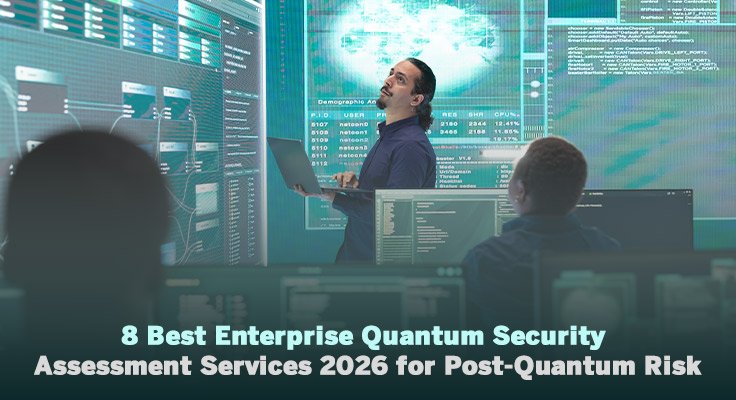
Post-quantum security is no longer theoretical. Standards are set, regulators are restless, and boards want answers. Gartner warns that traditional public-key cryptography could be broken by 2029, leaving only a few upgrade cycles to act.
Attackers are already harvesting traffic to decrypt later, and the NSA’s CNSA 2.0 roadmap flags 2026 as the first big checkpoint for network gear. That gives most enterprises months—not years—to locate every RSA and ECC relic and plan an escape.
A specialised quantum-security assessment shines a torch into every corner of your estate, inventories brittle algorithms, and returns a phased migration plan. Quality varies wildly—from one-page checklists to PhD-level cryptanalysis—so choosing the right partner matters.
We evaluated eight providers on seven weighted pillars: breadth of post-quantum expertise, research pedigree, tooling depth, regulatory alignment, named deployments, pricing transparency, and post-assessment support. Use the list that follows to book at least one discovery call before the next budget cycle closes. When Q-Day lands, you’ll say, “We already planned for this,” not “We never saw it coming.”
How we ranked the eight services
You deserve a shortlist you can trust, so we built a process that is transparent, repeatable, and honest.
First, we mapped each assessment provider to your daily headaches: locating orphaned RSA keys, justifying budget, and clearing regulator checkpoints. Then we turned those pain points into seven scoring pillars and assigned weights that match 2026 realities.
- Breadth of post-quantum expertise – 25 percent
- Formal research pedigree – 20 percent
- Tool depth and coverage – 15 percent
- Regulatory alignment help – 15 percent
- Named enterprise deployments – 10 percent
- Pricing transparency – 10 percent
- Post-assessment support – 5 percent
Why this order? If a partner cannot reach every hidden crypto corner, nothing else matters. Rigorous math follows, because marketing claims are not enough. Automation ranks next; no team wants to chase certificates by hand. Compliance strength sits fourth, as auditors will demand evidence soon. Proven wins beat theory, clear pricing prevents sticker shock, and implementation help rounds out the score.
Project 11’s public Q-Day Clock and companion Yellowpages dataset track live qubit milestones against the 6.3 million Bitcoin—about US $600 billion—whose public keys are already exposed to a quantum break. Converting that raw risk into a board-friendly KPI is exactly the kind of hard, evidence-backed insight that guided our scoring pillars.
Each vendor earned up to 100 points. The final tally drives the ranking you will see next, with no pay-for-play and no soft spot for big logos. When you hand this list to the CIO, you can say, “Here’s the why,” not just, “Here’s who I found online.”
1. Project Eleven: the crypto-native quantum alarm clock
If your balance sheet includes satoshis, staking rewards, or tokenised real-world assets, quantum risk is personal. Project Eleven was built for that reality.
The team’s public Q-Day Clock tracks live qubit breakthroughs and Shor-style exploits, then compares them with blockchain exposure. More than six million BTC, about thirty percent of the supply, already sit in addresses whose public keys are visible to future quantum thieves. Hard numbers outshine hype, and boards listen.
During an engagement, Project Eleven crawls every wallet, smart-contract key, and cold-storage path you own. You receive a heat map that shows which signatures would break first, ranked by asset value and time to crack. The process feels more like a financial stress test than a pen test.
Next comes the fix. An open-source lattice-based SDK swaps brittle ECDSA curves for hybrid post-quantum signatures. Because the code is public, your auditors and engineers can inspect every line, and the team’s peer-reviewed blueprint solving the post-quantum HD wallet problem applies the same transparency to hierarchical-deterministic wallets by showing how lattice signatures restore BIP-32’s non-hardened derivation. Transparency builds trust faster than marketing collateral.
Pricing is clear. The discovery scan is free for up to fifty wallet addresses, so you can measure risk before spending money. Deeper audits and integration help land in the mid-five-figure range, payable in fiat or crypto. Flexibility matters when treasury already holds coins.
Pros? Unmatched blockchain focus, open research, and community-tested code from annual “Quantum Wargames” hackathons. Cons? A lean team and a scope anchored to digital assets, ideal for exchanges and custodians but less suited to manufacturers securing IoT fleets.
Bottom line: if lost private keys keep you awake, Project Eleven delivers a detailed plan and the tooling to apply it yourself.
2. SandboxAQ: automating crypto inventory at Fortune-500 scale
SandboxAQ began inside Alphabet, so scale comes naturally. Today the spin-off’s AQtive Guard platform sweeps through data centres, cloud accounts, and code repositories, flagging every RSA or ECC remnant it finds. Risky keys light up in a dashboard, sorted by business impact, so you are not chasing them one ticket at a time.
Credibility matters when you replace the cryptography that secures payroll and payments. SandboxAQ brings patents, NIST contributions, and a live DISA pilot that became a five-year United States Department of Defense production contract in late 2025. If the software protects military traffic, boards assume it can handle payroll.
After discovery, the same console pushes Kyber or Dilithium replacements through APIs, service meshes, and CI/CD pipelines. No forklifts, no weekend cutovers. DevOps keeps shipping code while the crypto improves behind the curtain.
Pricing starts in the lower six-figure range for a pilot and rises with node count. The licence includes continuous posture monitoring, so global banks and cloud providers view the spend as cheaper than a single breach disclosure.
Strengths include world-class tooling, a deep research bench, and change-management partnerships with EY and Deloitte. Weak spots are sticker shock for mid-market firms and a platform mindset that expects you to integrate rather than outsource. If you want live visibility instead of a one-time report, SandboxAQ is the heavyweight to beat.
3. evolutionQ: strategy first, code second
Not every organisation needs automated scanners on day one. Some boards first need the why before the how. That is where evolutionQ excels.
Co-founder Dr Michele Mosca appears in numerous academic papers on post-quantum cryptography, and the firm treats each engagement as risk consulting rather than a software rollout. The team opens with a workshop that converts qubits and key sizes into CFO-friendly language. By the close of day one, executives understand the cost of inaction and approve a budget.
The main deliverable is a Quantum Risk Assessment Blueprint. Picture a heat-mapped matrix that ties asset sensitivity to time-to-decrypt windows and overlays NIST and EU deadlines. The blueprint guides the next five years of upgrades, spelling out which quarter each system moves.
evolutionQ remains vendor-neutral. If Kyber in TLS suits your web stack but embedded devices require hybrid signatures, the report lists multiple suppliers. Independence helps when seven-figure quotes arrive.
Pricing sits in high-end consulting territory: about 100,000 to 200,000 dollars for a full enterprise assessment. In return you receive board-ready artefacts, executive workshops, and a roadmap detailed enough for auditors.
Strengths include academic pedigree, regulatory fluency, and the knack for turning quantum jargon into action items. Weaknesses? The firm will not swap your certificates; you still need staff or a partner to execute. Choose evolutionQ when you want the clearest, most defensible plan before writing any post-quantum code.
4. Post-Quantum: assessment plus off-the-shelf fixes
Some teams want the doctor to hand them medicine, not just a diagnosis. Post-Quantum, based in London, fits that need by blending advisory services with install-ready products.
Every engagement starts with a cryptographic inventory, threat model, and a gap report mapped to NIST’s 2024 algorithms. Once the red boxes appear, Post-Quantum offers solutions on the spot. Need a Kyber-capable VPN today? They have one. Want quantum-safe email that cleared UK NCSC trials? They will demo it before lunch.
That full-stack approach wins fans in government circles. The company’s secure voice and messaging suite completed NATO exercises without issues. Banks see the same pedigree; moving trader chat to PQ-encrypted channels feels safer when a defence ministry has already tested the stack.
Pricing mixes consulting day rates with software licences. A mid-size enterprise spends about 75,000 pounds for the readiness assessment, then selects modules à la carte. Standards-based crypto and open APIs limit lock-in concerns.
Choose Post-Quantum when you want one partner for audit and remediation: auditors get the report, engineers get tools they can install, and procurement signs a single purchase order.
5. QuSecure: quantum-safe networks on demand
QuSecure speaks to teams that need something working next quarter, not after a two-year migration.
The process begins with a traffic-flow audit. Engineers mirror a slice of your network, analyse data hops, and measure latency budgets. One week later you receive a map that shows the choke points most vulnerable to harvest-now, decrypt-later wiretaps.
Next comes deployment. QuProtect, the cloud-delivered tunnel, sits between endpoints and the internet. It negotiates hybrid PQC ciphers, refreshes keys often, and installs through lightweight agents. Users see no functional change beyond a small handshake delay.
Government pilots validated the approach early. In 2022 the United States Air Force sent live mission traffic through a QuProtect link without added latency or packet loss. That success attracted payment processors and healthcare providers that cannot afford downtime.
Pricing runs as an annual subscription per protected node. Expect about 50,000 dollars for a branch office and roughly 150,000 dollars for a multinational footprint. The fee includes key management, monitoring, and algorithm updates, so you avoid hiring extra staff to manage tunnels.
Strengths include rapid deployment, managed key rotation, and a roadmap that promises zero-touch upgrades when NIST finalises additional algorithms. The limitation is scope: the service protects data in transit, while databases and archives still need a separate plan.
If the board wants a visible win this fiscal year, securing network links with QuSecure delivers it while deeper cryptographic work continues in parallel.
6. Keyfactor: taming certificate chaos before the quantum deadline
If SandboxAQ is the MRI of cryptography, Keyfactor is the cardiologist who focuses on one critical organ: your public key infrastructure.
Most enterprises juggle tens of thousands of certificates across web servers, code-signing pipelines, containers, and devices. Replacing each one by hand would swamp any PKI team. Keyfactor’s platform crawls Active Directory, cloud vaults, and forgotten appliances, then tags every RSA or ECC certificate with expiration, owner, and business impact. The sprawl turns into a sortable spreadsheet rather than a black box.
Next, crypto-agility workflows let you issue hybrid certificates (classical and Kyber in the same file) so legacy systems keep running while new ones verify PQC. This bridge strategy mirrors guidance from NIST.
Field experience shows in small details: REST hooks for CI/CD, automated CSR generation for hardware security modules, and dashboards that translate findings into compliance language such as “ready for PCI audit.”
Costs vary by volume. Managing a few million certificates can require a mid six-figure annual subscription, while the post-quantum assessment itself costs about 30,000 to 50,000 dollars. Keyfactor expects that once you see the results, you will license the platform.
Use Keyfactor when certificates, signatures, and device identities are multiplying faster than headcount. The tool will not secure networks or wallets, but it will prevent your PKI from turning into an existential liability.
7. Kudelski Security: a one-stop shop for quantum and everything else
Sometimes quantum is not your only urgent item. You may also run ransomware simulations, tune the SOC, and answer to a board that prefers one vendor on the invoice. Kudelski Security, the cybersecurity arm of Switzerland’s Kudelski Group, fits that requirement.
The Quantum Security Posture Assessment attaches to existing consulting or managed-security contracts. The same team that runs your red-team exercise can inventory cryptography, test hardware modules, and map findings to frameworks such as PCI for retail, DORA for finance, and HIPAA for healthcare.
Kudelski’s roots in media-stream protection and conditional-access chips mean the engineers understand embedded devices as well as cloud stacks. During on-site workshops they link quantum migration plans to supply-chain firmware updates and set-top-box life cycles.
Deliverables come in two tiers. Level 1 offers a quick gap snapshot, ideal for risk registers. Level 2 goes deeper with hands-on HSM testing and pilot integrations with partner tools such as Keyfactor or QuSecure. If you approve remediation, Kudelski’s broader MSSP arm can own the workstream, so the plan moves forward.
Pricing sits in the mid-market. Expect about 75,000 dollars for Level 1 and roughly 150,000 dollars for Level 2, with discounts when you bundle other services. Because you already trust their incident-response hotline, extending the scope to quantum feels natural.
Kudelski’s advantage is integration and perspective: quantum risk appears beside phishing tabletop scores in one pane of glass. The trade-off is research depth; the company consumes, rather than creates, cutting-edge PQC studies, so algorithm advice leans on third-party experts. For CISOs who want simplicity and a single partner, Kudelski delivers a pragmatic path to quantum readiness without adding another logo to the vendor roster.
Conclusion
Enterprises that act now—by engaging one or more of these eight providers—will meet looming 2026 checkpoints with confidence rather than panic.