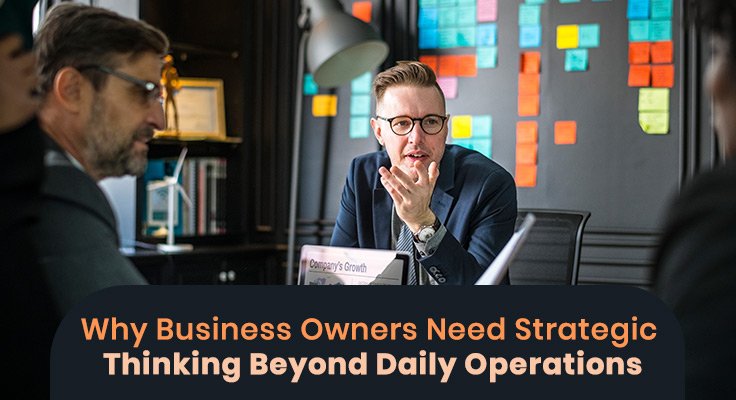
Most business owners are not only proficient in running a business but are experts in it. For one, they are familiar with the operations; they know the customers; they are able to manage the team and lastly, they never stop the flow of things. The problem is that running a business and growing a business are two different things and the majority of owners spend most of their time on the first one while they are puzzled as to why the second one is not being done.
It is difficult to exaggerate how daily operations have a magnetic pull. One day is filled with emergencies, customer inquiries, personnel problems, and operational decisions that are so pressing that you cannot help but pay attention to them. However, strategic thinking will not give a visible result on the day of thinking. It is soft, it disturbs you, and it is very easy to put off. Which indeed is the reason why business owners don’t do it enough.
The Difference Between Working In and Working On the Business
The very fact that the dividing line between working in the business and working on the business has been recognized so long that many owners could practically recite it from memory already. And yet, very few can genuinely admit to having implemented it. Working in the business essentially is carrying out the daily tasks of customer service, team leadership, and client relationship management. Contrarily, working on the business means taking a critical look at the system’s strategy positioning and direction that will help decide if the business will be even stronger in three years than it is now.
Both are important. You can’t just shut down the operations. However, if the ratio is very much tipped heavily towards the day-to-day execution with almost no time designated for strategic thinking, the business will begin to drift. It will be more of a reactor rather than a director. It will go after the demand that comes along rather than the one it should be actively creating.
Why Urgency Crowds Out Strategy
It turns out that the reason why strategic thinking is often overlooked is not due to laziness or lack of ambition. The thing is that daily operations produce such a stream of urgent demands that a person running one hardly has a moment to spare for other things. Inbox, Slack messages, client escalation, team member who needs guidance – these all seem more urgent than locking yourself in a room and thinking about where the company should be in two years.
The point is even supported by neuroscience. The brain is structured to give higher priority to immediate threats and rewards rather than long-term planning. Operational issues set off an instant reaction system in the brain whereas strategic thinking does not. So business people who do not make an effort to reserve time for strategy work will find that it never gets done – not because they don’t appreciate it, but the urgent always wins over the important when they both need the same free time that is unstructured.
What Strategic Thinking Actually Looks Like in Practice
Business literature often mystifies strategic thinking to the point where it sounds so abstract that it is practically inaccessible. The reality of it however, is simply a few specific questions regularly asked and answered in a brutally honest way, then followed up clearly. No use of retreat, a consultant, or a whiteboard session is needed. It only demands a commitment of time and honest thinking.
The questions themselves are quite simple. Where is the business making money from a real point of view as opposed to spending energy for minimal returns? Which customers, products, or services are bringing most value, and which ones are quietly depleting resources? What circumstances would have to be in place for the business to double in the next three years, and what are the current obstacles to that? These are not tough questions. They are just ones that day-to-day operations do not let you ask.
This is an area where outside perspective consistently proves its worth. Business coaches and strategic advisors who work directly with founders people like Mark Evans, whose work centers on helping entrepreneurs build businesses with more clarity and strategic intention often find that the answers to these questions are already inside the business. The owner knows what’s not working. They just haven’t had the structured space to surface it, examine it honestly, and decide what to do about it.
Building Strategic Capacity Into the Business Structure
Of course, individual founders must think strategically for business growth, but that alone is not sufficient. It is those companies that successfully grow strategically that incorporate this ability into their very structure, thereby making strategy less dependent on the founder’s clear vision, which hardly ever happens.
This involves setting up forums for strategy discussions within the company. Regular leadership meetings should be held that not only share operational updates but also look at performance trends, market positioning and resource allocation. Quarterly reviews can be conducted to very openly state whether the company is on the right path or not, and what changes are necessary. Annual planning sessions should be done to bring about a real change in direction rather than just continuing with last year’s figures.
Besides that, you should also consider getting and training people who can look beyond their job description. If only the founder of a company thinks strategically, then such a company will always be limited by how much time the founder has. When the company expands, the culture of strategic thinking should penetrate the leadership team, the decision-making processes at all levels, and the entire organization as well.
The Compounding Cost of Strategic Neglect
Missing out on strategic thinking for even a week is just about the same as not taking one step in a journey. When you miss it for a whole year, it’s like the business being on autopilot for twelve months while the market changed, competitors made moves, and internally the major shifts without a deliberate course correction were happening. If you miss it for three years then the gap between the business’s current position and its potential is almost impossible to reconcile.
Most business owners do not recognize this as the cost of compounding until it becomes quite large. It is as if strategic neglect is a silent killer. The business continues to operate, revenue keeps flowing, and the team is consistently present. However, the trajectory is quietly getting worse. Market share is slowly being reduced. The business model that was performing really well two years ago gradually became less and less relevant until finally it is completely outdated. By the time the issue shows up in the numbers, the strategic effort needed to fix it is very large.