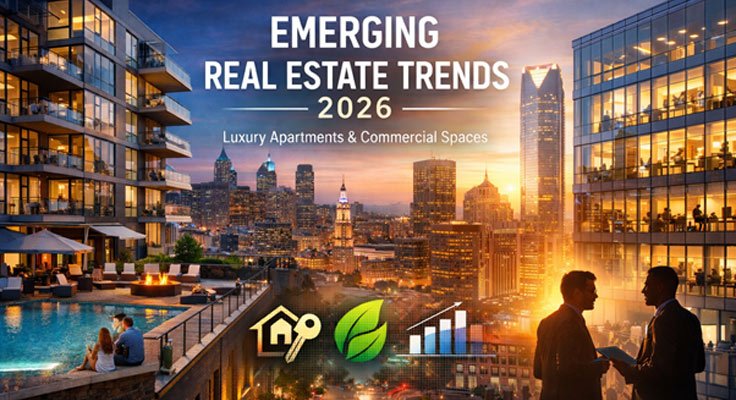
The U.S. real estate sector is navigating one of its most complex transitions in decades. According to recent industry reports, more than 60% of U.S. renters now prioritize quality of living, amenities, and overall experience over sheer square footage, while commercial property owners continue to adjust to long-term structural shifts driven by hybrid work, operational efficiency, and evolving tenant expectations. At the same time, investment activity is increasingly favoring assets that demonstrate resilience, flexibility, and sustainable performance, rather than short-term yield alone.
These changes are reshaping both ends of the real estate spectrum. Luxury residential rentals are evolving to meet lifestyle-driven demand, while commercial properties are redefining their role in a post-pandemic economy. Although these segments serve different users, they are increasingly influenced by the same forces – experience-led design, technology integration, and strategic asset management.
As 2026 approaches, the future of real estate will be defined not by whether a property is residential or commercial, but by how effectively it aligns with human behavior, operational intelligence, and long-term market adaptability.
Experience Is Becoming the New Measure of Value
In established urban rental markets like Philadelphia, tenant expectations have evolved significantly. Renters are no longer evaluating properties solely based on location; instead, they are looking for environments that support wellness, productivity, and community living. This shift is particularly visible in luxury apartment buildings in Philadelphia, where amenities such as shared workspaces, fitness-focused design, smart-home features, and thoughtfully designed common areas now play a central role in perceived value.
The same experience-driven mindset influences how people choose to rent apartments in Philadelphia, with growing demand for properties that offer convenience, flexibility, and a cohesive lifestyle rather than just premium interiors.
Commercial real estate is experiencing a parallel evolution. Office buildings and mixed-use developments are being reimagined to enhance comfort, collaboration, and engagement. Spaces designed around tenant experience are proving more resilient in attracting and retaining occupants navigating new work models.
Across both residential and commercial sectors, experience has become a defining factor in occupancy, retention, and long-term asset performance.
Flexibility Is Redefining How Space Is Used
Flexibility has emerged as one of the most influential principles shaping modern real estate strategy.
On the residential side, adaptable layouts and flexible living environments are responding to renters whose homes now serve multiple purposes from remote work to wellness and leisure. Urban properties that allow residents to seamlessly shift between these needs are gaining a competitive advantage.
In commercial markets such as Oklahoma City, flexibility is reshaping how businesses approach real estate decisions. Organizations are seeking spaces that allow for scalable operations, efficient layouts, and long-term adaptability. This demand is increasingly shaping OKC Commercial Real Estate, where flexible office configurations and mixed-use developments align closely with evolving tenant needs.
As these trends continue, properties built around adaptability will be better positioned to perform through economic cycles and market shifts.
Technology Is Powering Smarter, More Efficient Properties
Technology has become a foundational component of effective property management.
In residential properties, digital platforms enable seamless communication, faster service resolution, and improved resident satisfaction. Smart building systems also provide insights into energy usage, space efficiency, and operational performance, allowing property managers to make data-driven decisions.
Commercial real estate is leveraging similar tools to optimize asset performance and reduce operational costs. Predictive maintenance, centralized management platforms, and real-time reporting are increasingly shaping Oklahoma City Commercial Real Estate, where efficiency and long-term tenant retention are critical priorities.
As competition intensifies, technology-enabled operations will continue to separate forward-thinking properties from those relying on traditional management models.
Sustainability Has Shifted from Preference to Priority
Sustainability is no longer viewed as a value-added feature; it has become a core business requirement.
Luxury residential developments are increasingly integrating energy-efficient systems, sustainable materials, and long-term resource management practices. These initiatives not only align with renter expectations but also contribute to reduced operating costs and stronger asset durability.
Commercial properties are following a similar path. Environmental responsibility now plays a significant role in investment decisions, tenant selection, and regulatory readiness. In growing business hubs like Oklahoma City, sustainability considerations are becoming a defining element of OKC Commercial Real Estate strategy.
As environmental standards continue to evolve, sustainable design and operations will remain central to long-term property performance.
Local Market Intelligence Remains a Competitive Advantage
Despite the influence of national trends, real estate performance is ultimately shaped by local dynamics.
Residential demand varies by neighborhood, demographic shifts, and lifestyle preferences. In cities such as Philadelphia, understanding renter behavior is essential for properties designed to serve those looking to rent apartments in Philadelphia while maintaining long-term occupancy stability.
Similarly, commercial performance depends heavily on regional economic conditions, workforce trends, and industry concentration. In Oklahoma City Commercial Real Estate, localized expertise allows property leaders to anticipate demand shifts and align assets with tenant expectations more effectively.
The strongest strategies combine national insight with deep local market knowledge.
The Strategic Shift Defining the Next Era of Real Estate
The convergence of trends across luxury residential and commercial real estate reflects a broader transformation in how property value is created. Real estate is no longer defined solely by asset type or geography, but by how effectively it supports people, performance, and long-term adaptability.
As 2026 approaches, the most successful real estate leaders will be those who move beyond traditional models. Embracing flexible design, leveraging technology for smarter decision-making, and committing to sustainable, experience-driven environments will separate resilient portfolios from reactive ones. Whether operating luxury apartment buildings in Philadelphia or managing assets within Oklahoma City Commercial Real Estate, the future belongs to organizations that treat real estate not just as space but as a strategic platform for growth.