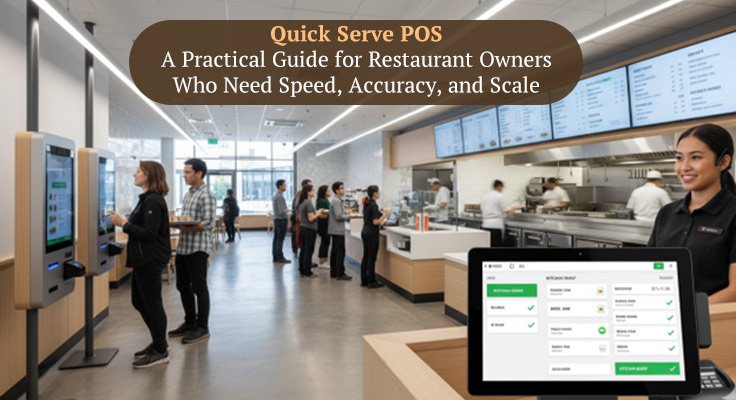
Running a restaurant today is a race against time. Customers expect faster service, shorter lines, and frictionless payments, and that’s exactly where a quick serve POS becomes critical. Unlike traditional POS systems built for slower, table-service environments, a quick serve POS is designed to handle high order volumes, peak-hour rushes, and rapid customer turnover without compromising accuracy or revenue.
For restaurant owners operating in fast-paced formats like QSRs, cafés, food courts, and fast-casual concepts, choosing the right restaurant POS system is no longer just an operational decision; it’s a growth decision.
What Is a Quick Serve POS?
A quick serve restaurant POS is a point-of-sale system specifically designed for quick service and fast-casual restaurants where speed and efficiency matter more than table management. These systems prioritize fast order entry, streamlined payments, kitchen coordination, and real-time insights.
Unlike traditional restaurant POS systems that focus on courses, seating, and long ticket times, quick serve POS platforms are optimized for:
- High order frequency
- Short customer interactions
- Counter service and self-service models
They are commonly used by:
- Quick Service Restaurants (QSRs)
- Coffee shops and bakeries
- Food trucks and kiosks
- Fast-casual restaurant chains
Why Traditional POS Systems Fall Short for Quick Service Restaurants
Many restaurant owners start with a basic or legacy POS system, only to realize it slows them down during rush hours. Traditional POS systems often struggle with:
- Slow order entry during peak times
- Clunky modifier handling
- Limited payment flexibility
- Poor visibility into real-time performance
In a quick service environment, even a few seconds added per transaction can result in long lines, frustrated customers, and lost revenue. A quick serve POS eliminates these bottlenecks by design.
Core Features of a Modern Quick Serve POS
Not all POS systems are created equal. A modern quick serve POS should include the following essential features:
1. Fast and Intuitive Order Entry
Touch-first interfaces with customizable buttons allow staff to place orders in seconds. Menus are easy to navigate, even during peak hours.
2. Customizable Menus and Modifiers
Quick service menus rely heavily on add-ons, combos, and modifiers. A strong POS system allows easy customization without slowing down the order flow.
3. Integrated Payments
Support for cards, digital wallets, QR codes, and tap-to-pay ensures faster checkout and fewer abandoned orders.
4. Kitchen Display System (KDS) Integration
Orders flow directly to the kitchen in real time, reducing miscommunication and improving preparation speed.
5. Online Ordering and Self-Service
Many quick serve POS systems support online ordering, kiosks, and mobile ordering—helping reduce counter congestion.
6. Real-Time Reporting and Analytics
Live sales data, peak-hour insights, and product performance reports help owners make faster, smarter decisions.
Benefits of Using a Quick Serve POS for Restaurant Owners
Investing in the right quick serve POS delivers measurable operational and financial benefits:
Faster Service and Shorter Lines
Speed is the biggest advantage. Faster order-taking and payments mean more customers served per hour.
Improved Order Accuracy
Clear modifiers and direct kitchen integration reduce errors, refunds, and wasted food.
Higher Average Order Value
Built-in upsell prompts, combo suggestions, and add-ons increase ticket size without pressuring staff.
Better Labor Efficiency
With faster workflows, fewer staff members are needed to handle the same volume—especially during peak periods.
Real-Time Business Visibility
Owners gain instant insights into sales, best-selling items, and performance trends across shifts or locations.
Quick Serve POS vs Traditional POS: Key Differences
| Feature | Quick Serve POS | Traditional POS |
| Order Speed | Optimized for seconds | Slower, multi-step |
| Menu Structure | Simple, modifier-heavy | Course-based |
| Peak Hour Handling | Designed for rush | Often struggles |
| Payments | Fast, flexible | Limited or slower |
| Scalability | Easy multi-location | Complex setup |
For restaurant owners focused on volume and speed, the difference is significant.
How to Choose the Right Quick Serve POS for Your Restaurant
Before selecting a POS system, restaurant owners should ask the following questions:
- Can my staff learn and use it quickly?
- Does it handle peak-hour traffic without slowing down?
- Does it support multiple payment types?
- Can it scale as I add locations or revenue streams?
- Does it provide real-time insights, not just reports?
The right quick serve POS should feel like a natural extension of your operation—not another system to manage.
Common Mistakes Restaurant Owners Make
Many restaurant owners make avoidable mistakes when selecting a POS system:
- Choosing based on price instead of performance
- Ignoring how the system behaves during rush hours
- Overlooking integration with online ordering and payments
- Underestimating the importance of real-time reporting
A POS system that looks good in a demo but fails under pressure can cost far more in lost sales and inefficiency.
How a Quick Serve POS Supports Growth and Expansion
As restaurants grow, complexity increases. A modern quick serve POS supports expansion by offering:
- Centralized menu and pricing control
- Location-wise performance tracking
- Faster onboarding for new staff and locations
- Consistent customer experience across outlets
For multi-location restaurant owners, the POS becomes the operational backbone of the business.
Future Trends in Quick Serve POS Technology
Quick service POS systems are evolving rapidly. Some trends shaping the future include:
- AI-driven upselling and recommendations
- Automated order routing and prep timing
- Deeper integration with loyalty and marketing tools
- Mobile-first and handheld POS devices
Restaurant owners who adopt modern systems early are better positioned to compete as customer expectations continue to rise.
Final Thoughts: Is a Quick Serve POS Worth It?
For restaurant owners operating in fast-paced environments, a quick serve POS is no longer optional—it’s essential. The right system improves speed, accuracy, staff efficiency, and profitability while laying the foundation for long-term growth.
If your restaurant depends on quick decisions, fast service, and high-volume transactions, investing in a modern quick serve POS is one of the smartest moves you can make.
Also Read: What Are the Top Restaurant Equipment Trends in 2025?