The USA Leaders
January 08, 2026
Washington, D.C. –
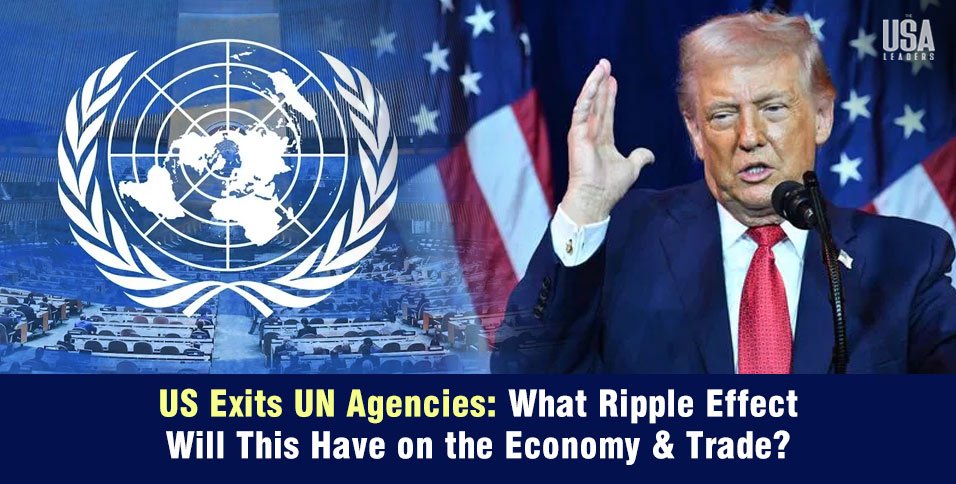
In a sweeping foreign policy shift, the Trump Administration ordered that the country will exit UN agencies and other international bodies that it says no longer serve American interests. This “America First” pivot marks a definitive end to decades of multilateral engagement, as the administration moves to shutter participation in 66 international bodies, including 31 United Nations entities.
As the US exits UN agencies, the scale of this is unprecedented, with agencies such as the UN Framework Convention on Climate Change (UNFCCC) to the UN Population Fund ( UNFPA) being left behind.
While the administration frames this as a necessary reclaiming of national sovereignty and taxpayer funds, the business community and economists are bracing for a massive shift in how American goods and services move across the globe.
Why the US is Walking Away From International Organizations
The White House has been clear: the current global institutional framework no longer serves the American worker or the American taxpayer. According to an internal review, these organizations were deemed “contrary to U.S. national interests, security, and economic prosperity.”
The logic behind the withdrawal rests on three main pillars:
- Fiscal Responsibility: Redirecting billions in membership dues toward domestic infrastructure and defense.
- Regulatory Sovereignty: Eliminating “red tape” and standards set by foreign bureaucrats that may hinder American industrial growth.
- Bilateral Focus: Shifting from large, slow-moving multilateral groups to direct, one-on-one deals with strategic partners.
As departments begin to phase out funding “as soon as possible,” the question for every American business owner, from tech giants in Silicon Valley to manufacturing hubs in the Midwest, is: What happens when the U.S. no longer helps write the global rulebook?
What Risks Will the American Economy Might Bear
For decades, UN agencies have acted as the “invisible plumbing” of global trade. They set the technical standards that ensure a product made in Ohio can be sold in Osaka without a total redesign.
By exiting these bodies, the U.S. faces several immediate hurdles:
- Losing a Seat at the Table
When the US exits UN agencies involved in digital trade and intellectual property, it loses its ability to fight for American patents and data privacy standards.
- Increased Compliance Costs
Without harmonized global regulations, U.S. exporters may face a “patchwork quilt” of different rules for every country they enter, significantly increasing the cost of doing business.
- Reciprocal Trade Barriers
Analysts warn that trading partners may view this withdrawal as a retreat from fair play, potentially leading to retaliatory tariffs or “green” trade barriers that target U.S. goods.
Why is Trump Breaking The Global Climate Treaty
Perhaps the most contentious move is the exit from the UNFCCC. As the world moves toward a low-carbon economy, the U.S. departure from international climate frameworks creates a massive strategic opening for competitors.
With the U.S. stepping back, the European Union and China are now the primary architects of global “green trade” rules. This could mean that future carbon taxes or renewable energy standards will be designed to favor foreign industries over American ones.
For the private sector, this creates policy uncertainty. Investors loathe unpredictability; without a clear tie to global climate agreements, long-term investments in American clean-tech and carbon markets may stall as capital flees to more stable regulatory environments.
How The US Exit Will Impact Emerging Markets and Foreign Aid
It isn’t just about high-level diplomacy; it’s about future customers. Many of the agencies being exited, such as development and health bodies, lay the groundwork for economic stability in emerging markets.
These programs often build the infrastructure and workforce needed for American companies to expand overseas.
A sudden reduction in U.S. engagement could lead to:
- Stunted Growth in New Markets: Reduced health and education support can destabilize regions that are key importers of American goods.
- The “Influence Gap”: As the U.S. pulls back, other nations often step in with “debt-trap diplomacy,” securing long-term trade loyalty from developing nations at the expense of American influence.
Long-Term Global Strategic Outlook
The decision for the US to exit UN agencies is more than a budget cut; it is a fundamental redesign of the global order. As the U.S. moves toward a more isolationist or bilateral economic policy, the world isn’t hitting “pause.” Instead, new alliances, likely led by the EU, Japan, and the ASEAN nations, will form to fill the vacuum.
Financial markets are already monitoring these shifts. We can expect to see volatility in:
- Exchange Rates: As the U.S. moves away from cooperative economic governance.
- Foreign Direct Investment (FDI): As multinational corporations reassess the safety of long-term U.S.-based projects.
- Global Tech Standards: A potential “splinternet” where U.S. tech operates under one set of rules and the rest of the world under another.
The Bottom Line
The administration’s move is a high-stakes bet that American sovereignty and domestic reinvestment will outweigh the benefits of global cooperation. Proponents believe this will “unshackle” the American economy.
Critics, however, fear that by leaving the room where the rules are made, the U.S. is handing the keys of the global economy to its fiercest competitors. Instead of relying on the State Department to represent their interests in Geneva or Paris, the US firms may have to build their own diplomatic arms to navigate international markets.
In the coming months, the focus will shift from the “why” to the “how.” As the phase-out begins, American businesses must remain agile, preparing for a world where “Made in America” must compete without the support of the international frameworks that defined the last 80 years of commerce.