There is a particular kind of silence that is not quiet. It is the thunderous, desperate silence of a mind fully alive, trapped inside a body that will not respond. It is the silence of Locked-In Syndrome (LIS), of advanced Amyotrophic Lateral Sclerosis (ALS), a state of being where the world’s entire lexicon of thought, wit, love, and pain is compressed into a single, unbridgeable void. For decades, the only tools to cross this chasm were primitive, slow, and agonizingly incomplete. The problem was not that these individuals had nothing to say. It was that no one knew how to listen.
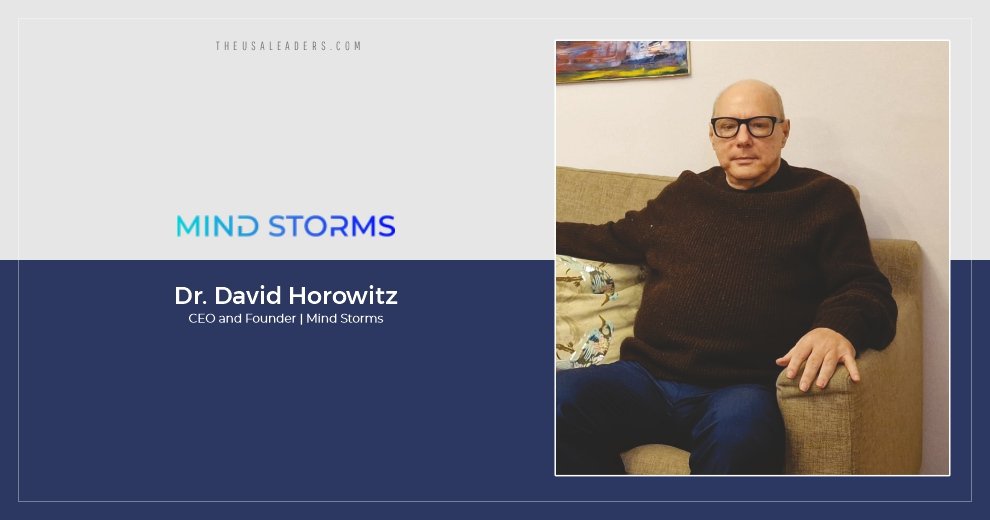
To solve a problem of this magnitude, you need a different kind of thinker. You need someone who exists at the intersection of disciplines, a person who can see the invisible connections between disparate worlds. You need someone who can understand the mathematical beauty of an electronic circuit, the cognitive science of human thought, and the pure, emotional resonance of a musical note. You need Dr. David Horowitz.
As the CEO and Founder of Mind Storms, a groundbreaking Brain-Computer Interface (BCI) startup, Dr. Horowitz is leading one of the most profound technological quests of our time: to translate thought directly into speech. But his journey to this futuristic precipice did not begin with code or silicon. It began with music. It began with an enduring curiosity not just about how to build machines, but about the fundamental nature of how humans perceive the world. After more than twenty years of building the technology of speech, he is now on a mission to restore it, giving voice to the silenced and proving that with the right vision, no communication barrier is permanent.
The Interdisciplinary Ear
The map of Dr. Horowitz’s career is not a straight line. It is a constellation of seemingly unrelated points of light that, when viewed from a distance, create a brilliant, coherent picture. His journey began at Michigan’s elite Kalamazoo College, a place that actively encouraged interdisciplinary work. He did not choose between the humanities and the sciences; he studied both music and health science. This dual focus, on the abstract beauty of art and the concrete systems of the human body, would become the foundational grammar of his life’s work.
When it came time for graduate school, he was drawn to MIT, not for its famed computer science, but for its pioneering work in Speech and Hearing Science. He had a specific question, one born from his musical background. “I wanted to apply hearing science to learn how a person perceives pitch and loudness,” Dr. Horowitz recalls. To answer this, he immersed himself in a staggering range of subjects: electronic circuits, digital signal processing, cognitive science, and artificial intelligence. He was not just learning a trade; he was assembling a multidimensional toolkit.
This unique blend of skills quickly found a purpose. As a junior faculty member at Tufts University School of Medicine, he pursued bioengineering and speech recognition, building a speech-driven robot designed to help severely disabled people. This was the first spark, an early indication of where his interdisciplinary mind was heading. The work led him to an MIT Research Fellowship in Mechanical Engineering, then into the MIT Doctoral program in Electrical Engineering. He later completed his Ph.D. by Publication at the University of East Anglia, solidifying a resume that reads less like a career path and more like a syllabus for a new field of study.
From Replication to Restoration
After leaving academia, Dr. Horowitz entered the commercial world and began a long, successful career as a developer and manager of speech recognition applications. He was on the front lines of teaching machines how to listen. His first product, VoiceRAD, was one he initially developed as the sole developer, partnering with a leading radiologist. The product was successful, sold to Kurzweil AI, where he then worked to transfer the technology.
His fingerprints are all over the evolution of the voices we now take for granted. He focused on speech user interfaces, on speech telephony, and on the natural language interface that would become the core of Dragon Naturally Speaking. He worked on FASiL, the first voice personal assistant, and applied knowledge bases to spoken dialog. He spent a full decade specializing in speaker identification. For over twenty years, he mastered the art and science of replicating the human voice.
But a deeper question, planted years before, remained. “Mind Storms was founded,” he explains, “because Horowitz studied Cognition and Brain Science at MIT. He studied the representation of speech production in the brain.” This was the key. He had spent a career teaching machines to understand the sound of a voice. Now, he realized, he could use that knowledge to build a machine that could understand the thought of a voice. Mind Storms was born to “bring this science to life,” with a singular, profound mission: to help disabled, nonvocal people speak again.
The Storm Within the Mind
Mind Storms is not just another health tech startup. It is a mission-driven company focused on an “underserved population in great need.” The team, a skilled group of scientists and engineers led by Dr. Horowitz, is building a brain wave decoder integrated with commercial software. The project is backed by $800,000 in funding and is already protected by nine provisional patents.
The company operates at the nexus of brain wave decoding, neuro accessibility, and AI-integrated interfaces. “Neuro disabled had no effective means of communicating prior to BCI technology,” Dr. Horowitz states simply. “Since the eighties, primitive solutions were the only techniques available. BCI technology dramatically and radically changed the playing field.” Mind Storms, he says, is leading the way.
While the technology sounds like science fiction, Dr. Horowitz explains it with the clarity of a seasoned educator. The concept, he notes, has been validated by numerous studies. It works by employing EEG sensors, a medical technology that has been used for decades to record brainwaves. The innovation lies in the application of modern AI. “AI has been studied for a long time. AI does pattern recognition,” he says. “The brainwave is a pattern, and the AI is taught to recognise what the different patterns mean.” In simple terms, a person thinks of the language, the EEG sensors capture the pattern of that thought, and the AI analyzes that pattern and produces the result: spoken language.
The company’s expertise has been recognized. Dr. Horowitz and Mind Storms were honored with membership into the International Artificial Intelligence Industry Alliance (AIIA), and they are participants in Digital Health London’s #DHLLeap Programme, all contributing to the goal of advancing health tech for the non-vocal and paralyzed.
An Environment, Not Just a Device
What truly sets Mind Storms apart is not just that it decodes thought, but what it does with it. Dr. Horowitz is not just building a communication aide; he is building a world. “What distinguishes Mind Storms is we provide an environment for the disabled and nonvocal person to live in,” he explains. This is a critical distinction. The product is designed to extend the user’s entire living capacity into a virtual world, a place where they can be entertained, participate in social media, and communicate their health and daily living needs.
This ambitious vision dictates the technology. To create a seamless, immersive world, you need a highly effective and user-friendly interface. This is why Dr. Horowitz is so focused on UX/UI, one that combines conversational UI, gaming, and augmented reality. It is also why the company is leveraging the most advanced technology available, from multi-channel EEG sensors to next-generation Quantum Sensors, all fed into a “special purpose thought recognizer that incorporates multiple AI techniques.” The goal is not just to let someone type a “yes” or “no” with their mind. The goal is to let them live.
The Human Centric Blueprint
To build a technology this sensitive, the process must be as human-centric as the product. The Mind Storms team is deep in a software development process to create their Minimum Viable Product (MVP). “We do this iteratively in 3 sprints,” Dr. Horowitz says. “Therefore, we built 3 MVPs.” After each code freeze, the MVP goes through rigorous quality assurance and usability verification.
User centricity is not a buzzword here; it is the entire process. “User centricity is being achieved by testing the system with real users, both nonvocal and quadriplegic,” he notes. “Experts observe their experience and recommend tuning accordingly.” The team runs tests with ten real disabled users alongside ten able-bodied individuals as a control group. This “sensitive tuning” is what assures the quality and responsiveness of the final product.
This commitment to inclusive design is the driving force behind one of the company’s most exciting milestones. “The most fulfilling milestone which is underway is UI development in collaboration with the world-renowned SmartLab under the direction of Prof. Lizbeth Goodman at University College Dublin,” Dr. Horowitz shares. “She and her team are at the pinnacle of inclusive design.”
The Visionary’s Toolkit
As CEO, Dr. Horowitz sees his role as “largely both administrative and visionary.” He has a long career in bioengineering, one that includes responsibility for $30 million in approved grants, giving him the administrative experience to guide the company. But it is the vision that drives him. When asked about his greatest pride, he is quick to answer: “As CEO, I am most proud of my team and the software they developed.” Above all, he is “happy to serve the company and deliver products to a largely underserved population.”
Dr. Horowitz is introspective about the difficulty of his work. “Having the right vision and possessing the right scientific background is the most challenging part of contributing to the creation of a new field,” he reflects. “For me, it has taken a long time to grow into this field.”
He credits his broad, deep education as the key. “I was fortunate to major in Electrical Engineering at MIT. I did not know it then, but my work in speech and hearing laid the foundation for my career in AI. With the proper background, career experience the challenge in wielding the Right Vision becomes tractable.”
After bootstrapping “Mind Storms,” he is now most excited about taking in investment, noting that investors are giving the MVP a “warm reception.”
When asked about work-life balance, Dr. Horowitz is characteristically grounded. “I don’t think there is such a thing as a perfect work-life balance,” he says. “For me, I have strong faith, and I learned a long time ago to live in the day, if not live in the moment.”
His advice to new entrepreneurs is a perfect summary of his own journey: “Dream fearlessly, verbalize your dreams, acquire the right background, and value every boss, colleague, teacher, or friend you encounter in life. It’s all about growing strong relationships and learning hard lessons from your mistakes.”
And, Dr. Horowitz adds, one last, crucial thing: “Above all, make sure every day you are having fun!” It is the advice of a man who has managed to do the impossible, to merge his passions with his profession, and to channel a lifetime of learning toward a single, noble goal. He is a scientist, an engineer, and a musician, who, by mastering the intricate rules of sound and science, is now giving the gift of a voice back to those who have none.
Quotes
“Dream fearlessly, verbalize your dreams, acquire the right background, and value every boss, colleague, teacher, or friend you encounter in life.”
“It’s all about growing strong relationships and learning hard lessons from your mistakes.”
Also Read: Visionary Leaders Advancing Global Leadership 2026