Player welfare has become an increasingly hot topic in soccer. Over the last few years, with prominent tournaments like the FIFA World Cup, the UEFA Champions League and the FIFA Club World Cup expanding, the number of games that players are asked to perform in continues to spiral out of control.
Despite the extra physical and mental demands on players, the game keeps growing, and fans still love to forecast outcomes and back them with bets. Everything to do with form and statistics, along with reliable tips, such as a suggestion from an all sports prediction on Legalbet, a website devoted to sports betting and bookmakers, helps bettors make stronger predictions. But the weather could now be another important factor to take into consideration.
FIFA Club World Cup Delays
The recent FIFA Club World Cup (CWC) hosted by the USA was a vastly expanded tournament from its previous format. Previously, it had been only for continental champions, plus the occasional invitational team, but this year it was expanded to a 24-team event, and pegged as a dress rehearsal for next year’s World Cup there.
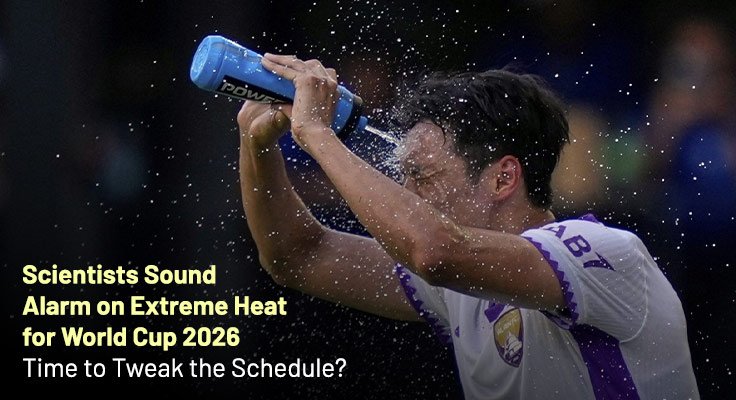
However, it highlighted another major player welfare concern: the weather. There were significant delays at the CWC because of lightning storms and heavy rainfall, and soaring summer temperatures meant that extra cooling breaks were required, training sessions were kept shorter, and for one match, German club Borussia Dortmund took the groundbreaking step of keeping their substitutes inside the dressing room for the first half because of the heat.
FIFA’s response to the ongoing temperature problems, which were sometimes reaching 90°F, was to allow for extra drinks breaks, cooling fans on the side of the pitch and more water accessible to players. But still, players reported feeling dizzy because of the heat and the problem is only set to get worse. According to the players’ union FIFPRO, six of the 16 cities hosting the 2026 World Cup are going to be at “extremely high risk” for heat stress during the tournament’s schedule.
Since 1930, the summer months of June, July and August across North America have collectively seen a warming of 1.05 degrees Celsius, as reported by the US National Oceanic and Atmospheric Administration. In Europe, that number is a 1.81 increase, and has been accelerating since the 1990s. Now FIFA has been pressured to rethink the 2026 World Cup, which the USA co-hosts with Mexico and Canada.
Health Risks
Playing in excessive heat can take a toll on the body. It can include inducing hyperthermia, and when the body temperature is abnormally high, it puts a strain on the cardiovascular system. A rise in a player’s core temperature can potentially lead to muscle cramping, heat exhaustion, and even life-threatening heat stroke.
Playing in the heat also raises dehydration concerns, which can impair performance levels and increase the rate of fatigue. It’s recommended that players have 48 to 72 hours to fully recover from a match before playing the next one, with four days being an ideal period of rest to reset physiological and psychological levels. With fixture congestion eating into recovery time, particularly during an international tournament, the problem is compounded by heat.
How Heat Affects the Game
Feedback from the 2025 CWC unsurprisingly showed that the pace of the game slows as players get fatigued more quickly than in milder weather. This was seen in a comparison of throw-in percentages.
In last season’s UEFA Champions League, there were an average of 37.81 throw-ins per game, but during the heat-plagued CWC, there were just 29.47 throw-ins per game, suggesting that there was a greater emphasis on ball retention with less direct play.
Heat also brings substitutions into greater effect, as head coaches have to turn to backup players more often. In this year’s Champions League Final, there were odds around 2.05 for “Over 7.5 Substitutions” in the match, but for Club World Cup matches, there were often quotes as short as 1.10 on “Over 9.5 Substitutions”. The statistics show that heat is changing the game.
FIFA Sets its Precedent
The 2022 World Cup was the first World Cup edition not held in its traditional calendar spot of June/July. Due to the extreme heat and high humidity in Qatar at that time of year, for both player and fan safety, FIFA took the step of moving the tournament to November and December. But doing so came with problems because of how badly it disrupted domestic seasons.
Qatar 2022 had a planned move to the European winter time from the start, and it’s too late in the day to make adjustments to the 2026 World Cup. Switching stadium venues isn’t likely, and it’s hard to see FIFA moving to earlier kick-off times to avoid the heat, because that would cause logistical problems with sponsorship, broadcasting and advertising.
Bigger Issues
The fact that these discussions won’t go away means that the challenges the World Cup faces are symbolic of the bigger problems. It’s a stark reminder of how disruptive climate change can be in everyday life, and soccer has a heavy hand in that, too.
A report earlier this year found that the industry is responsible for between 64 and 66 million tonnes of CO2 each year, more than the output of Austria, so this isn’t just about World Cups. The biggest changes and actions over player and fan welfare can only come from the top, and with Saudi Arabia hosting in 2034, FIFA may be pressured again into more drastic action.
Also Read: The Spirit of the Stars: What Drives South America’s Football Supremacy?