There is a particular kind of knowledge that comes not from a classroom but from circumstance.
When Arushi Jyoti was twelve years old, her family moved from India to Canada. She watched her parents navigate that transition with what she describes as extraordinary grace, and she came away from it with something she could not have named at the time: a practiced instinct for staying grounded when everything around you changes.
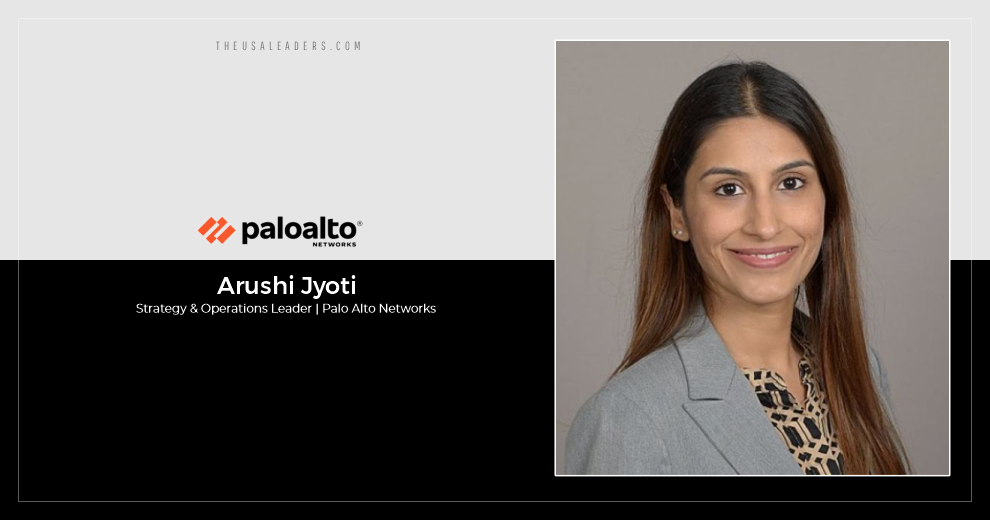
That early lesson would become the quiet thread running through everything she has built since. Today, she leads Transformation and Portfolio Management at Palo Alto Networks, a leading cybersecurity company, overseeing dozens of strategic launches and releases at any given time and ensuring the company’s most important work has every condition it needs to succeed.
The distance between where she started and where she stands now is not accidental. It is the result of a career built on one consistent and disciplined belief: that strategy without execution is just a good idea, and execution without strategy is just activity.
From the Engineering Bench to the Business Table
Arushi studied engineering at the University of Alberta, drawn to what she calls problem-solving at scale. After graduating, she joined National Oilwell Varco, a Fortune 100 company, entering a structured leadership development program that she navigated for three years. That experience took her from technical work into product management, from contributor to operator. It was a formative shift.
“That pivot from technical contributor to business operator defined the leader I would become,” she says. “I learned early that the most durable outcomes come from bridging the gap between what’s technically possible and what the business actually needs.”
She then pursued her MBA at Harvard, carrying into it a perspective that was already distinct from most. She did not arrive looking to understand business in the abstract. She arrived as someone who had already seen how technical excellence and business reality can miss each other entirely, and who had spent three years learning how to close that gap.
Building the Foundation, Role by Role
After Harvard, Arushi moved through a series of strategy and operations roles at high-growth technology companies, each one building on the experience of the last. She is careful not to frame this as a linear climb. It was more deliberate than that.
“Each role deepened my conviction,” she says, “that the companies doing the most critical work need the sharpest operational foundations.”
Across these experiences, three core principles took shape. They are not values she aspires to. These are the ways she actually works.
The first is outcomes over activities. At Carta, her team built a meaningful cost-savings initiative by asking, without sentiment, what was genuinely creating value. This is often difficult to apply consistently inside fast-moving organizations.
The second is earning trust through specificity. Recommendations alone are not enough. The difference between a recommendation that gets adopted and one that gets politely shelved comes down to whether the people who need to act on it actually trust the data behind it. She has learned to build that trust before presenting conclusions, not alongside them.
The third principle is finding the constraint. At Cisco-AppDynamics, a significant Nvidia AI partnership required aligning engineering, sales, and product across two organizations simultaneously. “The breakthroughs came from identifying the one thing slowing everything else down and removing it,” she says.
There is a version of portfolio management that most people in large organizations have encountered. It involves dashboards, status updates, and coordination work that feels important but is difficult to connect directly to outcomes.
That is not what Arushi does, and she is clear-eyed about the distinction.
At Palo Alto Networks, leading Transformation and Portfolio Management means something more specific and more demanding. It means translating executive intent into structured programs with clear ownership, milestones, and decision rights. It means surfacing trade-offs before they become crises. It means holding the system accountable, not simply tracking it.
“Portfolio management done well isn’t a reporting function; it’s a forcing function,” she says. “We create the conditions for the company’s most important bets to succeed by surfacing trade-offs early, before they become crises.”
She is also deliberate about why cybersecurity is the right context for this kind of work. It is mission-critical infrastructure for modern organizations. When the opportunity to lead transformation at Palo Alto Networks came, she recognized it as a chance to apply everything she had built in the service of something that genuinely matters.
“That felt like the right place to make a difference,” she says simply.
Strategy and Operations: Built for Impact
In the technology industry, Strategy and Operations is widely understood as a high-impact, highly strategic function. Arushi takes that responsibility seriously, and she is precise about what it actually demands.
“A strong Strategy and Operations team is the connective tissue of a business,” she says. “We don’t just execute; we architect how execution happens.”
Her teams are built on two foundational commitments. The first is intellectual honesty. The second is psychological safety. Cross-functional alignment breaks down most predictably when people are afraid to name the real problem. Creating an environment where disagreement is treated as useful input rather than as friction is not a soft aspiration for Arushi. It is a structural requirement.
She also invests heavily in role clarity. “People perform best when they know exactly what they own and what ‘done’ looks like,” she says. Her teams have consistently delivered results that outpaced what their headcount would suggest, because everyone understood the mission and had the trust to execute it.
“My job is to make the leaders around me faster, sharper, and better coordinated,” she says. “And when that’s working, nobody notices the seams.”
The goal is not recognition. The measure of excellent operational work is that everything appears to run smoothly, and the coordination that made it possible is invisible.
Data as a Discipline, Not a Defense
Arushi’s philosophy on data is more precise than the widely used phrase “data-driven” tends to capture.
“I believe data should constrain intuition, not replace it,” she says.
Her approach is to build a shared factual baseline and use it to guide strategic decisions. At Cisco-AppDynamics, a meaningful improvement in OKR attainment came not from asking teams to work harder but from redesigning how targets were set in the first place.
“Innovation, to me, means applying rigor where others are operating on assumptions,” she says.
It is a quiet kind of innovation. It does not generate announcements. It shows up in the quality of decisions made, in the planning cycles that actually land, and in the programs that deliver on what was promised.
The Longer Arc
Ask Arushi where she is headed, and the word she reaches for, carefully and without hesitation, is ownership.
After more than a decade of building operational excellence inside high-growth technology companies, she is increasingly drawn to the challenge of applying those same capabilities as a founder or general manager with P&L ownership. Someone who can take a strong business and make it exceptional.
“I’ve spent over a decade building operational excellence inside high-growth companies,” she says, “and I’m increasingly drawn to the challenge of applying those skills as a founder.”
It is not a restless ambition. It is the logical next destination for someone who has spent her career building the systems that let others’ most important work succeed, and who now sees clearly what it would mean to bring that same discipline to something she owns entirely.
She is also committed to advising early-stage founders and to investing her time in the next generation of women operators who want to lead, not merely support. Her message to those women is direct.
“The operational roles, the Chief of Staff roles, the ‘unglamorous’ infrastructure roles,” she says, “these are where some of the deepest leadership development happens. Own them fully, and they will take you further than you expect.”
Full Presence
Balance, for Arushi, is not a quantity. It is a quality.
“Balance, for me, is less about equal time and more about full presence,” she says.
She practices yoga and meditation daily, not as wellness accessories but as the mental discipline that strategy work demands at its best. She is also learning tennis, which she describes as “humbling in the best way,” because it reminds her, day after day, that mastery requires repetition and patience. These are lessons, she notes, that apply well beyond the instrument.
She also does pro bono consulting with nonprofits, which keeps her connected to the purpose beneath all the rigor. The discipline, the frameworks, the relentless focus on outcomes: none of it exists for its own sake. It is in the service of something larger.
For those who encounter Arushi Jyoti’s story looking for the obvious markers of ambition, they will find them. But the more interesting thing is what holds all of it together: a consistent commitment to building the systems that allow the most important work to actually happen.
She has built her career at the intersection of strategy and execution. That work is rarely visible. It is almost never celebrated. And by her own account, that is exactly how it should be.
“Don’t mistake proximity to power for influence,” she says. “Build real expertise, deliver real results, and your seat at the table will be earned, not assigned.”
The table she has earned her seat at is a consequential one. And she is still building.
Quotes
“I hire for intellectual honesty, and I build for psychological safety.”
“The fastest way through a credibility gap is to make the people who doubt you co-authors of the solution.”
Also Read – Trailblazing Women Leaders Driving Business Outcomes in 2026