
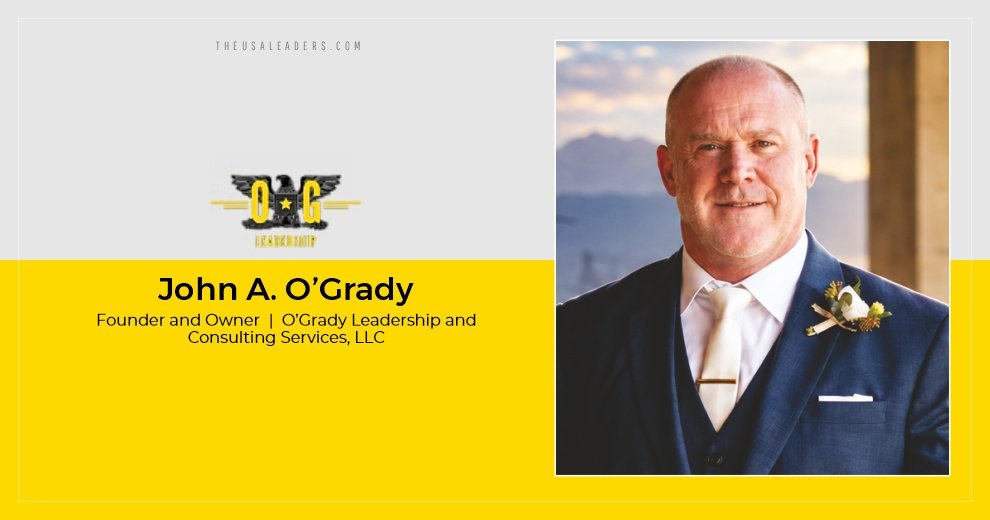
There is a sentence John A. O’Grady offers early in the conversation, almost offhandedly, as though it is simply a thing he has always known. He says it without theatre, in the tone of someone who is not trying to impress but cannot help being precise.
“Culture often determines success more than strategy.”
Coming from most people, that sentence might sound like a conference-room observation, the kind of thing printed on a slide and forgotten by lunch. Coming from a man who has led 3,500 soldiers through active war zones, managed a $14.4 billion readiness portfolio for the United States Army, and spent more than thirty years studying what separates organizations that endure from those that merely survive, it arrives with the weight of lived experience.
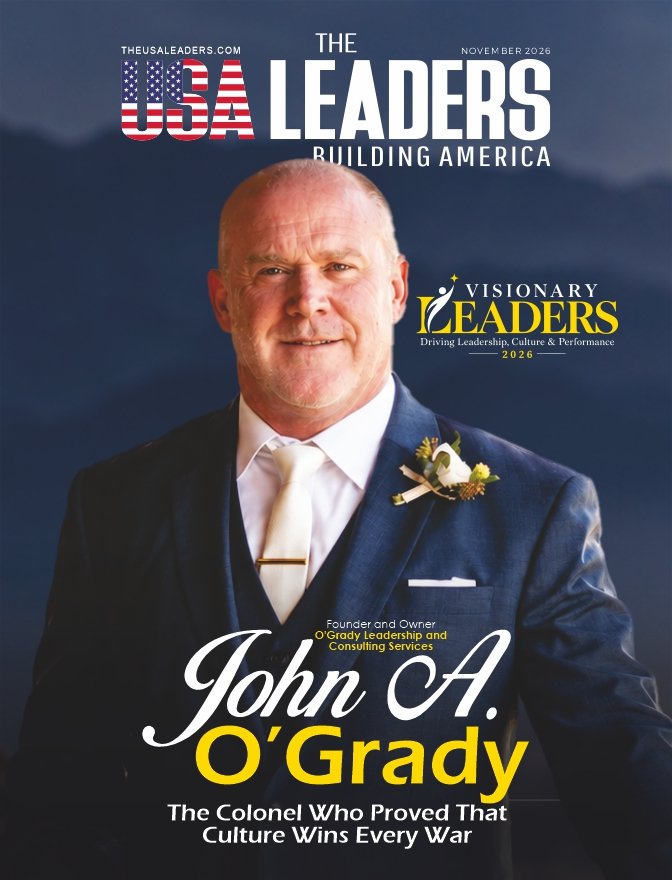
John A. O’Grady, Founder and Owner of O’Grady Leadership and Consulting Services, LLC, is not a theorist. He is a practitioner who has since turned his conclusions into instruments other leaders can use: a measurable trust framework, a facilitator system, a published participant book, and curricula now running in boardrooms, locker rooms, and government staffs. In 2026, his work stands as one of the more compelling examples of what happens when battlefield judgment meets the complexity of modern organizational life.
Roots, Responsibility, and the Road to West Point
John grew up in New York in a blue-collar Irish Catholic family, in a household where service, accountability, and hard work were not spoken about as values so much as simply enacted as a way of life. They were the quiet architecture of his upbringing, the expectations that shaped a young man before he had the language to name them.
Those foundations eventually drew him to West Point, where he played Division I lacrosse and encountered a conception of leadership that would reorient the next three decades of his life. The academy did not merely train him to command. What he carried out of it was something more durable and more demanding.
“Leadership is ultimately about serving others,” he says. That distinction—between commanding and serving, between authority exercised over people and authority exercised on their behalf—became the cornerstone of everything he would build.
Thirty Years, Two Bronze Stars, and a Presidential Unit Citation
The breadth of John’s military career is the kind that requires a moment to absorb. Over thirty years, across two combat deployments and multiple command assignments, he led organizations ranging from 30 to 3,500 people in environments that left little margin for error and none at all for cultural weakness.
He earned two Bronze Stars. One of the organizations he led was awarded the Presidential Unit Citation, the highest honor given to a military unit, formally recognizing “extraordinary heroism in the face of an armed enemy.” He is careful, and characteristically generous, in attributing that recognition not to tactics but to the values-based culture through which he led and inspired his team.
His career took him to İzmir, Turkey, where he served as Executive Officer to the Commanding General of NATO Allied Land Command, advising across a 350-person international staff representing more than 26 NATO nations on matters ranging from geo-strategic direction to organizational modernization. He was subsequently selected as one of just eleven officers chosen to represent the Chief of Staff of the Army as a Senior Fellow at the Center for Strategic and International Studies in Washington, D.C.
As Chief of the Collective Training Division at Department of the Army Headquarters, he managed a $14.4 billion portfolio, advising senior Army leaders on readiness, risk, and the alignment of resources with strategic goals—work that required him to defend trade-offs to four-star leadership and to the staffs that had to live with the consequences.
Across every assignment—continents, command structures, and wildly different circumstances—the work was always, at its foundation, about people.
The Intersection Where the Magic Happens
In June 2019, John founded O’Grady Leadership and Consulting Services, LLC, giving formal shape to what had been the animating project of his entire career. His practice is built, as he describes it, at “the intersection of leadership and culture.” That phrase is not a marketing formulation. It is a diagnosis.
He observed, across decades of service, that organizations with comparable resources routinely produced dramatically different results. The differentiator, almost without exception, was leadership and the environment leaders created around their people. Not strategy. Not capital. Not talent alone.
His client portfolio reflects the range of that conviction. He has worked with IBM, the New York Jets, Georgetown University Women’s Lacrosse, the Chesapeake Bayhawks—who won the 2019 Major League Lacrosse Championship—Georgetown Prep Boys’ Lacrosse, West Point’s Men’s and Women’s Lacrosse programs, Wagner College Football, an executive from the LA 2028 Olympics, Soldiers to Sidelines, the Intercollegiate Men’s Lacrosse Coaches Association, the National Interscholastic Lacrosse Coaches Association, Intellectible, and the Center for a New American Security.
In September 2020, he was accepted into the Forbes Coaches Council, an invitation-only community for leading business and career coaches, selected on the depth and diversity of his experience.
He has continued simultaneously in a senior role at Raytheon, where, since November 2020, he has served as the primary interface between the U.S. Army’s Transformation and Training Command and Raytheon’s business and innovation ecosystem across the Texas Triangle, spanning Dallas–Fort Worth, San Antonio, Austin, and Houston. The work is upstream by design: engaging Army modernization, experimentation, and innovation pathways before requirements harden into programs, and connecting startups, small businesses, and university research to a prime’s integration capacity. He has since proposed a matrixed engagement model—technology scouting, demonstrations and experimentation, university talent and research partnerships, and startup and near-prime teaming—that expands coverage without adding a new organization or reporting chain.
Between January and September 2025 at Raytheon, John led a cross-functional team through development of a holistic business strategy for Golden Dome for America, submitting multiple responses to the government’s request for information and briefing C-suite leadership on the full landscape of opportunities, risks, and strategic direction tied to the President’s Executive Order.
The Misconception That Costs Organizations the Most
When John steps into a new advisory engagement, he frequently encounters a version of the same assumption, dressed in slightly different language depending on the industry. Leaders tend to regard culture as a human-resources matter: something managed by a department, measured in surveys, addressed at off-site retreats.
He does not share that view.
“Culture reflects what leaders tolerate, reward, and model every day,” he says. It is not a program or a policy. It is behavior—continuous and cumulative—shaped by every decision a leader makes and every behavior they choose to overlook.
The consequence of treating culture as a delegable function, he argues, is that organizations end up living one culture while believing they inhabit another. The gap between stated values and actual behavior is not a branding problem. It is a performance problem, and it shows up in retention, in speed, and in what people are willing to tell you before a decision goes wrong.
“When leaders intentionally shape culture, performance improves naturally,” he notes. The inverse, he has seen enough times to say with confidence, is equally true.
Three Principles That Held Under Fire
Pressed to distill his leadership framework to its most essential components, John does not reach for a slide or a management metaphor. He names three things, steadily and in order: clarity of purpose, trust, and accountability.
Clarity of purpose means people understand not merely what they are doing, but why it matters. Trust is built through credibility, consistency, and mutual respect—accumulated over time and impossible to manufacture on demand. Accountability means standards hold, particularly when pressure is highest, and the temptation to lower the bar is most seductive.
“In combat, uncertainty is constant,” he says. “But strong cultures create stability amid chaos.”
The teams that performed best under the most extreme conditions, he explains, were not the ones with the most elaborate procedures. They were the ones that had invested in relationships before the crisis arrived. When difficult moments came—and in combat they always come—people trusted one another and stayed committed to the mission.
That principle has transferred with remarkable consistency into every boardroom, coaching staff, and executive team he has worked with since.
Making Trust Measurable
John’s most distinctive contribution is his refusal to leave trust in the realm of sentiment. In his Trust Equity system, trust behaves like a balance sheet: it is built through observable deposits, drawn down by inconsistency, and capable of producing a return. The framework, published as the participant book Trust: The Ultimate Competitive Advantage in Business and Life, pairs a trust spectrum, a trust equation, and a four-directions model with a diagnostic called the Trust Audit.
The audit is where the concept becomes consequential. Participants compare what others expect of them against what they dependably deliver, locate the relationship on a spectrum, identify the single lever most responsible for the gap, and commit to one specific deposit within 72 hours. A separate facilitator edition supplies 90-, 120-, and 180-minute formats, interpretive answer keys, worked vignettes, and a 72-hour, 30-day, and quarterly follow-up rhythm.
That architecture—vocabulary, diagnosis, commitment, follow-through—is what allows his work to survive contact with a calendar. It also travels. In The Fifth Fundamental, he places leadership alongside the drop, the throw, the route, and the catch, delivering the curriculum through counselors and coaches so it scales inside a camp rather than displacing practice minutes. In Coaches University and his clinic work with Texas high school programs, the same audit becomes a season-long instrument. In Win From Within, his forthcoming book, the thesis is stated plainly: a team can win a championship and still fail to build a culture that repeats.
Systems Over Heroes, and the Long Game of Lasting Success
One of John’s more persistent concerns about organizational life is the seduction of building success around exceptional individuals rather than replicable, resilient systems. He has watched it unfold in uniform and in business: an extraordinary person holds an organization together through sheer force of ability, and when that person leaves, the performance leaves with them.
His advisory work is oriented deliberately against that pattern. He helps organizations concentrate on leadership development, succession planning, cultural alignment, and talent growth across every level of the enterprise.
“Short-term success can be achieved through effort and urgency,” he says. “But long-term success requires consistency and intentionality.”
The distinction between urgency and intentionality is one he returns to with quiet persistence. Urgency is fuel; it burns hot and fast. Intentionality is infrastructure; it supports performance across time. The strongest cultures, he argues, have made excellence not an occasional event but an embedded expectation.
When Leadership Was Tested in Full
There are periods in any career, particularly a military one, when the ideas a leader holds about themselves meet the reality of what the situation demands. For John, those periods came during combat operations, when decisions made under pressure carried consequences that were irreversible.
He speaks about those times with the measured restraint of someone who understands the weight of what he carries. What he shares is this: in those moments, authority alone is insufficient. Leaders must fall back on what was built before the crisis—on trust, on preparation, on character.
“I learned the importance of staying calm, communicating clearly, and focusing on what could be controlled,” he reflects.
It is the kind of lesson that sounds straightforward until you consider the conditions under which it was absorbed.
Staying Relevant Across Three Worlds
What distinguishes John’s advisory practice is not simply the breadth of his military experience. It is his fluency across three distinct environments: the armed forces, the athletic program, and the corporate organization. Each operates according to different rules, different incentive structures, and different vocabularies of success. Few advisors can move among all three without translation loss; he has held senior positions in each.
And yet his position is that the human fundamentals do not change. “The tools may change, but people still want purpose, trust, and connection.”
He stays engaged with emerging trends in technology, organizational development, and human performance—not to replace proven leadership principles, but to understand how they apply in continuously evolving environments. The principles are timeless. The application must be current. That balance is what keeps his message transferable across industries and sectors.
A Life Lived With Purpose Beyond the Office
John speaks about balance not as a scheduling achievement but as a matter of understanding priorities. Family, faith, health, and meaningful work remain the anchors of his life. He spends time with his wife and family, travels, reads, mentors emerging leaders, and maintains the physical discipline that has been a constant since his days playing Division I lacrosse at West Point.
His interests in leadership, history, and human performance are not professional obligations. They are genuine curiosities, and they continuously provide new perspectives that enrich both his personal and professional life.
Looking ahead, he plans to expand his advisory work, speaking engagements, leadership expeditions, and educational content, building toward a vision of stronger leaders, healthier cultures, and higher-performing organizations across business, government, education, and sport. He believes, without apparent reservation, that leadership is one of the most powerful forces for positive change available to any organization or community.
Vulneratus Non Victus
John carries a Latin phrase with him, a personal motto that has accompanied him through both triumph and adversity: Vulneratus Non Victus—Wounded, Not Conquered.
It is not a triumphalist declaration. It is an honest one. It acknowledges that leadership and life will deliver setbacks, failures, and disappointments, and it makes no promise of exemption from difficulty. What it offers instead is a posture: resilience, character, and a continued commitment to serving others.
His encouragement, offered simply and without decoration, is this: focus on becoming the kind of leader people want to follow—not because they have to, but because they choose to. Build trust. Invest in people. Create cultures where individuals can thrive.
The battlefield taught him that. Thirty years of service confirmed it. And the leaders he continues to develop are, in their own way, carrying it forward.
Quotes
“I am most proud of my leadership tree: the continued success of the people who have been direct reports for me in the past. Many have gone on to be selected for promotions and positions requiring special trust and confidence.”
“People perform best when they feel connected to a meaningful mission and understand how they contribute.”
“Trust is not a feeling. It is a balance you build with deposits people can see.”
“Culture is not what you publish. It is what you permit.”
Also Read – Visionary Leaders Driving Leadership, Culture & Performance in 2026