
Read a career backward, and it can resemble a stack of postcards from unrelated places. A few summer months spent alongside engineers working on systems beneath the sea. Three years analyzing counter-terrorism finance for policymakers. A desk at the FBI. Strategy sessions with major companies across the retail and energy sectors, including Fortune 100 firms.
Taken one at a time, the cards have little to say to each other. Laid side by side, they begin to trace a single route.
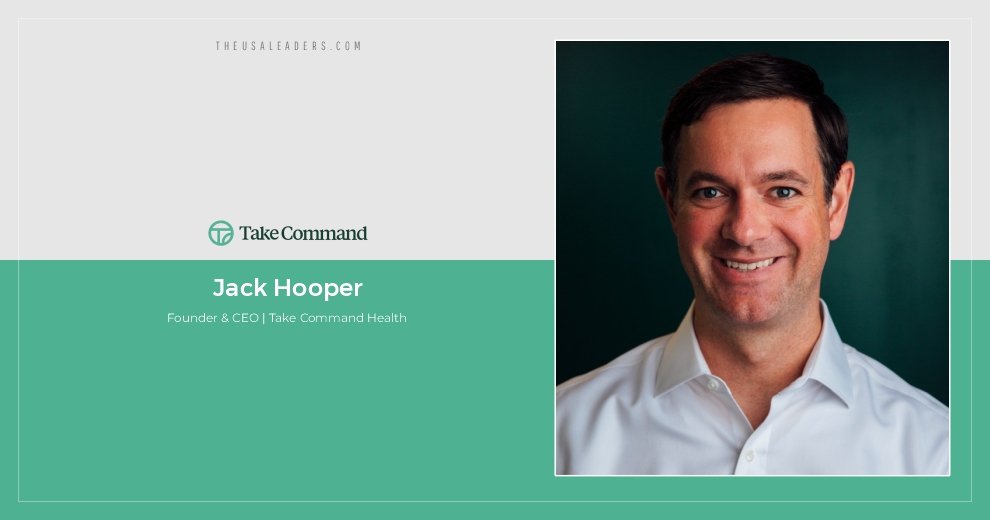
The route ends in the Dallas-Fort Worth Metroplex, where Jack Hooper is the Founder & CEO of Take Command Health. He has held that title since January 2014. His career has taken him from engineering and intelligence work to corporate strategy and, ultimately, to the challenge of changing how employers provide health benefits.
The Mission, Stated Plainly
At its heart, Take Command Health aims to make health insurance reimbursement a more widely adopted way for employers to fund coverage.
The company helps employers reimburse employees for health insurance. It also helps employees connect with the insurance that is best for their unique needs.
That makes two audiences and one operating model that must serve both. From the outset, Jack has focused on turning that approach into a workable arrangement for the organizations funding coverage and the employees choosing their plans.
The Chairman’s Chair
In May 2021, Jack took on a second kind of leadership. He became Chairman of the Board at the HRA Council, a position he held until September 2024.
The council is a nonprofit, nonpartisan coalition. Its members are employers and industry partners. Their shared goal is a vibrant defined-contribution community for health insurance.
Its work centers on education and advocacy. The subjects are CHOICE Arrangements, the updated name for ICHRAs, and QSEHRAs, along with other forms of defined contribution.
Notice the pairing. One role built a product. The other worked on the understanding that surrounds it. The pairing reveals a broader ambition: to build the technology while helping the market understand and embrace the model behind it.
Two Titles at Once
The two roles ran concurrently. While Jack led a business with customers and a product to build, he also helped shape the wider conversation around defined-contribution health benefits.
The overlap was not limited to his business and industry leadership. Earlier in his career, he also worked at The Boston Consulting Group while building Take Command Health. In both instances, he balanced the work of developing a business with the broader challenge of helping organizations understand a changing model.
The Earlier Cards
The postcards are worth turning over one at a time.
In the summer of 2006, from June to August, Jack was a Graduate Fellow Engineer at Shell Oil Company in Greater Houston. He worked with the Subsea Completions Team at Shell International Exploration and Production.
From January 2007 to February 2010, he was an Analyst with the Central Intelligence Agency in the Washington, D.C.-Baltimore area. There he provided strategic analysis for policymakers on counter-terrorism finance, foreign energy, and clean-technology developments.
Then came the Federal Bureau of Investigation. From February 2010 to August 2012, Jack worked as an Information Manager in Greater Houston. His responsibilities included managing information sharing.
Next, in the Dallas-Fort Worth Metroplex, came The Boston Consulting Group. From June 2013 to March 2016, Jack was a strategy and management consultant for Fortune 100 retail and energy firms.
Taken together, these four roles trace nearly nine years of experience before and alongside the company he now leads.
What the Cards Add Up To
Lay the roles out in order and certain themes surface.
Across these positions, Jack moved between engineering, national-security analysis, information management, and corporate strategy. The geography shifted from Houston to the Washington-Baltimore corridor and then to North Texas, where he built Take Command Health.
The route was not a straight line into healthcare. Yet it repeatedly placed him in environments where complex systems had to be understood before decisions could be made. That experience offers a plausible bridge to the challenge he took on next: helping employers navigate a different way of funding health coverage.
The Case for Choice
What connects these chapters is less a shared industry than a recurring kind of problem: how to make complex systems work for the people who depend on them.
At Take Command Health, that question has become concrete. How can employers fund health coverage in a predictable way while giving employees greater freedom to choose the plans that suit their needs?
More than a decade after founding the company, Jack continues to pursue that question through the reimbursement model. The challenge is not simply to make a case for choice, but to build the systems that make it workable for employers and employees alike.
For the ICHRA market in 2026, that is the significance of his work: helping turn an alternative approach to health benefits into a practical model that organizations can evaluate, adopt, and operate.
Also Read – The 5 Most Influential ICHRA & Health Benefits Leaders to Watch in 2026