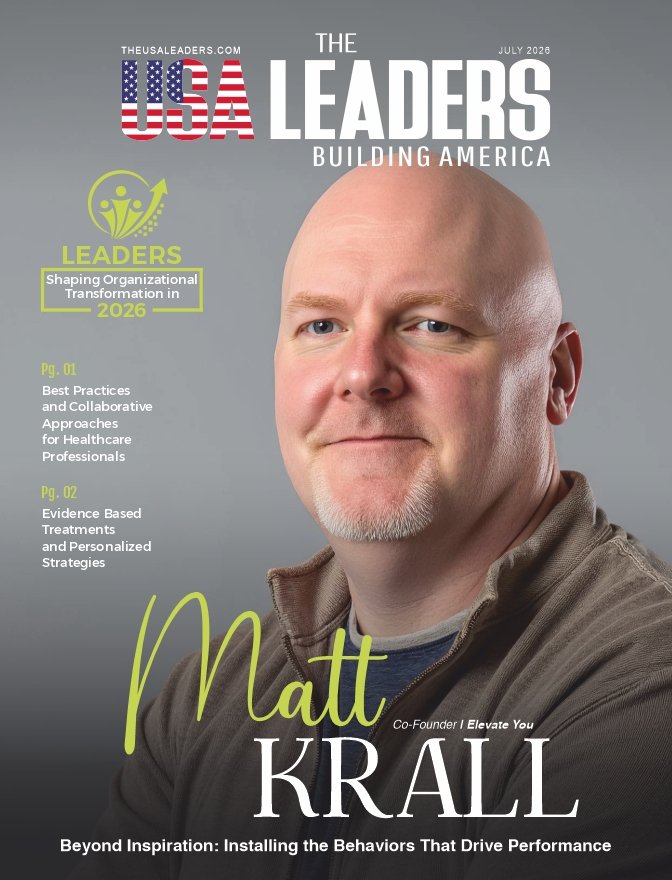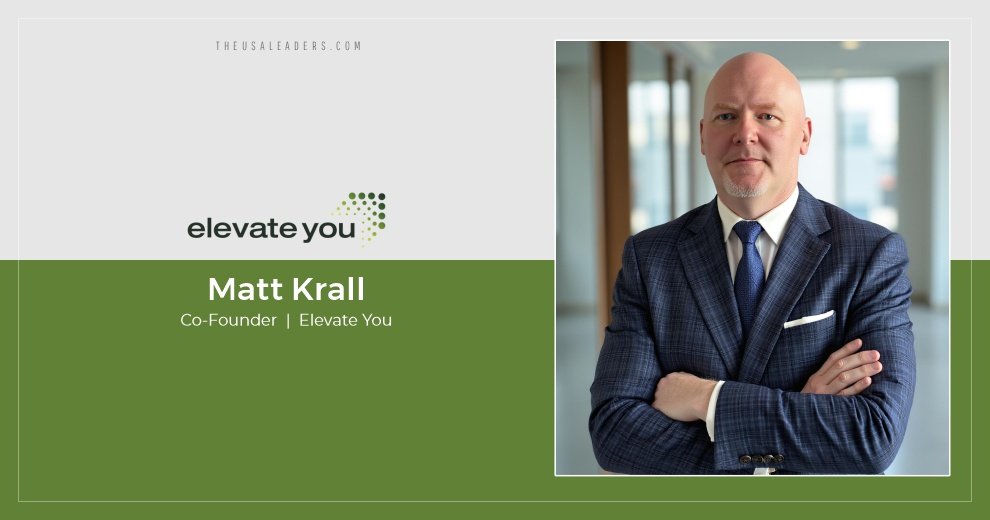
There is a moment that Matt Krall returns to, again and again, in conversation and in his work. It is not a boardroom triumph or a product launch or the signing of a consequential deal. It is, in his telling, a very ordinary Tuesday afternoon. The pressure is high. The data is incomplete. The calendar is full. And somewhere in that unremarkable middle hour of an otherwise ordinary workday, the most carefully constructed strategy in the world begins, quietly and almost invisibly, to come apart.
Most leaders, when pressed, can identify that moment in their own organizations. They just rarely know what to call it or what to do about it. Matt has spent the better part of his career giving it a name and then building the architecture to fix it.
The View From the Top, and What It Actually Taught Him
Matt’s career followed a trajectory that most business professionals would recognize as a version of the dream: beginning at the front lines of operations and climbing, deliberately, all the way to President and Chief Operating Officer.
What he found at the top, however, was not what he had expected. “I expected that the higher you go, the more the work becomes about strategy, vision, and big decisions,” he says. “And it does. But what I discovered is that none of that matters if the people executing the strategy don’t have the behavioral capacity to hold it together under pressure.”
The experiences that stayed with him were not the wins. They were the moments he watched talented, well-intentioned people, people who genuinely cared about the work and believed in the mission, fall short. Not because of any deficit in intelligence or effort. But because they had never been given the tools to lead themselves first. They had never been trained in the human skills that determine whether someone can stay clear, stay accountable, and stay present when things get hard.
He pauses when he talks about those people. Not with frustration, but with something quieter. A kind of protective regard that tells you these were not abstract case studies to him. These were real colleagues. People he worked alongside. People he genuinely liked. Watching them stay stuck, not from complacency, but from the absence of any system designed to help them grow, is what eventually moved him from operator to architect.
That pattern, talented people stuck in patterns they couldn’t even see, became the thing Matt couldn’t stop thinking about. And eventually, after enough years of watching it repeat across different organizations and different industries, it became Elevate You.
Fifty Million Dollars and the Word That Changes Everything
The origin story of Elevate You begins, as Matt tells it, with a number. “The origin story starts with a number: $50 million.”
He was part of an organization that lost that sum, not due to a flawed strategy, not due to a market disruption, but because of something far more insidious: a culture that was too nice. He is careful, always, to draw the distinction between that word and another one that sounds similar but operates completely differently. “Nice and kind are not the same thing. Nice avoids the hard conversation. Kind has it, because it cares enough about the person to tell them the truth.”
The organization had built a culture of nice. Tenured employees, long past the point where anyone thought to challenge them, had quietly plateaued inside roles that no longer asked anything difficult of them. No one told them the truth. The hard conversations had stopped. The honest assessments had stopped. And in that silence, potential stagnated at scale.
“That made me angry,” he says. “Not at them, for them. Because they deserved better.” What they deserved, in his view, was a system that would help them grow rather than a culture that would quietly let them stagnate. That system is what Elevate You is. Not a workshop. Not a wellness application. A real, structured, science-backed mechanism for installing the behaviors that make people, and the organizations they work within, genuinely better.
He does not dress this up or soften the edges. He sat with that anger long enough to turn it into something useful. The question he kept returning to was not “how did this happen?” It was harder than that: what would it actually take to fix it? Not a values refresh. Not a new set of competencies on a slide deck. Something that would work when the pressure came back, because the pressure, in his experience, always comes back.
The Silence That Speaks Loudest
Ask Matt why strategies fail, and he will not point you toward the strategy itself. “The strategy is sound. The plan is clear. The team is capable. And then pressure hits — a difficult quarter, a leadership transition, a market disruption — and the wheels come off.”
What he observed, over and over across his career, is that the failure point is a specific and stubbornly consistent gap: the distance between what people know and what they can actually do when the pressure is on. He calls this the Capacity Gap, and it reveals itself in a pattern that most organizations, if they look honestly, will recognize. High engagement. Low confidence.
The math does not add up, and that is exactly the point.
Survey the average organization, and people will tell you they care. They believe in the work. They are engaged. But ask whether they feel equipped to perform under real pressure, to have the hard conversation, to make a call without perfect information, to hold a standard when it is uncomfortable, and the room goes quiet. “That silence is not a motivation problem,” he says. “It is a behavioral capacity problem. And most organizations have never had a system designed to solve it.”
Not Inspiration. Installation.
The traditional model of leadership development is built on a faith in inspiration. Bring people into a room, create a compelling experience, send them back to their desks fired up, and trust that the energy carries forward. It rarely does. Within weeks, often days, the pressure returns, the old patterns reassert themselves, and the workshop might as well have never happened.
Most leaders have felt this. The post-retreat energy that evaporates by Thursday. The keynote that moved the room and changed nothing.
“That’s not a failure of the content,” he says. “It’s a failure of the model. Inspiration is not installation.”
Elevate You is built on a fundamentally different understanding: behavior change is a neurological process, not an emotional event. The foundation of the system draws on habit formation research, specifically Lally et al.’s findings that automaticity, the point at which a new behavior becomes genuinely automatic, requires an average of 66 days, with some behaviors taking up to 254 days to solidify. On the basis of that science, Matt built a 48-week system that installs behavioral capacity the way the brain actually constructs it: through progressive, repeated practice embedded in the flow of real work.
The system is organized around five behavioral Anchors: Clarity over Noise, Ownership over Blame, Courage over Comfort, Collective over Self, and Energy over Exhaustion. These are not values printed on a lobby wall. They are practiced daily, in 10 minutes per person, woven directly into the existing workflow, requiring no new meetings, no separate platform, and no workshop disruption. “The result is not inspiration that fades. It’s behavior that sticks, because it’s been installed at the neurological level.”
When the Brain Defaults to Survival
There is a reason that smart, trained, well-meaning leaders still make the wrong call under pressure. Matt calls it the Neurological Bottleneck, and understanding it is central to everything Elevate You does.
Under stress, the brain defaults to its most practiced pathways. If the most practiced pathway is avoidance, that is what emerges. If it is over-control, that is what emerges. A leader can know, in the abstract, exactly what the right response looks like. They can articulate it clearly in a calm setting and still, when the stakes are high and the timeline is short, revert to a pattern that undermines everything the training was supposed to build.
“That’s not a character flaw,” he says. “That’s neuroscience.” The only way to close the gap between knowing and doing under pressure is not more knowledge. It is more practice, specifically the kind of deliberate, repeated, in-context practice that builds new neural pathways strong enough to hold when things get genuinely hard.
The Equation: A Sequence That Cannot Be Skipped
Most behavior change programs fail, Matt argues, because they begin in the wrong place. They move immediately to activation, presenting the new behavior and asking people to immediately implement it. And for a week or two, people try. But willpower is a finite resource, and without the right foundation, the new behavior collapses the first time real pressure arrives.
The framework at the heart of Elevate You, which he calls The Equation, addresses this through a precise sequence of four phases.
First comes Awareness, which he describes as “The Sensor,” the ability to interrupt the autopilot state and see a pattern that was previously invisible. Then comes Alignment, or “The Logic,” the process of connecting that pattern to something that matters personally to the individual. Only then does Activation, “The Engine,” become viable: the actual behavioral practice now has something genuine to anchor to. The final phase, Amplification, is “The Scale,” the point at which behavior becomes automatic and begins to spread through the team and into the culture itself.
“Skip Awareness and Alignment, and you’re asking people to change behaviors they can’t yet see, for reasons that don’t yet feel personal. That’s why most programs fail. The sequence isn’t optional. It’s the mechanism.”
What makes this measurable is that each phase carries its own leading indicators, tracked weekly rather than waiting for an annual engagement survey. The metrics include language adoption, recovery speed, peer feedback velocity, and decision autonomy, all of them behavioral signals that shift before business results move.
Seeing What Was Always Invisible
For all the sophistication of modern enterprise dashboards, Matt points out a remarkable gap. Leaders can see revenue, inventory, and spend in real time. But when asked how their culture is performing today, they typically point to an engagement survey conducted six months ago. “That’s like trying to fly a plane by looking at a photograph of the instrument panel from last year.”
The Visual Pulse is Elevate You’s answer to that gap. It is a real-time behavioral diagnostic that surfaces the leading indicators behind performance, the signals that appear before performance outcomes materially change. Recovery speed: how quickly does a team pivot back to an Anchor behavior after encountering friction? Peer feedback velocity: Is accountability becoming a cultural standard, or is it still resting entirely on the manager’s shoulders? Language adoption: Is the team using a shared operating language to navigate pressure? Decision autonomy: Are people making better calls without excessive escalation?
The data from Elevate You’s pilots speaks clearly. Across 16 structured pilots with approximately 400 participants, the results have been consistent. In one cable provider contact center, attrition declined 30% over six months, in an industry where annual turnover routinely exceeds 40%. Calls per hour improved 12%. One-call resolution improved 15%. Matt notes that these results mirror Oxford University research almost exactly, in which productivity gains were driven by behavioral and emotional capacity rather than longer hours or harder management.
Equally significant is what the behavioral data itself reveals: weekly practice completion rates are running above 60% and climbing over time. Most leadership initiatives see participation drop sharply after launch. The fact that engagement is rising is, for him, a leading indicator of genuine behavioral stickiness. “People are not just completing the practice. They’re finding value in it.”
The Skills That AI Cannot Replicate
As 2026 accelerates the pace of organizational transformation, Matt is watching a paradox unfold at the center of every talent and leadership conversation. The World Economic Forum’s Future of Jobs Report 2025, which surveyed over 1,000 employers across 55 economies, identified the skills most critical over the next decade as almost entirely human: resilience, adaptability, analytical thinking, creative thinking, leadership, emotional intelligence, and curiosity. McKinsey’s research arrives at the same conclusion from a different direction: as artificial intelligence absorbs routine and technical work, the economic value of the human workforce concentrates in the relational, emotional, and judgment-based capacities that AI cannot replicate.
The paradox is this: these human skills appear on every leadership competency model. They are cited in every future-of-work report and embedded into nearly every modern talent strategy. And they are almost never trained in a lasting way. “AI will grow. Ambiguity will increase. The pace of change will not slow down,” he says. “And in that environment, the leaders who will be most effective are not the ones with the best technical strategies. They are the ones with the highest behavioral capacity.”
The shift he believes leaders must make is specific: from knowing to doing under pressure. From managing others to leading oneself first. From inspiration to installation. He frames it plainly as the defining leadership challenge of the decade ahead, and argues that the organizations that build systems to address it now will develop a compounding advantage that is genuinely difficult to replicate.
The Tuesday That’s Already Happening
Right now, somewhere in your organization, it is 2:00 PM on a Tuesday.
The strategy is sound. The plan has been communicated. The people in the room are smart, and they care. And the pressure building in that meeting, on that call, in that inbox, is quietly asking your culture a question that no engagement survey will ever capture: can your people actually hold it together when it gets hard? Not in theory. Not in a calm setting where they can articulate the right answer. Right now, today, under real conditions.
Most leaders, if they are honest with themselves, already know the answer. They have felt the silence in the room that should have had a hard conversation. Watched a standard quietly erode because no one wanted to be the person who named it. Sat in the meeting where the decision got deferred, again, not because the information was not there, but because the behavioral capacity to act on it was not.
That is not a people problem. That is a system problem.
And the most uncomfortable part is this: it is fixable. But only if you stop treating behavioral capacity as a given, and start treating it as something that must be built, deliberately, with the same rigor you bring to every other system in the business.
Matt Krall built Elevate You because he needed it first. He watched the cost of not having it, to the tune of $50 million, and an entire generation of talent that deserved more than the culture they were handed. He has spent years building the system he wished had existed.
The question is not whether your organization needs this. It almost certainly does. The question is what you will do the next time it is 2:00 PM on a Tuesday, the pressure is high, the data is incomplete, and your human system has to decide: default to survival, or rise to the standard you actually set for it.
That moment is coming. It may already be here.
Quotes
“Inspiration is a temporary state; behavior is a permanent system. If you aren’t actively installing the habits your strategy requires, you aren’t leading—you’re just hoping.”
“The most powerful thing a leader can do is not protect people from hard truths. It’s to build the conditions where hard truths can be spoken, heard, and acted on, safely, consistently, and over time.”