Some people move through the world with a quiet, unwavering sense of purpose. They do not need to announce their mission loudly. Over time, it becomes clear in the way they lead, the systems they build, and the people who are better because they crossed their path.
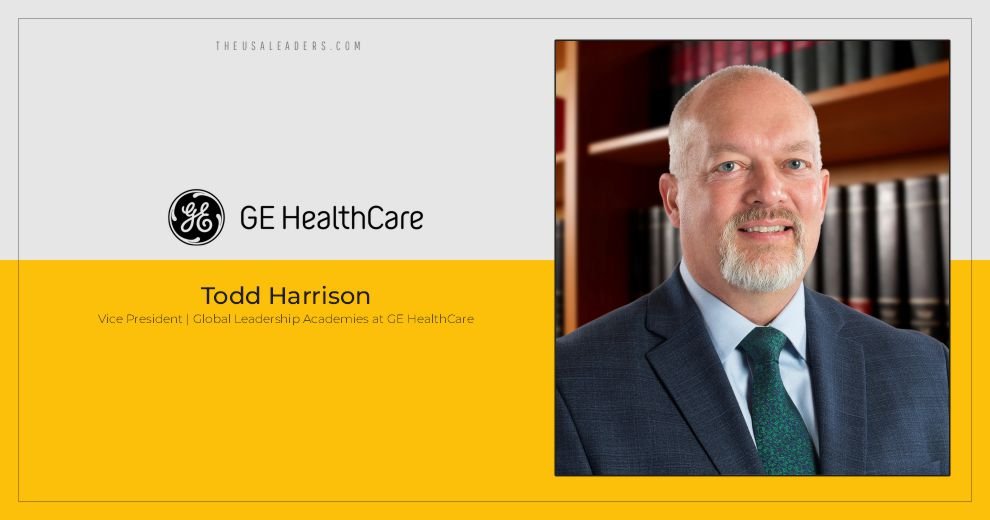
Dr. Todd Harrison is one of those people. His career has stretched across battlefields, boardrooms, classrooms, and global organizations. He spent twenty-three years as a U.S. Army officer, including over a year serving in Iraq during a war that tested leaders not in theory, but in the hardest conditions imaginable, what he called his “crucible experience” as a leader. He retired as a Lieutenant Colonel in 2005, but he did not step away from leadership. In many ways, that was when the next chapter of his leadership story began.
For more than two decades since leaving the military, Harrison has devoted his professional life to a mission that sounds simple but is anything but: helping organizations build better leaders. Today, as Vice President, Global Leadership Academies at GE HealthCare, he is leading one of the most ambitious efforts of his career. He is helping create a world-class leadership development ecosystem for one of the world’s most consequential healthcare companies. It is work that requires strategy, science, discipline, patience, and a clear understanding of what leaders need in a world that refuses to stand still.
Leadership, at its core, is about navigating uncertainty. Harrison has been doing that in one form or another for nearly his entire adult life.
The Uniform Before the Boardroom
Long before Harrison was shaping leadership development strategy for a global healthcare company, he was learning leadership in an environment where decisions carried immediate consequences.
The Army gave him structure, discipline, and responsibility. It also gave him a front-row seat to the way organizations function under pressure. Over time, he came to understand that leadership is not simply about rank, authority, or charisma. It is about behavior. It is about clarity. It is about trust. It is about whether people are prepared to act when the situation becomes difficult, uncertain, or complex.
One of the most defining moments of his military career came during an assignment at the Army’s Organizational Effectiveness Center and School, where he became certified as an organizational effectiveness consultant and instructor. It was there that his passion for leadership development moved from instinct to vocation.
“This experience was a major turning point in my life by providing focus for my post-military career,” Harrison reflects.
That turning point gave shape to everything that followed. When he transitioned out of the Army, he carried with him more than the lessons of command. He carried a way of seeing organizations. He understood that strong leadership does not happen by accident. It must be deliberately developed, reinforced, measured, and practiced over time.
His first civilian role was in a healthcare corporation, working in learning and leadership development. It became the foundation for what would grow into a twenty-plus-year post-military career dedicated to the science and practice of helping leaders grow.
The Crotonville Legacy and a New Mandate
In January 2023, GE HealthCare separated from GE and became an independent, publicly traded company. The move marked a major milestone in the company’s history. It also created a leadership development challenge that few organizations ever face.
For decades, GE had access to the legendary John F. Welch Leadership Development Center, widely known as Crotonville. The institution was recognized around the world as one of the premier centers for corporate leadership training. When GE HealthCare became independent, that access was gone. The company needed to build its own leadership development capability. Not a small program. Not a temporary replacement. A full system.
Harrison’s role was created in response to that need. He was brought in with a clear and ambitious mandate: build a world-class leadership development system from the ground up. He was new to the organization, and he did not assume that yesterday’s model would solve tomorrow’s problems. Instead, he approached the challenge the way a seasoned leader, researcher, and practitioner would. He began by asking better questions.
He drew on his doctoral education in Organizational Leadership. He reviewed current best-practice research in leadership development. He studied emerging insights from neuroscience and learning science. The conclusion was clear: the traditional model of leadership development, built largely around week-long, immersive, campus-based programs, was no longer enough. Crotonville had been iconic, but the science of development had moved forward. So, Harrison moved forward, too.
Building Leaders Over Time, Not in a Week
Harrison’s philosophy is built on a practical truth: leaders do not become better because they attended an impressive event. They become better when new skills are introduced, practiced, reinforced, coached, and turned into habits.
Instead of flooding leaders with content in a single intensive session, Harrison favors a blended model delivered over a longer period. His approach “dose-feeds” development. Leaders focus on one or two skills at a time, apply them in real work, reflect on the experience, receive feedback, and then build from there. It is a more patient model. It is also a more serious one.
At the foundation of his approach are two key ideas. The first is The Leadership Pipeline, developed by Ram Charan, Stephen Drotter, and Jim Noel. The model holds that leaders must make meaningful shifts in mindset and skill as they move from individual contributor to frontline manager, from manager to executive, and eventually to enterprise leader.
The second is the Leadership Strateplex, a framework that explains how the mix of skills required for leading self, leading others, and leading the business changes at each level of leadership.
Together, these ideas reinforce one of Harrison’s central beliefs: leadership development must be targeted to the leader’s level, context, and future responsibilities. A new frontline leader does not need the same development experience as a senior executive. A high-potential emerging leader does not need the same support as someone preparing to lead a global business. Development must meet leaders where they are and prepare them for where they are going.
The Three-Legged Stool
From these foundational concepts, Harrison built a leadership development methodology that he often describes as a three-legged stool. The metaphor is simple because the principle is simple: remove one leg, and the entire system becomes unstable.
The first leg is self-insight through assessment. Harrison distinguishes between two types of assessments. Signs-based assessments, such as Hogan, CliftonStrengths, and EQ-i, help leaders understand their preferences, tendencies, and patterns. These tools support self-awareness and discovery. Signals-based assessments, including 360-degree and multi-rater tools, focus on observable behavior and skill proficiency. They show leaders how others experience them.
Together, these assessments create a more complete picture. They help leaders understand not only who they are inclined to be, but how their leadership is actually landing with others.
The second leg is the extended learning journey. For Harrison, leadership development should not be a one-time event. It should be a structured experience that unfolds over time. Leaders need new insights, repeated practice, and opportunities to apply what they are learning in real work. Only then do new behaviors become habits. Only then do habits create different results.
The third leg is coaching. Harrison sees coaching as essential because it helps translate learning into action. “Coaching serves as a force multiplier in the transfer of the skills learned back on the job and to help add context to what is being learned,” he explains.
Without coaching, even well-designed programs can become inspirational moments that fade after participants return to the pressure of daily work. With coaching, the learning has a stronger chance of sticking. That is the power of the stool. Assessment creates insight. Learning journeys build capability. Coaching accelerates transfer. Together, they make development durable.
From “Feed the Beast” to the Future of AI
In the early days after GE HealthCare’s spin-off, Harrison describes the leadership development strategy with characteristic candor. He called it “Feed the Beast.” The phrase captures the urgency of the moment. The company had immediate gaps to close. Leaders need development opportunities. The business needed momentum. There was no luxury of waiting for a perfect system to emerge fully formed.
So, Harrison and his team moved quickly and deliberately. They addressed the most urgent needs first while keeping a longer-term architecture in mind.
Now, the strategy is evolving. Harrison and his team are incorporating artificial intelligence and simulations as reinforcing tools that help leaders transfer learning from formal programs into daily work. They are also expanding into more on-the-job experiential development, partnering directly with the talent management team to identify rotational assignments and other experiences that strengthen leadership capability.
This aligns with the well-known 70-20-10 model associated with Morgan McCall, Michael Lombardo, and Robert Eichinger, which suggests that effective development comes primarily from experience, supported by relationships and feedback, with formal education playing a smaller but still important role.
Harrison also regionalized program delivery to make the work more relevant. By involving local leaders in training, the development experience becomes more contextual and grounded in the realities leaders face in different parts of the world. The goal is not simply to teach leadership concepts. It is to help leaders apply those concepts in the environments where they actually lead.
Making the Case for Investment
Anyone who has worked in talent or leadership development knows the argument. Eventually, especially during periods of financial pressure, someone asks whether leadership development is a cost that can be reduced. Harrison has encountered that misconception throughout his career.
“The greatest misconception I have encountered is that leadership development is still perceived as a cost instead of an investment,” he says.
His response is practical and business minded. First, he uses a statistically based predictive analytics survey process to gather feedback from both participants and their managers. The evaluation looks at immediate feedback after a program and then again 90 days later, creating a clearer picture of whether learning is translating into behavior and impact.
Second, he designs programs that are explicitly tied to the business. The work is not abstract. It is connected to real organizational challenges, real leadership pain points, and real performance needs.
That approach has helped the work withstand scrutiny. Even amid recent macroeconomic pressure, GE HealthCare’s leadership development system has remained fully funded. The central budget is deliberately lean, and much of the investment comes directly from the business units. That matters. When business leaders continue to invest in developing their people during financially challenging periods, it signals that they see the work as valuable, relevant, and connected to outcomes.
For Harrison, one of the strongest indicators of success will be seen in the company’s growing pool of ready-now successors for critical roles. Leadership development is not just about helping individuals grow. It is about strengthening the organization’s future.
Recognition Beyond the Organization
The impact of the work has not gone unnoticed. In 2025, GE HealthCare’s Leadership Academies received three Gold awards and one Silver award from the Brandon Hall Group, a professional HR and talent research organization. That same year, Development Dimensions International, a leadership development and assessment research company with a 50-year history, honored the program with its top award for Leadership Development Design.
Awards are not the reason Harrison does the work. But in a field where excellence requires rigor, relevance, and measurable impact, external recognition offers another form of validation. It confirms that the system being built at GE HealthCare is not only filling a gap left by the spin-off. It is creating something distinctive in its own right.
The Tested Leader
Building a system is harder than launching a program. Harrison knows this from experience. Throughout his career, one of his recurring challenges has been persuading organizations to think beyond episodic training. Many companies are comfortable with individual programs. Far fewer are prepared to commit to a comprehensive leadership development system that takes years to mature.
Harrison’s response has been steady and strategic. He lays out the long-term roadmap so stakeholders can see the full destination. Then he builds incrementally, adding components over time at a pace the organization can absorb. It is a disciplined approach: hold the larger vision, then execute it in stages.
That instinct feels connected to his military background. The mission matters, but so does the sequence. You do not build durable capability by rushing the foundation. You build it by knowing where you are going and then taking the next right step.
The Life That Sustains the Work
Harrison takes self-care seriously because he understands that leadership is demanding work. It requires attention, energy, and emotional discipline. A leader who helps others grow must also remain committed to his own growth.
His practices are deliberate. He meditates and practices mindfulness, paying attention to the present moment with openness and without judgment. He commits to high-intensity interval training at least four times a week. At work, he blocks focus time on his calendar and protects it from the constant pull of back-to-back meetings.
Outside work, his interests include hiking, traveling, woodworking, and reading. Together, they reveal a life that is physical, creative, reflective, and exploratory.
There is a quiet consistency between the way Harrison lives and the way he leads. He believes in systems, discipline, practice, and renewal. Those principles show up not only in the leadership academies he builds, but in the way he manages his own energy and attention.
What Comes Next
Harrison is clear-eyed about the next chapter. He plans to retire from the corporate world in early 2027. But retirement from corporate life will not mean retirement from leadership. He intends to continue contributing to the field through guest speaking, consulting, and writing. He also plans to keep offering his leadership skills to nonprofit organizations, where strong leadership is often deeply needed, and development resources can be limited.
The field itself is still changing. Harrison believes leadership development must become more contextual, more immediately applicable, and more closely connected to the realities leaders face in their roles. He also believes artificial intelligence will become a new force multiplier, creating what he describes as “hybrid intelligence.” But even as the tools change, Harrison is clear that the human core of leadership must remain at the center.
“We need to build leaders who are prepared to create the future they want to see, even if the future is not always clear,” he says.
It is a fitting belief for someone who has spent a career helping people lead through uncertainty.
Leaving It Better
Harrison firmly believes that the best way to predict the future is to create it. In a world he describes as permanently VUCA: volatile, uncertain, complex, and ambiguous — leadership development is not simply preparation for change. It is one of the ways organizations create the future they hope to inhabit.
That idea has guided Harrison from his years in uniform to his work in healthcare and global leadership development. It will likely guide whatever comes next. Beneath it all is the mantra he has lived by throughout his career: “To leave it better than I found it.” The “it,” he is careful to explain, means anyone or anything he encounters.
That is more than a personal motto. It is a complete leadership philosophy. It is the throughline of a career spent serving, building, teaching, and preparing others to step into the future with greater courage and capability. And for Todd Harrison, it may be the clearest measure of a life’s work.