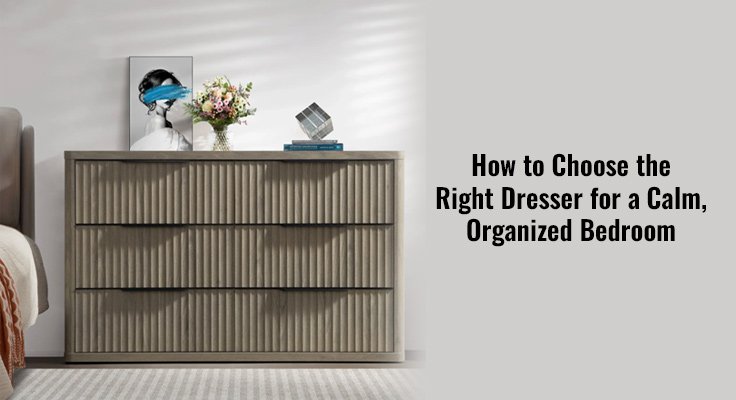
A calm bedroom rarely happens by accident. It is not just about soft bedding, warm lighting, or a beautiful wall colour. More often, the difference between a room that feels restful and one that feels visually busy comes down to storage — specifically, whether everyday clothing and household items have a proper place to go.
Clothes need a home. So do extra linens, accessories, pyjamas, folded sweaters, chargers, and the small things that somehow end up on chairs and nightstands. When a bedroom does not have enough hidden storage, clutter quietly becomes part of the decor whether you planned it or not.
That is why choosing the right dresser for the bedroom matters. A bedroom dresser is not just a place to put clothing. It can become the quiet anchor of the room — the piece that keeps daily routines organized, helps the space feel finished, and supports the overall style of the bedroom.
The challenge is that dressers come in many forms: tall, wide, compact, modular, three-drawer, six-drawer, nine-drawer, light wood, dark wood, rattan-fronted, fluted, modern, traditional. The right choice depends less on what looks good in a product photo and more on how the room actually works in real life. This guide walks through the practical decisions that matter, in the order most buyers should think about them.
Start With the Real Problem: What Do You Need to Store?
Before thinking about colour or style, start with the storage problem itself. A dresser should be chosen around what it needs to hold — not the other way around.
For some people, daily storage is mainly T-shirts, socks, and folded basics. For others, it is sweaters, denim, bedding, children’s clothes, workout gear, or seasonal items. A dresser that looks beautiful but cannot handle real storage volume will only push the clutter somewhere else — usually onto a chair, a bench, or the bed itself.
Before shopping, ask:
- How many people will use this dresser day to day?
- Is it storing everyday clothing or seasonal overflow?
- Do you need shallow drawers for small items, or deeper drawers for bulky pieces?
- Will the dresser replace closet storage or simply support it?
- Will the top be styled with art and a lamp, or used as a daily drop zone?
A useful rule of thumb on drawer count:
- A single person in a small bedroom is often comfortable with a 3- or 4-drawer dresser.
- A couple usually needs at least 6 drawers to keep clothing properly separated.
- A family bedroom, primary suite, or shared room may need 8 or 9 drawers.
The best dresser is not always the largest. It is the one that matches your clothing volume, your room size, and the way you actually live.
Tall Dresser vs. Wide Dresser: Choose Based on Room Shape
One of the most common bedroom-furniture mistakes is choosing a dresser based only on drawer count. Room shape matters just as much.
A tall dresser works well when floor space is limited. It uses vertical space instead of stretching across the wall, which makes it useful for apartments, smaller bedrooms, guest rooms, and narrow layouts. If you need more storage but do not have a long open wall to give up, a tall dresser is usually the smarter choice.
A piece like the Savanna 7-Drawer Tall Dresser shows what this format does well: seven stacked drawers deliver substantial clothing storage on a narrow footprint, which is exactly what a smaller bedroom usually needs. The vertical proportions also make a low-ceiling room read taller — a useful side effect in flats and older houses.
A wide dresser, by contrast, works best when the bedroom has a longer wall and enough walking space in front of it. It can create a grounded, finished look — especially in a primary bedroom — and offers a larger top surface for a mirror, lamp, framed art, or a small styled tray.
| Dresser Type | Best For | Main Benefit |
|---|---|---|
| Tall dresser | Small bedrooms, narrow walls, apartments | Saves floor width while adding vertical storage |
| Wide dresser | Larger bedrooms, long open walls, primary suites | Adds storage and creates a clear visual anchor |
| Low dresser | Under windows, lighter rooms, smaller spaces | Keeps the room feeling open and airy |
| Modular dresser | Growing storage needs or flexible layouts | Adapts as the household and room evolve |
A simple decision rule: if the bedroom already feels full, choose a tall dresser and go vertical. If the bedroom feels unfinished or under-furnished, a wider dresser can help anchor the space and make the room feel complete.
Why Drawer Count Matters More Than Most People Think
Drawer count is not a small product detail. It directly shapes how easy the dresser is to use every single day.
A 3-drawer dresser may work in a guest room, child’s room, or small apartment where storage needs are modest. A 6 drawer dresser is often the most balanced choice for the majority of bedrooms — it offers enough separation for daily organization without feeling oversized. Larger 8- or 9-drawer dressers are better for couples, families, or anyone who wants to fully separate clothing by category.
Think of drawer count as a built-in organization system:
- One drawer for socks and undergarments
- One drawer for T-shirts
- One drawer for sleepwear
- One drawer for workout or loungewear
- One drawer for sweaters or denim
- One drawer for seasonal or occasional items
If you constantly stack unrelated items in the same drawer, the dresser is almost certainly too small for your routine — and the bedroom will feel the strain.
For bedrooms that need balanced storage without overwhelming the room, the Cas 6-Drawer Dresser is a strong example of a storage-rich piece that can keep clothing and everyday essentials neatly tucked away. Six drawers create enough structure for daily organization while still fitting naturally into most bedroom layouts — a sweet spot that explains why this format works for so many households.
For couples and families who genuinely need more separation, a larger format like the Zura Modular 9-Drawer Dresser is the better answer. Nine drawers let two people each have their own categories without sharing space, which prevents the slow drift toward stacking unrelated items in the same drawer — the most common reason a dresser stops feeling organized after a few months.
Measure the Room Before Falling in Love With a Dresser
A dresser can look right online and still feel wrong in the room. That usually happens when buyers measure the wall but forget how the furniture needs to function once it is actually in use.
Before ordering, measure all of these — not just the obvious ones:
- The full wall width, including baseboards and outlets
- The dresser width and depth
- The space in front of the drawers when fully extended
- The distance between the dresser and the bed
- Door swings and closet access
- Heating vents, radiators, or windows that the dresser cannot block
The most overlooked measurement is the clearance in front. Drawers need room to open all the way, and the person using them needs space to stand comfortably. A practical rule: take the dresser depth, add the depth of a fully open drawer, then add a little extra for standing room. If the dresser faces the foot of the bed, measure from the dresser front to the bed frame — not just from wall to wall.
Painter’s tape is the cheapest design tool available. Tape the dresser footprint on the floor before ordering, then walk the room as you would on a normal morning. Open the closet door. Pretend to pull out the top drawer. Cross to the bathroom. If the taped shape feels tight, the actual dresser will feel tighter once it is loaded with clothing.
This simple step prevents one of the most frustrating online furniture mistakes: buying a piece that technically fits but quietly makes the bedroom harder to live in.
Choose a Finish That Supports the Bedroom Mood
Once size and drawer count are settled, finish becomes the next decision. A bedroom dresser takes up a meaningful amount of visual space, so its finish can shift the mood of the entire room.
Light wood tones make smaller bedrooms feel brighter. Warm wood softens neutral walls. Rattan or woven fronts add natural texture and a relaxed, organic feel. Matte finishes feel quieter than glossy ones. Darker woods bring weight and depth, but can shrink a small room if there is not enough natural light. Fluted or vertical-line fronts make storage feel more designed without being loud.
A few simple guidelines:
- Choose light or warm finishes for smaller bedrooms.
- Use darker finishes only when the room has enough natural light and visual space.
- Add rattan or woven texture if the room feels too smooth or sterile.
- Choose clean-lined fronts for a calmer, more modern look.
- Repeat at least one finish or material somewhere else in the room — frames, lamp bases, side tables — so the dresser does not feel isolated.
A bedroom does not need to be perfectly matched, but it should feel coordinated. The dresser should support the mood, not compete with it.
Think of the Bedroom as a Collection, Not a Single Piece
Many people shop for a dresser as a one-off purchase, but bedrooms almost always work better when furniture is chosen as part of a larger story.
A dresser does not have to match the nightstands exactly — in fact, mixing pieces often makes a room feel more personal. But there should be a connection: a shared wood tone, a similar silhouette, a repeated texture, or a consistent level of visual weight. If every piece has a different finish, scale, and style, the room can feel accidental even when each item looks good on its own.
This matters more in a bedroom than almost any other room, because the main pieces sit close together. The dresser, nightstands, bed frame, and any wardrobe or bench all share the same field of view from the bed and the doorway.
If you are building a more coordinated bedroom over time, browsing a full range of bedroom dressers can help you compare drawer count, scale, finish, and matching storage options in one place — and see which pieces share a design language with the nightstands or bed you already own.
Thinking in collections also makes future purchases easier. You might start with a dresser, then add nightstands a few months later. Or you may begin with a smaller storage piece and come back for a larger dresser once you know the finish works in the room. The goal is not to make everything identical. It is to make every piece feel like it belongs.
Don’t Ignore Assembly, Weight, and Everyday Use
A dresser is a practical purchase, and the practical details matter as much as the design ones.
Because dressers are larger furniture pieces, assembly should be part of the decision — not a surprise after delivery. A small nightstand may take 20 minutes; a multi-drawer dresser will realistically take longer and need more space. That is normal, but it should be planned for.
Before ordering, think through:
- Will you have enough floor space to assemble the piece comfortably?
- Can one person manage the parts, or will a second person be helpful for the larger panels?
- Are clear instructions and labelled hardware included?
- Does the dresser include anti-tip or wall-anchoring hardware — especially important in a child’s room?
- Will the assembled piece be easy to slide into final position?
Durability also lives in the small details: drawer glide quality, handle placement, surface finish, and how stable the piece feels once it is loaded with clothing. These are not as exciting as colour and style, but they shape the daily experience of the dresser for years.
Honest expectations help. A well-made flat-pack dresser is not “effortless” to assemble, but with clear instructions and a free hour, it can be a smooth, satisfying project.
A Quick Checklist Before You Buy
A good dresser should answer both design questions and practical ones. Run through this short checklist before placing an order:
| Question | Why It Matters |
|---|---|
| Does it fit the wall and allow drawers to open fully? | Prevents layout problems after delivery |
| Does the drawer count match your clothing volume? | Avoids under-buying storage and re-cluttering the room |
| Is the finish easy to coordinate with what you have? | Helps the bedroom read cohesive, not collected by accident |
| Does it match or complement your nightstands? | Supports a complete, intentional bedroom look |
| Is the scale right for the room? | Keeps the bedroom balanced rather than crowded |
| Are shipping, returns, and assembly expectations clear? | Reduces the risk of buying online without seeing the piece |
| Does the top surface support your real routine? | Helps with daily use and surface styling |
| Does it actually solve your clutter problem? | Keeps the purchase practical, not just aesthetic |
If a dresser passes most of these questions, it is far more likely to work long-term. The right piece should make the bedroom easier to maintain — fewer items left on chairs, calmer mornings, and a room that feels organized without constant tidying.
Where Sicotas Fits Into the Bedroom Storage Decision
For many shoppers, the ideal dresser sits between two extremes. They do not want something that feels disposable or short-lived. But they also may not want — or need — to spend on heavy solid hardwood or designer-priced bedroom storage furniture.
That middle ground is where value and design quality matter most. The best option is usually a dresser that delivers a refined look, useful drawer storage, and a finish that genuinely works with the room — without pushing the project beyond a realistic budget.
For shoppers looking for elevated storage pieces at a more accessible price point, Sicotas furniture offers coordinated bedroom and storage collections designed for real rooms, real routines, and real budgets. The collections are built to be expanded over time — start with a dresser, layer in matching nightstands later, and add a wardrobe or bench as the room evolves.
That phased, collection-based approach is closer to how most homes actually come together. You do not need to buy everything in one weekend. You need a first piece that fits the room properly, supports the way you live, and gives the rest of the bedroom something to coordinate with later.
A Calm Bedroom Starts With Storage That Works
A calm bedroom does not come from hiding every sign of daily life. It comes from giving daily essentials a proper place to go.
The right dresser for your bedroom should fit the room, support the way you store clothing, coordinate with the rest of the space, and make everyday routines feel easier. It should offer enough drawers for how you actually live, enough clearance for how you move through the room, and enough visual warmth to support the mood you want.
Choose the scale carefully. Pay attention to drawer count. Measure before buying. Think about the bedroom as a whole rather than a single isolated piece. And be honest about the practical realities — assembly, weight, durability — that will shape how the dresser feels a year from now, not just on the day it arrives.
A dresser may not be the loudest design feature in the bedroom. But chosen well, it can be the quiet piece that makes the entire room feel more organized, more polished, and much easier to live in.