The USA Leaders
Healthcare looks very different in 2026 than it did just a few years ago. The days when the future of medicine felt like science fiction are over. Smartwatches, remote monitoring, and AI‑driven workflows are already changing how doctors diagnose and how patients manage their care. The Healthcare Industry Trends 2026 show a shift from a reactive, visit‑based system to one that focuses on continuous wellness, real‑time data, and early intervention.
Patients now expect healthcare to be as smooth and seamless as digital banking. Providers who ignore these changes risk falling behind in both quality and competitiveness. At the same time, the U.S. healthcare industry market size continues to grow, with projections pointing to a global healthcare services market of around $7.5 trillion by the end of the decade.
What are the 5 trends in healthcare for 2026?
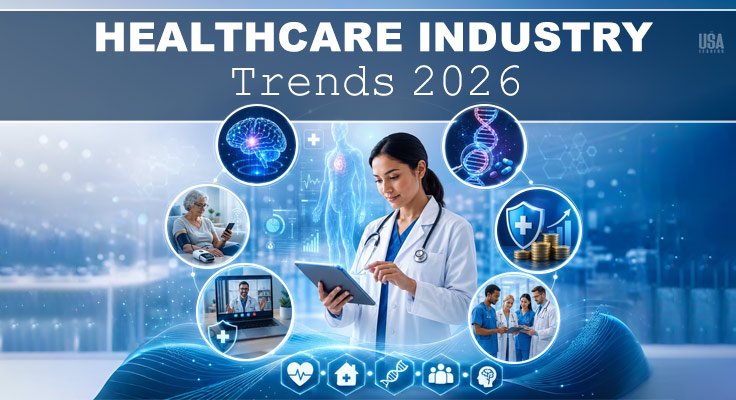
The five most significant trends shaping healthcare in 2026 include:
- AI-Powered Health Intelligence: Moving beyond basic automation toward “agentic AI” that manages complex clinical workflows.
- Home-Centric Decentralized Care: A shift of acute care into the home via advanced remote monitoring and hospital‑at‑home models.
- Hyper-Personalized Precision Medicine: Using pharmacogenomics and DNA mapping to tailor drug dosages to individual biology.
- Value-Based Care Maturity: A transition where insurers pay for patient health outcomes rather than the volume of procedures.
- Interdisciplinary Workforce Teams: Using collaborative models to combat clinician burnout while integrating specialized health-data roles.
Understanding the Future of Healthcare
Predicting the future of medicine used to feel like reading a sci-fi novel. However, as we navigate through 2026, the “future” is already appearing on our smartwatches and in local clinics.
The Healthcare Industry Trends 2026 point toward a system that is no longer reactive. Instead, it is a system built on maintaining wellness through real-time data and predictive intelligence.
The U.S. healthcare industry market size continues to be a global titan. According to “The 2026 Deloitte Global Healthcare Outlook”, the healthcare services market will reach $7.5 trillion globally by the end of the decade.
Specifically, North America leads with over 40% of that global healthcare growth. Yet, the sheer size of the industry is no longer the main story. The real narrative focuses on how it is changing.
Patients now expect their care to be as seamless as their digital banking. Consequently, providers must adapt to these changes in healthcare by 2026 or risk becoming obsolete in a competitive market.
What is the Importance of Predicting Healthcare Industry Trends 2026?
Why do we care so much about what happens this year? Healthcare is not a speedboat; it is a massive tanker. It takes years to turn.
For providers, investors, and patients, understanding these shifts is vital for survival. Accurate predictions help with resource allocation. For instance, hospitals need to know if they should build physical beds or invest in cybersecurity for remote monitoring.
For investors, understanding these trends is critical for capital placement. Healthcare venture capital reached record heights in 2025, according to the“Silicon Valley Bank Healthcare Investments and Exits Report”. Notably, 60% of that funding focused on AI and telehealth platforms.
Finally, these trends impact patient outcomes directly. Early adoption of genomic screening can literally be the difference between life and death. Therefore, staying ahead of the curve is both a moral and a financial imperative for the modern health system.
What are the Key Factors Driving Change in Healthcare?
Change does not happen in a vacuum. Three main “engines” are pushing us forward.
First, the “Silver Tsunami” is a primary driver. An aging global population requires more chronic disease management than ever before. This demographic shift remains one of the most consistent international healthcare trends we see today.
Second, economic pressure also plays a massive role. The us healthcare industry is facing a sustainability crisis. Costs are rising at an unsustainable rate, which forces a shift toward extreme operational efficiency.
Lastly, consumerism has changed everything. Patients now expect healthcare to be easy and fast. Therefore, convenience is no longer a luxury; it is a basic requirement for any provider.
Technological Innovations Shaping Healthcare
What is the Role of Artificial Intelligence in Healthcare?
Among the technological innovations driving Healthcare Industry Trends 2026, AI stands out as the primary disruptor. It has become the “digital stethoscope” of every modern doctor.
We have moved from Generative AI to “Agentic AI.” These are coordinated AI systems that can manage entire patient workflows. In the U.S. healthcare industry, AI is finally tackling administrative “bloat.”
This overhead accounts for nearly 25% of total healthcare spending. By automating billing and scheduling, AI allows doctors to actually look their patients in the eye again. Logic dictates that if we remove the paperwork, we improve the care.
Furthermore, AI algorithms now identify patterns in medical imaging faster than the human eye. According to a 2025 JAMA study on AI-assisted colonoscopy, AI-enabled systems reduced missed polyps by up to 50% compared to human-only reviews.
Telemedicine and Remote Patient Monitoring (RPM)
If 2020 was the “birth” of modern telemedicine, 2026 is its “adulthood.” It is no longer just a Zoom call with a doctor. International healthcare trends show a massive rise in “Hospital-at-Home” programs.
With RPM, your doctor receives a ping if your vitals spike at 3:00 AM. This is not just a convenience. It is a massive shift in Healthcare Industry Trends 2026 toward preventative intervention.
Furthermore, these tools reduce the burden on physical emergency rooms. According to a 2025 AHA report on telehealth adoption, telehealth visits have stabilized at 25% of all outpatient encounters. Therefore, we save the hospital beds for those who truly need surgical intervention.
The Rise of Digital Therapeutics (DTx)
Software is now being prescribed as medicine. Digital therapeutics offer three key advantages:
- 24/7 Availability – Continuous support without appointment scheduling.
- Real-Time Data – Clinicians adjust treatments based on immediate feedback.
- Cost Efficiency – Software scales far cheaper than human intervention.
These tools are especially effective for chronic insomnia and mental health. They offer a level of frequency that human doctors simply cannot match. This is one of the medical industry developments this year that is truly democratizing access to care.
Policy Changes and Their Impact on Healthcare
The Influence of Health Insurance Reforms
The healthcare trends in the United States are inextricably linked to payment models. By 2026, we see a deeper penetration of “Value-Based Care.” This is a significant change from the “fee-for-service” models of the past.
Insurance companies are increasingly refusing to pay for “volume.” They no longer care how many tests a doctor runs. Instead, they pay for “value.” They want to know if the patient actually got better and stayed out of the hospital.
In contrast to previous years, transparency in pricing is no longer optional. Patients are feeling the squeeze of rising premiums. As a result, clinics that provide clear, upfront pricing are winning the market.
Regulatory Changes Affecting Healthcare Delivery
Governments globally are tightening data privacy laws. We want our data to be used for better care. However, “Health Data Sovereignty” has become a major talking point in 2026.
Expect stricter regulations on how AI companies use patient data. Regulatory bodies are now auditing AI models for bias. This ensures that healthcare remains fair for all demographics, regardless of their background.
Additionally, new policies are streamlining the approval for medical devices. This allows life-saving tech to reach the market faster. The gap between lab discoveries and clinical reality is shrinking every month.
The Rise of Patient-Centered Care
The Shift Towards Personalized Medicine
The days of “take two aspirin and call me in the morning” are over. Emerging healthcare industry trends suggest that pharmacogenomics is now standard in oncology and cardiology.
Personalized medicine ensures you get the right dose of the right drug. It is logical to stop the trial-and-error approach. Why guess when your DNA can answer?
For example, cancer treatments are now tailored to the genetic makeup of the tumor. This increases the efficacy of chemotherapy while reducing side effects. Patients are no longer just statistics; they are individuals with unique biological blueprints.
What is the Impact of Patient Engagement on Healthcare Outcomes?
A patient who is engaged is a patient who heals faster and more completely. The relationship has shifted from the doctor as “commander” to the doctor as “consultant,” a partnership model where both parties share decision-making responsibility.
This shift is fundamental to the changes in healthcare 2026. Apps and portals allow patients to see their own data in real-time. This transparency leads to better compliance with medication.
When people see their health metrics improve on a screen, they stay motivated. Therefore, high engagement leads to lower hospitalization rates. It is a win-win for everyone involved, from the patient to the insurer.
The Evolution of Healthcare Workforce
The Increasing Demand for Specialized Healthcare Professionals
We are facing a global shortage of healthcare workers. However, the current trends reshaping American healthcare are not just about needing more people. We need different skills.
The industry now seeks “Bio-informaticists” and “Health-data Analysts.” These professionals bridge the gap between medicine and technology. They help make sense of the mountains of data we collect daily.
Moreover, the demand for specialized nursing is skyrocketing. As care moves out of hospitals, we need expert nurses in outpatient centers. This evolution is reshaping medical education across the globe to focus on “whole-person” care. For healthcare professionals preparing for work as a doctor, understanding how to collaborate with specialized nurses in multidisciplinary care settings is becoming an increasingly valuable part of modern clinical practice.
The Role of Interdisciplinary Teams in Healthcare
The “Lone Wolf” doctor is a myth of the past. The future belongs to the team. A modern team often includes these key roles:
- The Physician: Focuses on diagnosis and clinical strategy.
- The Pharmacist: Manages complex drug interactions in real-time.
- The Data Analyst: Identifies trends in patient vitals before symptoms appear.
- The Social Worker: Addresses social determinants of health, such as housing.
By 2026, these teams will be the standard for treating chronic conditions. They ensure that the mental and physical needs of the patient are met. This holistic approach is much more effective than isolated care.
Global Perspectives: International Healthcare Trends
When comparing key Healthcare Industry Trends 2026 across regions, we see different priorities. While the US healthcare industry focuses on cost-reduction, many nations are prioritizing “Green Healthcare” initiatives.
In Europe, hospitals are working to reduce their carbon footprint. They recognize that a sick planet leads to sick people. Meanwhile, in Asia, we see a rapid leapfrogging of traditional infrastructure.
Mobile-first healthcare delivery systems are blooming there. These systems bypass the need for physical clinics in rural areas. They bring the doctor directly to the smartphone, proving that digital access is a global equalizer.
U.S. Healthcare Industry Market Size: A 2026 Projection
Experts predict the U.S. market will see continued growth in MedTech. Innovation remains the only way to lower costs in the long run.
Statistics at a glance:
- 60% of U.S. hospitals now use some form of AI for triage, according to a 2025 HealthIT snapshot of hospital AI use.
- The global market for wearable medical devices is growing by 15% annually.
- Remote monitoring has reduced hospital readmission rates by 20% for heart failure patients.
Quick Recap: 5 Game‑Changing Shifts
- AI Integration: Moving from theory to daily clinical practice for better diagnostics.
- Home‑Centric Care: The “hospital” is now your living room, powered by advanced remote patient monitoring.
- Genomic Medicine: DNA‑based treatment plans that eliminate drug guesswork.
- Value‑Based Payment: Moving from “pay‑per‑visit” to “pay‑for‑results” models.
- Mental Health Parity: Digital tools expanding access and reducing stigma in mental health care.
Conclusion: Preparing for the 2026 Shift
The Healthcare Industry Trends 2026 reveal a sector that is finally catching up to the digital age. It is a mix of high-tech tools and high-touch care. We are using AI to be more human, not less.
For the US healthcare industry, the challenge is balancing innovation with affordability. However, the path forward is clear. We must embrace data to drive better decisions.
As these Healthcare Industry Trends 2026 reshape medicine, staying informed isn’t optional; it’s essential. Whether you’re choosing a provider, investing in health-tech, or simply managing your own care, understanding these shifts empowers better decisions.
Which of these Healthcare Industry Trends 2026 will impact your health journey the most this year, and how are you planning to adapt?
FAQ: Future of Healthcare 2026
How will AI change my doctor’s visit in 2026?
Expect your doctor to spend less time typing and more time talking. AI ambient listening tools now handle medical charting, while predictive tools help suggest the most effective treatments based on your history.
Is remote patient monitoring safe?
Studies increasingly show that, for many chronic conditions, remote patient monitoring is at least as safe as traditional in‑clinic care and often safer, thanks to continuous oversight. Secure, encrypted devices send data directly to your clinical team, catching issues before they become emergencies.
What is the “Silver Tsunami” in healthcare?
The “Silver Tsunami” refers to the rapid growth in the population over age 65. This trend is a major driver of Healthcare Industry Trends 2026, fueling demand for geriatric care, chronic disease management, and home‑based health technologies.
Will AI replace doctors in 2026?
No. AI supports doctors by automating paperwork and analysis so they can focus more on patients, not replace them.
How does value-based care affect me as a patient?
Value‑based care rewards better health outcomes, not visit volume. This often means more proactive, coordinated care and fewer unnecessary hospital stays.