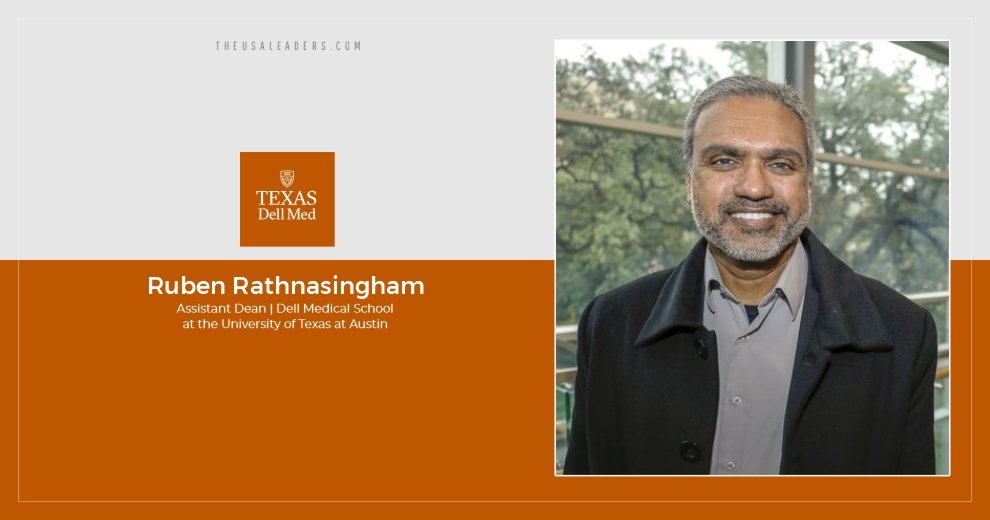
There is a number that Ruben Rathnasingham mentions, and when you first hear it, it does not quite land. Sixty. As in 60X, meaning sixty times the return on innovation investments, generated across academic and industry settings over the course of a career spent turning research into reality. Sixty times.
In a field where investment returns are measured against extraordinary uncertainty, where most promising discoveries never reach the market, and most startups never reach scale, that number is not just impressive. It is the kind of result that makes you want to understand how it happened.
Ruben is the Assistant Dean at Dell Medical School at the University of Texas at Austin, and before that, the former Associate Director at UCSF. The 60X return is one piece of a larger story about what is possible when someone builds the right infrastructure around the right mission.
“I lead strategic innovation initiatives that transform breakthrough research into market-ready solutions, generating exceptional returns while advancing patient care and community health,” he has said, and the sentence contains within it a pairing that is harder to achieve than it sounds: the financial and the human, the returns and the patients, held together rather than traded against each other.
A Portfolio That Speaks
The metrics of Ruben’s career form a portrait of sustained, deliberate impact. There is a 60X return on innovation investments across academic and industry settings, a number that reflects not luck but system-building. There is a 4X surge in intellectual property generation and protection, meaning that the institutions and collaborators he has worked with are not just producing more ideas but protecting them better, creating the legal and commercial infrastructure for those ideas to travel.
There is a 6X increase in successful licensing agreements and startup formations, a figure that speaks directly to the thing that matters most in technology commercialization: the translation, not just the creation of intellectual property, but its successful movement into the market, into the hands of companies that can carry it forward.
And there is the $60 million raised across three successful healthcare venture exits, a sum that represents not just financial return but the validation of three separate bets on three separate technologies, each of which found enough commercial traction to deliver an outcome.
These are not sequential accomplishments. They are the result of 50+ strategic industry partnerships spanning life sciences, medtech, and health IT, a network of relationships built over years across multiple institutions and multiple sectors.
The Texas Health Catalyst
At the University of Texas at Austin, Ruben has done something that goes beyond individual deal-making. He has built a program.
The Texas Health Catalyst and Industry Partnership programs are the infrastructure through which researchers, clinicians, and entrepreneurs at UT Austin move from idea to impact. These programs support their participants through a network of more than 350 industry experts, investors, and commercialization partners, a community assembled specifically to close the gap between academic discovery and market deployment.
That number, 350 or more, is worth sitting with for a moment. Building a network of that scale, and making it functional rather than merely large requires a specific kind of leadership. It requires knowing who the right people are, earning their sustained engagement, and creating a structure through which their expertise actually reaches the researchers and clinicians who need it.
Ruben designed these programs. He leads them. And the results, measured in IP generation, licensing agreements, startup formations, and capital raised, speak directly to what a well-designed innovation ecosystem can accomplish. This is what system-building looks like at its best: not a single success but a platform for many.
From UCSF to Dell Medical School
Ruben’s career has moved across institutions in a way that gives him an unusually broad perspective on how academic innovation works, and where it gets stuck.
As former Associate Director at UCSF, one of the country’s premier research universities and health systems, he developed a deep understanding of what world-class research looks like in practice, and what it takes to move that research toward clinical and commercial application.
At Dell Medical School, a relatively young institution with a distinctly entrepreneurial orientation, he has been able to build more from the ground up, designing the innovation infrastructure rather than inheriting it.
“I’ve built comprehensive innovation ecosystems that bridge world-class research with real-world clinical applications,” he has noted, and the word “bridge” appears in his vocabulary the way precise tools appear in the hands of someone who has learned through experience what actually connects things.
His approach integrates early clinical validation with strategic industry partnerships, ensuring that innovations are tested against genuine healthcare needs before they are brought to market. This is not simply due diligence. It is a philosophy: that the commercial viability of an innovation and its clinical value are not competing concerns but mutually reinforcing ones.
An Unusual Journey
One of the most distinctive elements of Ruben’s background is that it did not begin in healthcare at all.
His multi-sector experience includes time with Schlumberger, the global energy and technology company, working on energy innovations in a domain as complex, regulated, and technically demanding as medicine. That background gives him a perspective on technology translation that is genuinely unusual in healthcare circles.
He has seen how innovations travel through complex, regulated industries more broadly, and he has learned that the fundamental challenges, the gap between discovery and deployment, the need for validated proof, and the importance of strategic partnership are not specific to medicine.
They are the challenges of any field where the stakes are high, where the path from idea to impact is long, and where the people who successfully navigate that path are the ones who understand both the science and the system. Ruben understands both.
The Mission Behind the Metrics
It would be possible to read Ruben’s career as a story about returns and deal flow, about IP portfolios and venture exits. And that story would be true. But it would miss the other story, the one about why the metrics exist in the first place.
“Whether partnering with health systems, research institutions, or technology companies, I’m passionate about creating pathways that accelerate breakthrough innovations to market while delivering sustainable value for patients, communities, and stakeholders,” Ruben has said.
The patient and the community are not afterthoughts in his framing. They are the destination. The 60X return on investment, the $60 million raised, the 6X increase in licensing agreements: these are not ends. They are evidence that the path is working, that innovations are actually reaching the people who need them.
At Dell Medical School and across the broader UT Austin ecosystem, Ruben has built a model that others in academic medicine are watching closely. A model that does not ask innovators to choose between financial return and patient impact but insists, with considerable evidence, that the two belong together. That is the work. And by every available measure, it is working.
Also Read – Visionary Leaders Driving Healthcare Innovation, Leadership & Performance in 2026